

Claude Opus 5.5 API
claude-opus-5-5Claude Opus 5.5 is the first model in Anthropic's Claude 5.5 family, released on 22 September 2026, and on APIMODELS it costs $2.40 per 1M input tokens and $12.00 per 1M output — 40% below Anthropic's $4 / $20 list — with prompt-cache reads at $0.12 and cache writes at $3.00. Anthropic's own framing: it performs at the level of Claude Fable 5.1 on most work while costing 40% less to run than Opus 5 on typical workloads, and it is built for long-running agentic coding and knowledge work. The specifications match Fable 5.1: a 1M-token context window, 128K max output, text and image input, and a reliable knowledge cutoff of June 2026. Adaptive thinking is always on and cannot be disabled — you steer depth with the effort parameter (default medium) — and four breaking changes carry over from Fable 5.1: forced tool use returns an error, thinking blocks are tied to the model that produced them, the older computer_20251124 tool is not accepted, and text between tool calls comes back inside thinking blocks. It is also a strong motion designer in code: it writes canvas, SVG or Remotion programs that a headless browser renders to MP4, which suits kinetic type, UI demos, chart animation and logo reveals (photoreal footage is a job for a video model). Call it through /v1/messages or the OpenAI-compatible /v1/chat/completions with one key; failed requests are not charged.
API Documentation
View complete API reference with all parameters and examples.
Advanced Features
Streaming
Enable real-time streaming responses with Server-Sent Events.
{
  "model": "claude-opus-5-5",
  "stream": true,
  "max_tokens": 1024,
  "messages": [...]
}
Function Calling (Tools)
Enable Claude to use tools and call functions.
{
  "model": "claude-opus-5-5",
  "max_tokens": 1024,
  "tools": [{
    "name": "get_weather",
    "description": "Get current weather for a location",
    "input_schema": {
      "type": "object",
      "properties": {
        "location": {"type": "string", "description": "City name"}
      },
      "required": ["location"]
    }
  }],
  "tool_choice": {"type": "auto"},
  "messages": [{"role": "user", "content": "What's the weather in Tokyo?"}]
}
PDF Support
Analyze PDF documents by sending them as base64 encoded content.
{
  "model": "claude-opus-5-5",
  "max_tokens": 1024,
  "messages": [{
    "role": "user",
    "content": [{
      "type": "document",
      "source": {
        "type": "base64",
        "media_type": "application/pdf",
        "data": "<base64_encoded_pdf>"
      }
    }, {
      "type": "text",
      "text": "Summarize this document."
    }]
  }]
}
Structured Output (JSON Schema)
Get structured JSON responses that match your schema.
{
  "model": "claude-opus-5-5",
  "max_tokens": 1024,
  "output_format": {
    "type": "json_schema",
    "schema": {
      "type": "object",
      "properties": {
        "name": {"type": "string"},
        "age": {"type": "integer"}
      },
      "required": ["name", "age"]
    }
  },
  "messages": [{"role": "user", "content": "Extract info: John is 30 years old"}]
}
Web Search
Enable Claude to search the web for up-to-date information.
{
  "model": "claude-opus-5-5",
  "max_tokens": 1024,
  "tools": [{
    "type": "web_search_20250305",
    "name": "web_search",
    "max_uses": 5
  }],
  "messages": [{"role": "user", "content": "What's the latest news about AI?"}]
}
API Parameters Reference
| Parameter | Type | Required | Description |
|---|---|---|---|
| model | string | Yes | Model identifier (e.g., claude-opus-5-5) |
| messages | array | Yes | Array of message objects with role and content |
| max_tokens | integer | Yes | Maximum tokens in the response (1 - 128000) |
| system | string | No | System prompt to set context |
| stream | boolean | No | Enable streaming responses (SSE) |
| temperature | number | No | Sampling temperature (0.0 - 1.0) |
| top_p | number | No | Nucleus sampling threshold (0.0 - 1.0) |
| top_k | integer | No | Top-k sampling (0 - infinity) |
| stop_sequences | array | No | Sequences that stop generation |
| tools | array | No | Function calling tools definition |
| tool_choice | object | No | Tool selection strategy (auto/any/tool) |
| thinking | object | No | Enable extended thinking mode |
| output_format | object | No | Structured output with JSON schema |
Full API Documentation
View complete API reference with streaming, thinking, and more.
Pricing
Billing: Cost = (input_tokens * input_price + output_tokens * output_price) / 1,000,000
40% Below Official
$2.40 / $12.00 per 1M tokens against Anthropic's $4 / $20 list; cache reads $0.12
Fable-class Work, Opus Price
Anthropic: Fable 5.1-level results on most work, 40% less to run than Opus 5
1M Context, 128K Output
Same window as Fable 5.1; text and image input; knowledge cutoff June 2026
Adaptive Thinking Always On
Cannot be disabled — steer depth with effort (default medium); forced tool use now errors
Motion Design in Code
Writes canvas, SVG or Remotion code that renders to MP4; our 12 s test video cost $0.368
About Claude Opus 5.5
Claude Opus 5.5 is a Large Language Model API provided by Anthropic. Claude Opus 5.5 is the first model in Anthropic's Claude 5.5 family, released on 22 September 2026, and on APIMODELS it costs $2.40 per 1M input tokens and $12.00 per 1M output — 40% below Anthropic's $4 / $20 list — with prompt-cache reads at $0.12 and cache writes at $3.00. Anthropic's own framing: it performs at the level of Claude Fable 5.1 on most work while costing 40% less to run than Opus 5 on typical workloads, and it is built for long-running agentic coding and knowledge work. The specifications match Fable 5.1: a 1M-token context window, 128K max output, text and image input, and a reliable knowledge cutoff of June 2026. Adaptive thinking is always on and cannot be disabled — you steer depth with the effort parameter (default medium) — and four breaking changes carry over from Fable 5.1: forced tool use returns an error, thinking blocks are tied to the model that produced them, the older computer_20251124 tool is not accepted, and text between tool calls comes back inside thinking blocks. It is also a strong motion designer in code: it writes canvas, SVG or Remotion programs that a headless browser renders to MP4, which suits kinetic type, UI demos, chart animation and logo reveals (photoreal footage is a job for a video model). Call it through /v1/messages or the OpenAI-compatible /v1/chat/completions with one key; failed requests are not charged. Through APIMODELS platform, you can access this model via a unified API with transparent pay-as-you-go pricing. Current pricing: Input: $2.40, Output: $12.00 per 1M tokens.
Key Features
- 40% Below Official -- $2.40 / $12.00 per 1M tokens against Anthropic's $4 / $20 list; cache reads $0.12
- Fable-class Work, Opus Price -- Anthropic: Fable 5.1-level results on most work, 40% less to run than Opus 5
- 1M Context, 128K Output -- Same window as Fable 5.1; text and image input; knowledge cutoff June 2026
- Adaptive Thinking Always On -- Cannot be disabled — steer depth with effort (default medium); forced tool use now errors
- Motion Design in Code -- Writes canvas, SVG or Remotion code that renders to MP4; our 12 s test video cost $0.368
Use Cases
Chatbot & Customer Support
Build intelligent conversational systems to automatically answer user queries and improve service efficiency.
Content Generation
Automatically write articles, emails, ad copy, and other text content to boost productivity.
Code Assistant
Assist with code writing, debugging, and code review to accelerate software development.
Data Analysis
Understand and analyze unstructured data, extract key insights, and generate summary reports.
Why APIMODELS
- Unified API -- One API key to access all models, no need to register on multiple platforms
- Transparent Pricing -- Pay-as-you-go with per-call pricing published on every model page, ideal for indie developers and startups
- Instant Access -- Start using immediately after signup, supports Stripe and Alipay payments
- Full Documentation -- Detailed API docs with code examples in cURL, Python, and Node.js
Frequently Asked Questions
How much does Claude Opus 5.5 cost?
Claude Opus 5.5 is available through APIMODELS at: Input: $2.40, Output: $12.00 per 1M tokens. Billing is pay-as-you-go — you only pay for what you generate.
How to use Claude Opus 5.5 API?
Sign up at APIMODELS, get your API key, and call our unified API endpoint. We provide detailed API documentation with code examples in cURL, Python, and Node.js.
What is the difference between APIMODELS and the official Anthropic API?
APIMODELS offers the same Claude Opus 5.5 model through our aggregation platform. We provide a unified API interface so you do not need separate accounts for each provider - one API key to access all models.
What does Claude Opus 5.5 cost on apimodels, and how much more affordable is it than official?
$2.40 per 1M input tokens and $12.00 per 1M output, with cache reads at $0.12 and cache writes at $3.00. Anthropic lists $4 / $20 with cache reads at $0.20, so we are 40% below. Billing is per actual token, failed requests are free, and there is no monthly minimum.
How do I choose between Opus 5.5, Opus 5 and Fable 5.1?
Anthropic's own positioning: Opus 5.5 performs at the level of Fable 5.1 on most work while costing 40% less to run than Opus 5 on typical workloads. Here Opus 5.5 is $2.40 / $12.00, Opus 5 is $3 / $15 and Fable 5.1 is $5 / $25 — unless you have verified that a task only comes out right on Fable 5.1, starting on Opus 5.5 is the better default. All three share the same specs: 1M context, 128K output.
What changes when I migrate from Opus 5 to Opus 5.5?
Change the model name to claude-opus-5-5, then watch four breaking changes: adaptive thinking is always on and can no longer be disabled (steer depth with effort, default medium); forced tool use — tool_choice naming a specific tool — returns an error; thinking blocks are tied to the model that produced them, so a conversation cannot carry old thinking blocks across models; and the older computer_20251124 tool is not accepted. Text between tool calls also comes back inside thinking blocks, so apps that stream it as progress need to set display.
How do I call it, and is the OpenAI format supported?
Both work: the native Anthropic POST https://api.apimodels.app/v1/messages, or the OpenAI-compatible /v1/chat/completions, with model claude-opus-5-5 and Authorization: Bearer your apimodels key. Streaming, tool calling and image input are supported; prompt caching follows Anthropic's cache_control usage and hits bill at $0.12.
Can Claude Opus 5.5 do motion design, and how does it work?
Yes, through code. Opus 5.5 outputs text, not video, so for motion design it writes a program that draws every frame: an HTML canvas or SVG page that exposes renderFrame(t) or seek(t), or a Remotion composition. A headless browser renders each frame and ffmpeg encodes the MP4. It does well on kinetic typography, UI walkthroughs, animated charts, logo reveals and explainer animations. Photoreal footage, real people and natural camera motion are a job for a video model such as Seedance 2.5 or Veo 3.1. Our full tested walkthrough is on this page and at https://apimodels.app/access/claude-opus-5-5-video.
What is the best Claude Opus 5.5 motion design prompt?
The one most people start with was posted by @stephanlivera on 25 September 2026 and passed 2 million views: "make a dynamic 15-second motion graphics video that shows what an incredible motion designer you are, like it's your showreel for a résumé. go all out." It is a good test of your setup, but it gives everyone similar-looking results. The prompts that hold up are longer briefs: the inputs it should ask you for, one style and one accent colour, a banned list of default effects, every shot placed on a beat grid, and a seek(t) render contract. Seven of them, verbatim and credited, with the videos they produced, are at https://apimodels.app/claude-opus-5-5-video-prompts/motion-graphics.
How much does one Opus 5.5 motion design video cost through the API?
Our tested run on apimodels.app was one streamed call: 31,786 output tokens, 6 minutes 37 seconds, billed $0.368 for a 12-second 1280x720 promo, with rendering done locally at no cost. At $2.40 / $12 per million tokens every 10,000 output tokens costs $0.12, so a clip that takes 30,000 to 80,000 tokens of thinking and code lands at roughly $0.36 to $0.96 per attempt, plus a few cents of input. Long agent sessions with many revisions cost more: creators report about $2 to $400 for finished pieces. Failed calls are not charged.
How does Claude Opus 5.5 compare to other Large Language Model models?
On APIMODELS, Claude Opus 5.5 runs alongside 60+ models on one API key and one balance, so choosing is about fit, not lock-in. It supports 40% Below Official, 1M Context, Agentic Coding, Adaptive Thinking, and you can weigh it on price and capability against other Large Language Model models, then switch by changing a single model-name string — no new account or integration. Browse every Large Language Model option with live pricing at apimodels.app/models.
What can Claude Opus 5.5 do?
Claude Opus 5.5 supports: 40% Below Official, 1M Context, Agentic Coding, Adaptive Thinking. See the APIMODELS docs for full parameters and call examples.
Can I access the Claude Opus 5.5 API from anywhere (incl. China)?
Yes. APIMODELS exposes Claude Opus 5.5 through a single unified API and one key — no separate provider accounts, and no need to handle each provider's regional network access yourself.
What payment methods are supported?
We support Stripe (Visa, Mastercard, and other international cards) and Alipay. Credits are available instantly after payment.
Related models
Claude Opus 5.5 motion design: how it works, what it is good at, and a tested run with the full prompt
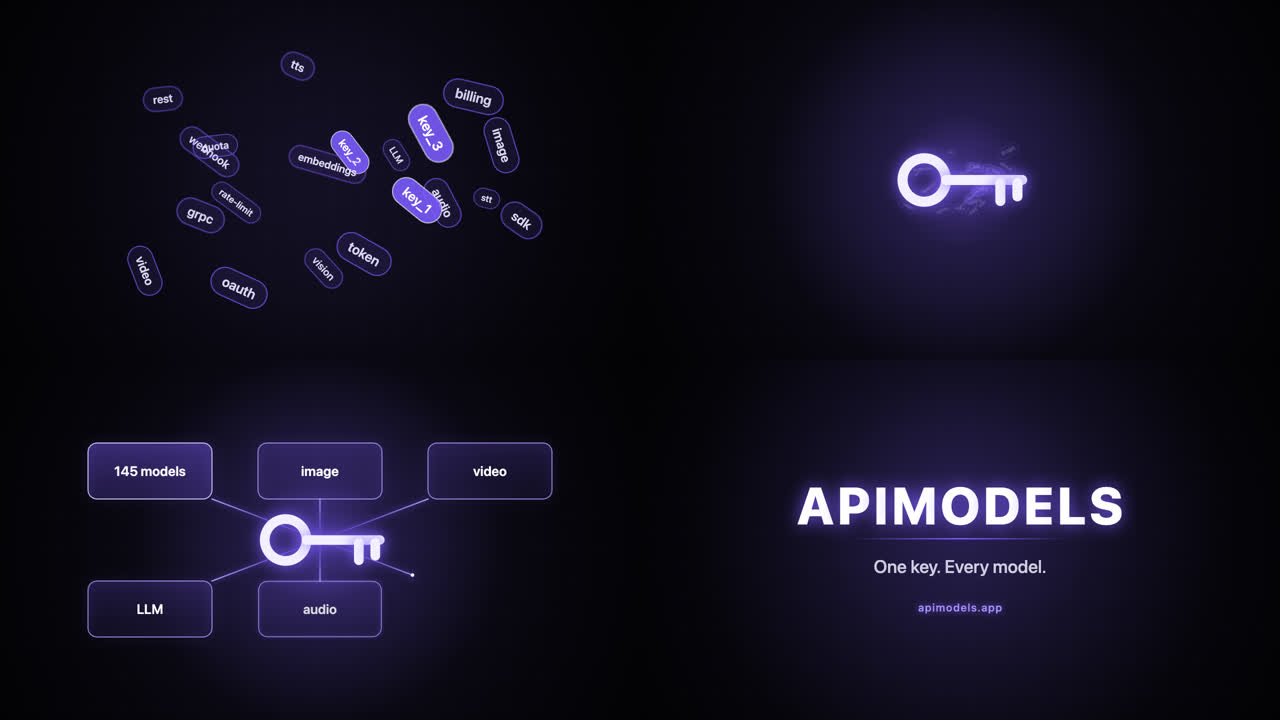
Motion design with Claude Opus 5.5 means code, not generated pixels. The model outputs text, so it writes a program that draws every frame (an HTML canvas page with a renderFrame(t) or seek(t) function, or a Remotion composition), and a headless browser plus ffmpeg turns those frames into an MP4. We ran the whole pipeline once through apimodels.app on 30 September 2026: one API call, a 12-second 1280x720 promo, 360 frames rendered with headless Chrome, encoded with ffmpeg. This is exactly what we did and what it cost.
This run
- Model
- claude-opus-5-5
- First token
- 110 s
- Total time
- 6 min 37 s
- Output tokens
- 31,786
- Billed
- $0.368
- Frames / render time
- 360 / 14 s
- Video
- 12 s · 1280x720 · 30 fps · 1.8 MB
What Opus 5.5 motion design does well
- Kinetic typography: words that land on the beat, masked reveals, type that morphs into the next scene.
- UI and product walkthroughs: a cursor clicking through screens, one shape morphing through button, loader, player and chart states.
- Animated charts and data stories, where every number and axis has to be exact.
- Logo reveals and end cards with precise timing and brand colours.
- Explainer animations, including Manim-style maths and science lessons with narration added afterwards.
- Short social templates and loops (vertical or square) you can re-render with new text in seconds.
Opus 5.5 motion design prompts: 8 cases, 7 full creator briefs, with the videos →
What it is not for
Anything that has to look filmed: photoreal people, natural camera motion, physics, skin and fabric. Code draws shapes and type; it does not shoot footage. For those shots use a video model and let Opus 5.5 write the shot list and prompts, or add titles and graphics on top in code. On apimodels.app these run on the same key:
The prompt everyone is running
This one-liner, posted by @stephanlivera on 25 September 2026, passed 2 million views and has been re-run thousands of times. It is a good way to check your setup works; because so many people use it, the results tend to look alike, and the longer briefs in our case library hold up better.
make a dynamic 15-second motion graphics video that shows what an incredible motion designer you are, like it's your showreel for a résumé. go all out.Prompt by @stephanlivera, verbatim from the original post · x.com/stephanlivera
What a run like this costs: our own 12-second test billed $0.368 for 31,786 output tokens. At $2.40 / $12 per million tokens every 10,000 output tokens is $0.12, so a clip that takes 30,000 to 80,000 tokens of thinking and code costs roughly $0.36 to $0.96 per attempt, plus a few cents of input. Rendering happens on your machine and costs nothing.
1. Ask for a program with a frame contract, not for a video
The one rule that makes everything else work: the page must expose window.renderFrame(t) and draw frame t from scratch, with no clock, no randomness and no state carried between calls. Then a script can ask for frame 0, frame 1 … frame 359 in any order and get the same picture every time, which is what a video encoder needs. A page that animates itself with requestAnimationFrame looks fine in a browser but cannot be exported frame-accurately. We also fixed the rhythm in the prompt (120 BPM, a beat every 0.5 s) and asked the model to list its beat plan as a comment; it did, 24 beats, and every cut landed on one.
2. Tell the story in time ranges, then the style
Describe what happens in each time window (problem, turn, payoff) before any visual detail. Name the labels you want on screen and say what must not appear (we asked for plain rounded labels instead of real company logos). Style comes last and stays short: one accent colour, which easing functions, and an explicit "no clutter in the last 3 seconds". The full prompt we sent is below, unedited.
The prompt we sent (verbatim)
You are writing a program that renders a video. Output one complete, self-contained HTML file and nothing else.

Rules for the program (these make it renderable frame by frame):
1. A single <canvas> of exactly 1280x720, no CSS scaling, black page background.
2. Expose a global function window.renderFrame(t) that draws the frame at time t (seconds, 0 <= t < 12) from scratch. Everything on screen must be a pure function of t: no Date.now, no performance.now, no Math.random (use a seeded PRNG if you need noise), no accumulated state between calls, no requestAnimationFrame loop.
3. Also expose window.DURATION = 12 and window.FPS = 30. When the page is opened normally, play it once in a loop with requestAnimationFrame by calling renderFrame, so a human can preview it.
4. No external assets, fonts, images or libraries. Use system-ui for text.
5. The rhythm is 120 BPM: a beat every 0.5 s. Put every major cut, text entrance and impact on a beat time (a multiple of 0.5). List the beat plan as a comment at the top of the script.

The story (tell this, then decide the visuals):
A 12-second promo for "APIMODELS", an API gateway. Problem, then turn, then payoff:
- 0-3 s: a developer's screen is cluttered with many different API keys and SDK logos flying in from every side, overlapping, getting chaotic (draw them as simple rounded labels such as "image", "video", "LLM", "audio", "key_1", "key_2", "sdk", not real company logos).
- 3-4.5 s: everything snaps together on a beat and collapses into one glowing key.
- 4.5-9 s: from that one key, lines fan out to a grid of model cards that light up one per beat (label them "145 models", "image", "video", "LLM", "audio", "one endpoint").
- 9-12 s: clean end card: the word APIMODELS, the line "One key. Every model.", and "apimodels.app" small underneath; hold still for the last second.

Style: dark background, one accent colour (electric violet #7c5cff) plus white, motion with easing (easeOutCubic / easeInOutQuad written by you), subtle depth (scale and blur fall-off), no clutter in the final 3 seconds.

Before the code, do not explain. Return only the HTML.
3. Call Opus 5.5 with streaming and no max_tokens
Opus 5.5 thinks before it writes, and the thinking counts as output. On this prompt the first character of the answer arrived after 110 seconds and the whole reply took 6 minutes 37 seconds: 31,786 output tokens for about 16,000 characters of HTML. Stream the request so the connection stays alive, and do not send a small max_tokens; the gateway forwards none when you omit it, so the model uses its own limit. The call cost $0.368 at $2.40 / $12 per million tokens, and the exact amount is returned by GET /v1/records/{id}.
curl https://api.apimodels.app/v1/chat/completions \
  -H "Authorization: Bearer $APIMODELS_API_KEY" \
  -H "Content-Type: application/json" \
  -d "$(jq -n --rawfile p prompt.md \
        '{model:"claude-opus-5-5", stream:true, messages:[{role:"user", content:$p}]}')" \
  --no-buffer > stream.txt
# no max_tokens on purpose: this run used 31,786 output tokens, mostly thinking
4. Render every frame with headless Chrome
Open the page, stop its preview loop, then call renderFrame(i / 30) for every frame and read the canvas back as a PNG. 360 frames took 14 seconds on a laptop and the page threw no errors. Encoding to H.264 with faststart gave a 1.8 MB file that plays everywhere.
// render.mjs — pnpm add puppeteer-core; uses the Chrome you already have
import puppeteer from 'puppeteer-core'
import { mkdirSync, writeFileSync } from 'node:fs'

mkdirSync('frames', { recursive: true })
const browser = await puppeteer.launch({
  executablePath: '/Applications/Google Chrome.app/Contents/MacOS/Google Chrome',
})
const page = await browser.newPage()
await page.setViewport({ width: 1280, height: 720 })
await page.goto('file://' + process.cwd() + '/promo.html')
await page.evaluate(() => { window.requestAnimationFrame = () => 0 }) // stop the preview loop
const { DURATION, FPS } = await page.evaluate(() => ({ DURATION, FPS }))
for (let i = 0; i < DURATION * FPS; i++) {
  const png = await page.evaluate((t) => {
    window.renderFrame(t)
    return document.querySelector('canvas').toDataURL('image/png')
  }, i / FPS)
  writeFileSync(`frames/f${String(i).padStart(4, '0')}.png`, Buffer.from(png.split(',')[1], 'base64'))
}
await browser.close()
ffmpeg -framerate 30 -i frames/f%04d.png -c:v libx264 -pix_fmt yuv420p -crf 20 -movflags +faststart promo.mp4
# add a soundtrack afterwards if you have one:
# ffmpeg -i promo.mp4 -i beat.mp3 -c:v copy -shortest promo-with-audio.mp45. Check the frames before you judge the video
Pull a few frames at the story beats into one contact sheet and compare them with the brief: here 2.3 s (the clutter), 3.5 s (one key), 7.2 s (cards lighting up) and 11.3 s (end card). All four matched on the first try. To change something, ask for it by timecode and beat ("at 7.5 s the sixth card should light up with a pulse"), and ask for the whole file back so the frame contract stays intact.
Limits we hit
- No audio. The program draws pictures only; add a soundtrack with ffmpeg afterwards and keep the BPM you gave the model.
- Slow first token. Expect around two minutes before the first character on a prompt like this; streaming keeps the connection alive, a short client timeout will not.
- It does not check its own output. The model never ran the page; we did. Render it, look at the frames, and treat the HTML as untested code.
Files from this run
Related guides
Idea credit: the workflow was inspired by EianLu’s article on making motion videos with Opus 5.5 on X. Everything on this page (prompt, code, video, numbers) comes from our own run. Read the original article on X
Opus 5.5 motion design examples
See all 60 →Prompts shared by their authors — copy and adapt them. Each one credits its author and links back to the original post.

The 15-second motion-designer showreel
make a dynamic 15-second motion graphics video that shows what an incredible motion designer you are, like it's your showreel for a résumé.…
by @stephanlivera

Showreel brief that lists the techniques
Create a bold, dynamic 15-second motion graphics showreel that feels like the ultimate portfolio piece of an exceptionally talented motion d…
by @lukasersil

One shape morphs through a dozen UI states on the beat
<inputs> Ask me for: 8 to 12 UI states I want the shape to become (e.g. button, loader, player, slider, toggle, tabs, chart, command palette…
by @twoclipping
Need prompts?
We curate copy-ready prompt libraries — every entry shows its full text and a sample result, ready to adapt.
Related reading
How to get access, regional availability, and how this model compares with its alternatives.
- Claude API Pricing, Compared (2026) — Fable 5.1, Opus 5.5, Sonnet 5.5, Haiku 5.5
- Claude Opus 5.5 vs Sonnet 5.5 (and Sonnet 5): Benchmarks, Price and Which to Use
- Claude Opus 5.5 vs Fable 5.1: Benchmarks, Price and When Fable Is Still Worth It
- Claude Opus 5.5 vs GPT-6 and GPT-6.1 (Sol, Astra): Price, Specs and How to Choose
- Claude Code with Opus 5.5: Setup in Two Minutes, Cost per Session, Effort Settings
- Claude Sonnet 5.5 Pricing: $2 / $10 per Million Tokens, Cache Prices and Real Cost per Task (2026)
- Make Videos with Claude Opus 5.5: Code-Rendered Motion Graphics, Tested (Prompt, Cost, Result)
- Is Claude Opus 5.5 Free? Try It on Free Credit, No Subscription