

Claude Opus 5.5 API: доступ и оплата из России
claude-opus-5-5Claude Opus 5.5 — первая модель семейства Claude 5.5 от Anthropic, выпущенная 22 сентября 2026 года. На APIMODELS она стоит $2.40 за 1M входных и $12.00 за 1M выходных токенов — на 40% ниже официального прайса $4 / $20, чтение кэша $0.12, запись $3.00. По словам Anthropic, на большинстве задач она работает на уровне Claude Fable 5.1, а на типичных нагрузках обходится на 40% выгоднее Opus 5; создана для долгих агентных сессий программирования и работы со знаниями. Характеристики совпадают с Fable 5.1: контекст 1M токенов, максимум 128K на выходе, ввод текста и изображений, надёжная граница знаний — июнь 2026. Адаптивное мышление включено всегда и не отключается, глубина регулируется параметром effort (по умолчанию medium); из Fable 5.1 перешли четыре ломающих изменения: принудительный вызов инструмента возвращает ошибку, блоки thinking привязаны к породившей их модели, старый инструмент computer_20251124 не принимается, а текст между вызовами инструментов приходит внутри блоков thinking. Вызов через /v1/messages или OpenAI-совместимый /v1/chat/completions одним ключом; неудачные запросы не тарифицируются.
API Documentation
View complete API reference with all parameters and examples.
Advanced Features
Streaming
Enable real-time streaming responses with Server-Sent Events.
{
  "model": "claude-opus-5-5",
  "stream": true,
  "max_tokens": 1024,
  "messages": [...]
}
Function Calling (Tools)
Enable Claude to use tools and call functions.
{
  "model": "claude-opus-5-5",
  "max_tokens": 1024,
  "tools": [{
    "name": "get_weather",
    "description": "Get current weather for a location",
    "input_schema": {
      "type": "object",
      "properties": {
        "location": {"type": "string", "description": "City name"}
      },
      "required": ["location"]
    }
  }],
  "tool_choice": {"type": "auto"},
  "messages": [{"role": "user", "content": "What's the weather in Tokyo?"}]
}
PDF Support
Analyze PDF documents by sending them as base64 encoded content.
{
  "model": "claude-opus-5-5",
  "max_tokens": 1024,
  "messages": [{
    "role": "user",
    "content": [{
      "type": "document",
      "source": {
        "type": "base64",
        "media_type": "application/pdf",
        "data": "<base64_encoded_pdf>"
      }
    }, {
      "type": "text",
      "text": "Summarize this document."
    }]
  }]
}
Structured Output (JSON Schema)
Get structured JSON responses that match your schema.
{
  "model": "claude-opus-5-5",
  "max_tokens": 1024,
  "output_format": {
    "type": "json_schema",
    "schema": {
      "type": "object",
      "properties": {
        "name": {"type": "string"},
        "age": {"type": "integer"}
      },
      "required": ["name", "age"]
    }
  },
  "messages": [{"role": "user", "content": "Extract info: John is 30 years old"}]
}
Web Search
Enable Claude to search the web for up-to-date information.
{
  "model": "claude-opus-5-5",
  "max_tokens": 1024,
  "tools": [{
    "type": "web_search_20250305",
    "name": "web_search",
    "max_uses": 5
  }],
  "messages": [{"role": "user", "content": "What's the latest news about AI?"}]
}
API Parameters Reference
| Parameter | Type | Required | Description |
|---|---|---|---|
| model | string | Yes | Model identifier (e.g., claude-opus-5-5) |
| messages | array | Yes | Array of message objects with role and content |
| max_tokens | integer | Yes | Maximum tokens in the response (1 - 128000) |
| system | string | No | System prompt to set context |
| stream | boolean | No | Enable streaming responses (SSE) |
| temperature | number | No | Sampling temperature (0.0 - 1.0) |
| top_p | number | No | Nucleus sampling threshold (0.0 - 1.0) |
| top_k | integer | No | Top-k sampling (0 - infinity) |
| stop_sequences | array | No | Sequences that stop generation |
| tools | array | No | Function calling tools definition |
| tool_choice | object | No | Tool selection strategy (auto/any/tool) |
| thinking | object | No | Enable extended thinking mode |
| output_format | object | No | Structured output with JSON schema |
Full API Documentation
View complete API reference with streaming, thinking, and more.
Pricing
Billing: Cost = (input_tokens * input_price + output_tokens * output_price) / 1,000,000
На 40% выгоднее прайса
$2.40 / $12.00 за 1M токенов против официальных $4 / $20; чтение кэша $0.12
Уровень Fable по цене Opus
Anthropic: результаты уровня Fable 5.1 на большинстве задач, на 40% выгоднее Opus 5 в работе
Контекст 1M, вывод 128K
Те же характеристики, что у Fable 5.1; текст и изображения на входе; знания по июнь 2026
Адаптивное мышление всегда включено
Отключить нельзя — глубина задаётся параметром effort (по умолчанию medium); принудительный вызов инструмента даёт ошибку
Моушн-дизайн кодом
Пишет код на canvas, SVG или Remotion, который рендерится в MP4; наш тестовый 12-секундный ролик стоил $0.368
О модели Claude Opus 5.5
Claude Opus 5.5 — это API категории «языковая модель» от Anthropic. Claude Opus 5.5 — первая модель семейства Claude 5.5 от Anthropic, выпущенная 22 сентября 2026 года. На APIMODELS она стоит $2.40 за 1M входных и $12.00 за 1M выходных токенов — на 40% ниже официального прайса $4 / $20, чтение кэша $0.12, запись $3.00. По словам Anthropic, на большинстве задач она работает на уровне Claude Fable 5.1, а на типичных нагрузках обходится на 40% выгоднее Opus 5; создана для долгих агентных сессий программирования и работы со знаниями. Характеристики совпадают с Fable 5.1: контекст 1M токенов, максимум 128K на выходе, ввод текста и изображений, надёжная граница знаний — июнь 2026. Адаптивное мышление включено всегда и не отключается, глубина регулируется параметром effort (по умолчанию medium); из Fable 5.1 перешли четыре ломающих изменения: принудительный вызов инструмента возвращает ошибку, блоки thinking привязаны к породившей их модели, старый инструмент computer_20251124 не принимается, а текст между вызовами инструментов приходит внутри блоков thinking. Вызов через /v1/messages или OpenAI-совместимый /v1/chat/completions одним ключом; неудачные запросы не тарифицируются. Через платформу APIMODELS доступ к этой модели идёт по единому API с прозрачной оплатой по факту использования. Текущая цена: Input: $2.40, Output: $12.00 per 1M tokens.
Ключевые возможности
- На 40% выгоднее прайса -- $2.40 / $12.00 за 1M токенов против официальных $4 / $20; чтение кэша $0.12
- Уровень Fable по цене Opus -- Anthropic: результаты уровня Fable 5.1 на большинстве задач, на 40% выгоднее Opus 5 в работе
- Контекст 1M, вывод 128K -- Те же характеристики, что у Fable 5.1; текст и изображения на входе; знания по июнь 2026
- Адаптивное мышление всегда включено -- Отключить нельзя — глубина задаётся параметром effort (по умолчанию medium); принудительный вызов инструмента даёт ошибку
- Моушн-дизайн кодом -- Пишет код на canvas, SVG или Remotion, который рендерится в MP4; наш тестовый 12-секундный ролик стоил $0.368
Сценарии использования
Чат-боты и поддержка клиентов
Диалоговые системы, которые сами отвечают на вопросы пользователей и разгружают поддержку.
Генерация контента
Статьи, письма, рекламные тексты и прочее — пишутся автоматически и экономят часы работы.
Помощник в коде
Писать код, искать ошибки и проводить ревью — разработка идёт быстрее.
Анализ данных
Разбирать неструктурированные данные, вытаскивать главное и собирать сводные отчёты.
Почему APIMODELS
- Единый API — один ключ на все модели, не нужно регистрироваться на нескольких площадках
- Прозрачные цены — оплата по факту использования, стоимость вызова указана на странице каждой модели; удобно независимым разработчикам и небольшим командам
- Доступ сразу — можно начинать сразу после регистрации, оплата через Stripe и Alipay
- Полная документация — подробная документация API с примерами на cURL, Python и Node.js
Частые вопросы
Сколько стоит Claude Opus 5.5?
Claude Opus 5.5 доступна через APIMODELS по цене: Input: $2.40, Output: $12.00 per 1M tokens. Оплата идёт по факту использования — вы платите только за то, что сгенерировали.
Как пользоваться API Claude Opus 5.5?
Зарегистрируйтесь на APIMODELS, получите API-ключ и обращайтесь к нашему единому эндпоинту. Есть подробная документация с примерами на cURL, Python и Node.js.
Чем APIMODELS отличается от официального API Anthropic?
APIMODELS отдаёт ту же самую модель Claude Opus 5.5 через свою агрегирующую платформу. Мы предоставляем единый интерфейс API, поэтому отдельные аккаунты у каждого поставщика не нужны — один ключ открывает доступ ко всем моделям.
Сколько стоит Claude Opus 5.5 на apimodels и насколько это выгоднее официальной цены?
$2.40 за 1M входных токенов и $12.00 за 1M выходных, чтение кэша $0.12, запись $3.00. У Anthropic в прайсе $4 / $20 и чтение кэша $0.20, то есть мы на 40% ниже. Оплата по фактическим токенам, неудачные запросы бесплатны, месячного минимума нет.
Как выбрать между Opus 5.5, Opus 5 и Fable 5.1?
Позиционирование самой Anthropic: Opus 5.5 работает на уровне Fable 5.1 на большинстве задач и при этом на 40% выгоднее Opus 5 в типичных нагрузках. У нас Opus 5.5 стоит $2.40 / $12.00, Opus 5 — $3 / $15, Fable 5.1 — $5 / $25; если вы не убедились, что какая-то задача получается только на Fable 5.1, начинать с Opus 5.5 выгоднее. Характеристики у всех трёх одинаковые: контекст 1M, вывод 128K.
Что меняется при переходе с Opus 5 на Opus 5.5?
Поменяйте имя модели на claude-opus-5-5 и учтите четыре ломающих изменения: адаптивное мышление включено всегда и больше не отключается (глубина — через effort, по умолчанию medium); принудительный вызов инструмента — tool_choice с конкретным инструментом — возвращает ошибку; блоки thinking привязаны к породившей их модели, так что диалог не может переносить старые блоки thinking между моделями; старый инструмент computer_20251124 не принимается. Текст между вызовами инструментов теперь приходит внутри блоков thinking, поэтому приложениям, которые показывают его как прогресс, нужно задать display.
Как вызывать и поддерживается ли формат OpenAI?
Работают оба варианта: нативный Anthropic POST https://api.apimodels.app/v1/messages или OpenAI-совместимый /v1/chat/completions, с model claude-opus-5-5 и Authorization: Bearer ваш ключ apimodels. Поддерживаются стриминг, вызов инструментов и ввод изображений; кэширование промптов — по правилам cache_control от Anthropic, попадания тарифицируются по $0.12.
Как оплатить Claude API из России?
Через apimodels.app аккаунт Anthropic и иностранная карта не нужны: баланс в долларах пополняется в USDT (сети TRC20 или BEP20), картой через Stripe или через PayPal, и одним ключом вызываются Claude Opus 5.5 и остальные модели. Оплата предварительная, списывается только за успешные запросы по $2.40 за 1M входных и $12.00 за 1M выходных токенов.
Умеет ли Claude Opus 5.5 моушн-дизайн и как это работает?
Да, но через код. Opus 5.5 выдаёт текст, а не видео, поэтому для моушн-дизайна он пишет программу, которая рисует каждый кадр: страницу на HTML canvas или SVG с функцией renderFrame(t) или seek(t) либо композицию Remotion. Headless-браузер рендерит кадры, ffmpeg собирает MP4. Хорошо получаются кинетическая типографика, демонстрации интерфейсов, анимированные графики, появление логотипа и обучающая анимация. Фотореалистичные съёмки, живых людей и естественное движение камеры лучше отдать видеомодели вроде Seedance 2.5 или Veo 3.1. Наш полный проверенный разбор — на этой странице и на https://apimodels.app/access/claude-opus-5-5-video.
Какой промпт для моушн-дизайна в Opus 5.5 лучший?
Чаще всего начинают с промпта, который @stephanlivera опубликовал 25 сентября 2026 года (больше 2 млн просмотров): "make a dynamic 15-second motion graphics video that shows what an incredible motion designer you are, like it's your showreel for a résumé. go all out." Он хорошо проверяет, что всё настроено, но у всех выходит похожий результат. Надёжнее работают длинные брифы: какие материалы модель должна запросить, один стиль и один акцентный цвет, список запрещённых эффектов по умолчанию, каждый кадр на сетке долей такта и контракт рендера через seek(t). Семь таких брифов дословно, с авторами и готовыми роликами — на https://apimodels.app/claude-opus-5-5-video-prompts/motion-graphics.
Сколько стоит один ролик моушн-дизайна на Opus 5.5 через API?
Наш тестовый прогон на apimodels.app — один потоковый вызов: 31 786 выходных токенов, 6 минут 37 секунд, списано $0.368 за 12-секундный ролик 1280x720; рендер шёл локально и ничего не стоил. При цене $2.40 / $12 за миллион токенов каждые 10 000 выходных токенов стоят $0.12, так что ролик, на который уходит от 30 000 до 80 000 токенов размышлений и кода, обходится примерно в $0.36–$0.96 за попытку плюс несколько центов за вход. Долгие сессии агента с правками дороже: авторы называют от $2 до $400 за готовую работу. Неудачные вызовы не оплачиваются.
Как Claude Opus 5.5 смотрится на фоне других моделей категории «языковая модель»?
В APIMODELS Claude Opus 5.5 соседствует более чем с 60 моделями под одним API-ключом и общим балансом, поэтому выбор — это вопрос соответствия задаче, а не привязки к поставщику. Модель поддерживает 40% Below Official, 1M Context, Agentic Coding, Adaptive Thinking; вы можете сравнить её по цене и возможностям с другими моделями категории «языковая модель» и переключиться, изменив одну строку с именем модели — без нового аккаунта и без переписывания интеграции. Все варианты категории «языковая модель» с актуальными ценами — на apimodels.app/models.
Что умеет Claude Opus 5.5?
Claude Opus 5.5 поддерживает: 40% Below Official, 1M Context, Agentic Coding, Adaptive Thinking. Полный список параметров и примеры вызовов — в документации APIMODELS.
Доступен ли API Claude Opus 5.5 из любой страны?
Да. APIMODELS отдаёт Claude Opus 5.5 через единый API и один ключ — отдельные аккаунты у каждого поставщика не нужны, и вам не приходится самостоятельно решать вопросы регионального сетевого доступа к каждому из них.
Какие способы оплаты поддерживаются?
Принимаем Stripe (Visa, Mastercard и другие международные карты) и Alipay. Баланс становится доступен сразу после оплаты.
Related models
Claude Opus 5.5 motion design: how it works, what it is good at, and a tested run with the full prompt
Motion design with Claude Opus 5.5 means code, not generated pixels. The model outputs text, so it writes a program that draws every frame (an HTML canvas page with a renderFrame(t) or seek(t) function, or a Remotion composition), and a headless browser plus ffmpeg turns those frames into an MP4. We ran the whole pipeline once through apimodels.app on 30 September 2026: one API call, a 12-second 1280x720 promo, 360 frames rendered with headless Chrome, encoded with ffmpeg. This is exactly what we did and what it cost.
This run
- Model
- claude-opus-5-5
- First token
- 110 s
- Total time
- 6 min 37 s
- Output tokens
- 31,786
- Billed
- $0.368
- Frames / render time
- 360 / 14 s
- Video
- 12 s · 1280x720 · 30 fps · 1.8 MB
What Opus 5.5 motion design does well
- Kinetic typography: words that land on the beat, masked reveals, type that morphs into the next scene.
- UI and product walkthroughs: a cursor clicking through screens, one shape morphing through button, loader, player and chart states.
- Animated charts and data stories, where every number and axis has to be exact.
- Logo reveals and end cards with precise timing and brand colours.
- Explainer animations, including Manim-style maths and science lessons with narration added afterwards.
- Short social templates and loops (vertical or square) you can re-render with new text in seconds.
Opus 5.5 motion design prompts: 8 cases, 7 full creator briefs, with the videos →
What it is not for
Anything that has to look filmed: photoreal people, natural camera motion, physics, skin and fabric. Code draws shapes and type; it does not shoot footage. For those shots use a video model and let Opus 5.5 write the shot list and prompts, or add titles and graphics on top in code. On apimodels.app these run on the same key:
The prompt everyone is running
This one-liner, posted by @stephanlivera on 25 September 2026, passed 2 million views and has been re-run thousands of times. It is a good way to check your setup works; because so many people use it, the results tend to look alike, and the longer briefs in our case library hold up better.
make a dynamic 15-second motion graphics video that shows what an incredible motion designer you are, like it's your showreel for a résumé. go all out.Prompt by @stephanlivera, verbatim from the original post · x.com/stephanlivera
What a run like this costs: our own 12-second test billed $0.368 for 31,786 output tokens. At $2.40 / $12 per million tokens every 10,000 output tokens is $0.12, so a clip that takes 30,000 to 80,000 tokens of thinking and code costs roughly $0.36 to $0.96 per attempt, plus a few cents of input. Rendering happens on your machine and costs nothing.
1. Ask for a program with a frame contract, not for a video
The one rule that makes everything else work: the page must expose window.renderFrame(t) and draw frame t from scratch, with no clock, no randomness and no state carried between calls. Then a script can ask for frame 0, frame 1 … frame 359 in any order and get the same picture every time, which is what a video encoder needs. A page that animates itself with requestAnimationFrame looks fine in a browser but cannot be exported frame-accurately. We also fixed the rhythm in the prompt (120 BPM, a beat every 0.5 s) and asked the model to list its beat plan as a comment; it did, 24 beats, and every cut landed on one.
2. Tell the story in time ranges, then the style
Describe what happens in each time window (problem, turn, payoff) before any visual detail. Name the labels you want on screen and say what must not appear (we asked for plain rounded labels instead of real company logos). Style comes last and stays short: one accent colour, which easing functions, and an explicit "no clutter in the last 3 seconds". The full prompt we sent is below, unedited.
The prompt we sent (verbatim)
You are writing a program that renders a video. Output one complete, self-contained HTML file and nothing else.

Rules for the program (these make it renderable frame by frame):
1. A single <canvas> of exactly 1280x720, no CSS scaling, black page background.
2. Expose a global function window.renderFrame(t) that draws the frame at time t (seconds, 0 <= t < 12) from scratch. Everything on screen must be a pure function of t: no Date.now, no performance.now, no Math.random (use a seeded PRNG if you need noise), no accumulated state between calls, no requestAnimationFrame loop.
3. Also expose window.DURATION = 12 and window.FPS = 30. When the page is opened normally, play it once in a loop with requestAnimationFrame by calling renderFrame, so a human can preview it.
4. No external assets, fonts, images or libraries. Use system-ui for text.
5. The rhythm is 120 BPM: a beat every 0.5 s. Put every major cut, text entrance and impact on a beat time (a multiple of 0.5). List the beat plan as a comment at the top of the script.

The story (tell this, then decide the visuals):
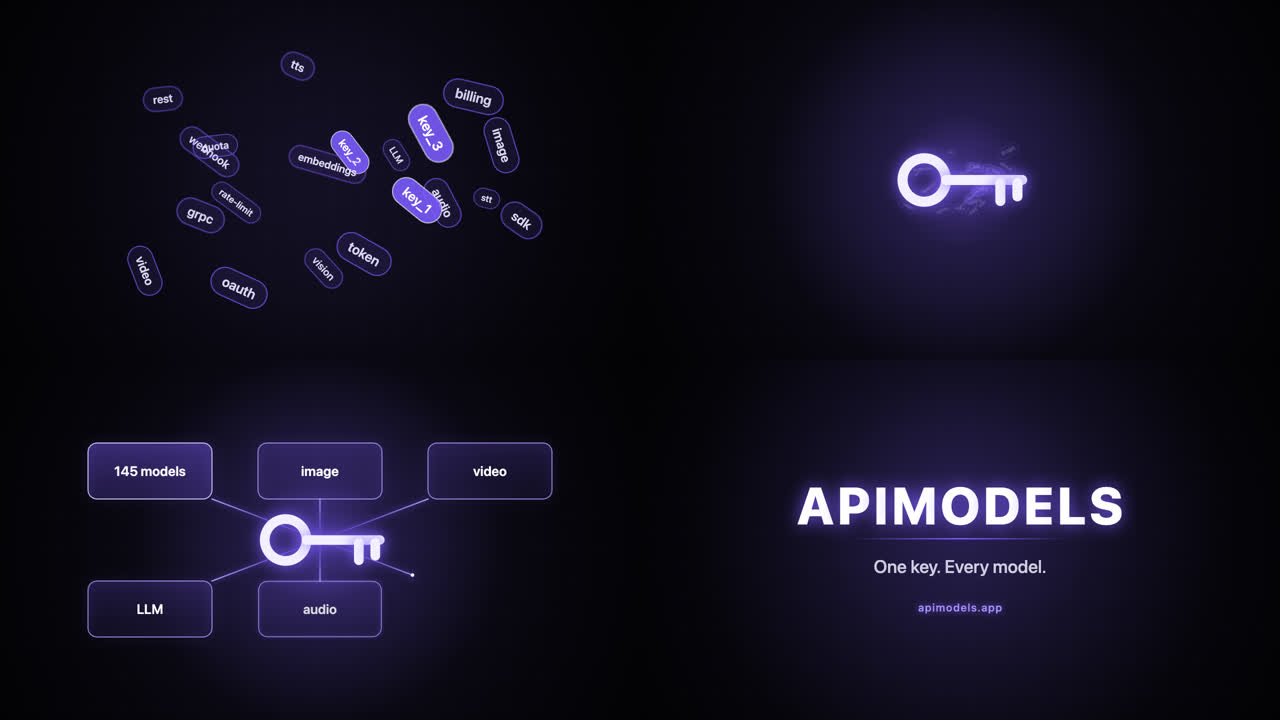
A 12-second promo for "APIMODELS", an API gateway. Problem, then turn, then payoff:
- 0-3 s: a developer's screen is cluttered with many different API keys and SDK logos flying in from every side, overlapping, getting chaotic (draw them as simple rounded labels such as "image", "video", "LLM", "audio", "key_1", "key_2", "sdk", not real company logos).
- 3-4.5 s: everything snaps together on a beat and collapses into one glowing key.
- 4.5-9 s: from that one key, lines fan out to a grid of model cards that light up one per beat (label them "145 models", "image", "video", "LLM", "audio", "one endpoint").
- 9-12 s: clean end card: the word APIMODELS, the line "One key. Every model.", and "apimodels.app" small underneath; hold still for the last second.

Style: dark background, one accent colour (electric violet #7c5cff) plus white, motion with easing (easeOutCubic / easeInOutQuad written by you), subtle depth (scale and blur fall-off), no clutter in the final 3 seconds.

Before the code, do not explain. Return only the HTML.
3. Call Opus 5.5 with streaming and no max_tokens
Opus 5.5 thinks before it writes, and the thinking counts as output. On this prompt the first character of the answer arrived after 110 seconds and the whole reply took 6 minutes 37 seconds: 31,786 output tokens for about 16,000 characters of HTML. Stream the request so the connection stays alive, and do not send a small max_tokens; the gateway forwards none when you omit it, so the model uses its own limit. The call cost $0.368 at $2.40 / $12 per million tokens, and the exact amount is returned by GET /v1/records/{id}.
curl https://api.apimodels.app/v1/chat/completions \
  -H "Authorization: Bearer $APIMODELS_API_KEY" \
  -H "Content-Type: application/json" \
  -d "$(jq -n --rawfile p prompt.md \
        '{model:"claude-opus-5-5", stream:true, messages:[{role:"user", content:$p}]}')" \
  --no-buffer > stream.txt
# no max_tokens on purpose: this run used 31,786 output tokens, mostly thinking
4. Render every frame with headless Chrome
Open the page, stop its preview loop, then call renderFrame(i / 30) for every frame and read the canvas back as a PNG. 360 frames took 14 seconds on a laptop and the page threw no errors. Encoding to H.264 with faststart gave a 1.8 MB file that plays everywhere.
// render.mjs — pnpm add puppeteer-core; uses the Chrome you already have
import puppeteer from 'puppeteer-core'
import { mkdirSync, writeFileSync } from 'node:fs'

mkdirSync('frames', { recursive: true })
const browser = await puppeteer.launch({
  executablePath: '/Applications/Google Chrome.app/Contents/MacOS/Google Chrome',
})
const page = await browser.newPage()
await page.setViewport({ width: 1280, height: 720 })
await page.goto('file://' + process.cwd() + '/promo.html')
await page.evaluate(() => { window.requestAnimationFrame = () => 0 }) // stop the preview loop
const { DURATION, FPS } = await page.evaluate(() => ({ DURATION, FPS }))
for (let i = 0; i < DURATION * FPS; i++) {
  const png = await page.evaluate((t) => {
    window.renderFrame(t)
    return document.querySelector('canvas').toDataURL('image/png')
  }, i / FPS)
  writeFileSync(`frames/f${String(i).padStart(4, '0')}.png`, Buffer.from(png.split(',')[1], 'base64'))
}
await browser.close()
ffmpeg -framerate 30 -i frames/f%04d.png -c:v libx264 -pix_fmt yuv420p -crf 20 -movflags +faststart promo.mp4
# add a soundtrack afterwards if you have one:
# ffmpeg -i promo.mp4 -i beat.mp3 -c:v copy -shortest promo-with-audio.mp45. Check the frames before you judge the video
Pull a few frames at the story beats into one contact sheet and compare them with the brief: here 2.3 s (the clutter), 3.5 s (one key), 7.2 s (cards lighting up) and 11.3 s (end card). All four matched on the first try. To change something, ask for it by timecode and beat ("at 7.5 s the sixth card should light up with a pulse"), and ask for the whole file back so the frame contract stays intact.
Limits we hit
- No audio. The program draws pictures only; add a soundtrack with ffmpeg afterwards and keep the BPM you gave the model.
- Slow first token. Expect around two minutes before the first character on a prompt like this; streaming keeps the connection alive, a short client timeout will not.
- It does not check its own output. The model never ran the page; we did. Render it, look at the frames, and treat the HTML as untested code.
Files from this run
Related guides
Idea credit: the workflow was inspired by EianLu’s article on making motion videos with Opus 5.5 on X. Everything on this page (prompt, code, video, numbers) comes from our own run. Read the original article on X
Opus 5.5 motion design examples
See all 60 →Prompts shared by their authors — copy and adapt them. Each one credits its author and links back to the original post.

The 15-second motion-designer showreel
make a dynamic 15-second motion graphics video that shows what an incredible motion designer you are, like it's your showreel for a résumé.…
by @stephanlivera

Showreel brief that lists the techniques
Create a bold, dynamic 15-second motion graphics showreel that feels like the ultimate portfolio piece of an exceptionally talented motion d…
by @lukasersil

One shape morphs through a dozen UI states on the beat
<inputs> Ask me for: 8 to 12 UI states I want the shape to become (e.g. button, loader, player, slider, toggle, tabs, chart, command palette…
by @twoclipping
Need prompts?
We curate copy-ready prompt libraries — every entry shows its full text and a sample result, ready to adapt.
Related reading
How to get access, regional availability, and how this model compares with its alternatives.
- Claude API Pricing, Compared (2026) — Fable 5.1, Opus 5.5, Sonnet 5.5, Haiku 5.5
- Claude Opus 5.5 vs Sonnet 5.5 (and Sonnet 5): Benchmarks, Price and Which to Use
- Claude Opus 5.5 vs Fable 5.1: Benchmarks, Price and When Fable Is Still Worth It
- Claude Opus 5.5 vs GPT-6 and GPT-6.1 (Sol, Astra): Price, Specs and How to Choose
- Claude Code with Opus 5.5: Setup in Two Minutes, Cost per Session, Effort Settings
- Claude Sonnet 5.5 Pricing: $2 / $10 per Million Tokens, Cache Prices and Real Cost per Task (2026)
- Make Videos with Claude Opus 5.5: Code-Rendered Motion Graphics, Tested (Prompt, Cost, Result)
- Is Claude Opus 5.5 Free? Try It on Free Credit, No Subscription