

Claude Opus 5.5 API の料金と使い方
claude-opus-5-5Claude Opus 5.5 は Anthropic の Claude 5.5 ファミリー最初のモデルで、2026 年 9 月 22 日に公開されました。APIMODELS では入力 100 万トークン $2.40、出力 100 万トークン $12.00 で、公式定価 $4 / $20 より 40% 安く、キャッシュ読み取り $0.12、書き込み $3.00 です。Anthropic の説明では、ほとんどの作業で Claude Fable 5.1 と同等の成果を出しながら、典型的な負荷での実行コストは Opus 5 より 40% 低く、長時間のエージェント型コーディングとナレッジワーク向けに作られています。仕様は Fable 5.1 と同じで、コンテキスト 100 万トークン、最大出力 128K、テキストと画像の入力、信頼できる知識カットオフは 2026 年 6 月です。適応的思考は常時オンで無効化できず、深さは effort パラメータ(既定 medium)で制御します。Fable 5.1 から引き継がれた 4 つの破壊的変更に注意してください。ツール使用の強制はエラーになり、thinking ブロックは生成したモデルに紐づき、旧 computer_20251124 ツールは受け付けられず、ツール呼び出しの間のテキストは thinking ブロックの中で返ります。/v1/messages か OpenAI 互換の /v1/chat/completions をキー 1 つで呼べ、失敗したリクエストは課金されません。
API Documentation
View complete API reference with all parameters and examples.
Advanced Features
Streaming
Enable real-time streaming responses with Server-Sent Events.
{
  "model": "claude-opus-5-5",
  "stream": true,
  "max_tokens": 1024,
  "messages": [...]
}
Function Calling (Tools)
Enable Claude to use tools and call functions.
{
  "model": "claude-opus-5-5",
  "max_tokens": 1024,
  "tools": [{
    "name": "get_weather",
    "description": "Get current weather for a location",
    "input_schema": {
      "type": "object",
      "properties": {
        "location": {"type": "string", "description": "City name"}
      },
      "required": ["location"]
    }
  }],
  "tool_choice": {"type": "auto"},
  "messages": [{"role": "user", "content": "What's the weather in Tokyo?"}]
}
PDF Support
Analyze PDF documents by sending them as base64 encoded content.
{
  "model": "claude-opus-5-5",
  "max_tokens": 1024,
  "messages": [{
    "role": "user",
    "content": [{
      "type": "document",
      "source": {
        "type": "base64",
        "media_type": "application/pdf",
        "data": "<base64_encoded_pdf>"
      }
    }, {
      "type": "text",
      "text": "Summarize this document."
    }]
  }]
}
Structured Output (JSON Schema)
Get structured JSON responses that match your schema.
{
  "model": "claude-opus-5-5",
  "max_tokens": 1024,
  "output_format": {
    "type": "json_schema",
    "schema": {
      "type": "object",
      "properties": {
        "name": {"type": "string"},
        "age": {"type": "integer"}
      },
      "required": ["name", "age"]
    }
  },
  "messages": [{"role": "user", "content": "Extract info: John is 30 years old"}]
}
Web Search
Enable Claude to search the web for up-to-date information.
{
  "model": "claude-opus-5-5",
  "max_tokens": 1024,
  "tools": [{
    "type": "web_search_20250305",
    "name": "web_search",
    "max_uses": 5
  }],
  "messages": [{"role": "user", "content": "What's the latest news about AI?"}]
}
API Parameters Reference
| Parameter | Type | Required | Description |
|---|---|---|---|
| model | string | Yes | Model identifier (e.g., claude-opus-5-5) |
| messages | array | Yes | Array of message objects with role and content |
| max_tokens | integer | Yes | Maximum tokens in the response (1 - 128000) |
| system | string | No | System prompt to set context |
| stream | boolean | No | Enable streaming responses (SSE) |
| temperature | number | No | Sampling temperature (0.0 - 1.0) |
| top_p | number | No | Nucleus sampling threshold (0.0 - 1.0) |
| top_k | integer | No | Top-k sampling (0 - infinity) |
| stop_sequences | array | No | Sequences that stop generation |
| tools | array | No | Function calling tools definition |
| tool_choice | object | No | Tool selection strategy (auto/any/tool) |
| thinking | object | No | Enable extended thinking mode |
| output_format | object | No | Structured output with JSON schema |
Full API Documentation
View complete API reference with streaming, thinking, and more.
Pricing
Billing: Cost = (input_tokens * input_price + output_tokens * output_price) / 1,000,000
公式より 40% 安い
100 万トークン $2.40 / $12.00、公式定価は $4 / $20。キャッシュ読み取り $0.12
Fable 級の成果を Opus の価格で
Anthropic:ほとんどの作業で Fable 5.1 と同等、実行コストは Opus 5 より 40% 低い
コンテキスト 1M、出力 128K
Fable 5.1 と同じ仕様。テキストと画像の入力。知識カットオフ 2026 年 6 月
適応的思考は常時オン
無効化不可。深さは effort(既定 medium)で制御。ツール使用の強制はエラーになる
コードでモーションデザイン
canvas・SVG・Remotion のコードを書いて MP4 に書き出す。12 秒の実測動画は $0.368
Claude Opus 5.5 について
Claude Opus 5.5 は Anthropic の大規模言語モデル API です。Claude Opus 5.5 は Anthropic の Claude 5.5 ファミリー最初のモデルで、2026 年 9 月 22 日に公開されました。APIMODELS では入力 100 万トークン $2.40、出力 100 万トークン $12.00 で、公式定価 $4 / $20 より 40% 安く、キャッシュ読み取り $0.12、書き込み $3.00 です。Anthropic の説明では、ほとんどの作業で Claude Fable 5.1 と同等の成果を出しながら、典型的な負荷での実行コストは Opus 5 より 40% 低く、長時間のエージェント型コーディングとナレッジワーク向けに作られています。仕様は Fable 5.1 と同じで、コンテキスト 100 万トークン、最大出力 128K、テキストと画像の入力、信頼できる知識カットオフは 2026 年 6 月です。適応的思考は常時オンで無効化できず、深さは effort パラメータ(既定 medium)で制御します。Fable 5.1 から引き継がれた 4 つの破壊的変更に注意してください。ツール使用の強制はエラーになり、thinking ブロックは生成したモデルに紐づき、旧 computer_20251124 ツールは受け付けられず、ツール呼び出しの間のテキストは thinking ブロックの中で返ります。/v1/messages か OpenAI 互換の /v1/chat/completions をキー 1 つで呼べ、失敗したリクエストは課金されません。 APIMODELS のプラットフォーム経由なら、統一 API と明朗な従量課金でこのモデルを呼び出せます。 現在の料金: Input: $2.40, Output: $12.00 per 1M tokens。
主な機能
- 公式より 40% 安い -- 100 万トークン $2.40 / $12.00、公式定価は $4 / $20。キャッシュ読み取り $0.12
- Fable 級の成果を Opus の価格で -- Anthropic:ほとんどの作業で Fable 5.1 と同等、実行コストは Opus 5 より 40% 低い
- コンテキスト 1M、出力 128K -- Fable 5.1 と同じ仕様。テキストと画像の入力。知識カットオフ 2026 年 6 月
- 適応的思考は常時オン -- 無効化不可。深さは effort(既定 medium)で制御。ツール使用の強制はエラーになる
- コードでモーションデザイン -- canvas・SVG・Remotion のコードを書いて MP4 に書き出す。12 秒の実測動画は $0.368
ユースケース
チャットボットとカスタマーサポート
問い合わせに自動で答える対話システムを構築し、対応の効率を上げます。
コンテンツ生成
記事、メール、広告コピーなどの文章を自動で書き、制作の手数を減らします。
コーディング支援
コードの記述、デバッグ、レビューを補助し、開発を前に進めます。
データ分析
非構造化データを読み解き、要点を抽出して要約レポートにまとめます。
APIMODELS を選ぶ理由
- 統一 API -- キー 1 本ですべてのモデルへ。プラットフォームごとに登録する必要はありません
- 明朗な料金 -- 従量課金で、1 回あたりの単価は各モデルページに掲載。個人開発者とスタートアップに向いています
- すぐ使える -- 登録した直後から利用でき、支払いは Stripe と Alipay に対応
- 充実したドキュメント -- cURL / Python / Node.js のサンプル付きで API を詳しく解説
よくある質問
Claude Opus 5.5 の料金は?
Claude Opus 5.5 は APIMODELS 経由で Input: $2.40, Output: $12.00 per 1M tokens で利用できます。課金は従量制で、生成した分だけの支払いです。
Claude Opus 5.5 の API はどう使いますか?
APIMODELS に登録して API キーを取得し、統一エンドポイントを呼ぶだけです。cURL / Python / Node.js のサンプルを含む詳しいドキュメントを用意しています。
APIMODELS と Anthropic 公式 API の違いは?
APIMODELS は同じ Claude Opus 5.5 を集約プラットフォーム経由で提供します。統一された API インターフェースなので、プロバイダごとにアカウントを作る必要はありません。キー 1 本ですべてのモデルに届きます。
apimodels での Claude Opus 5.5 の料金は?公式よりどれだけ安い?
入力 100 万トークン $2.40、出力 100 万トークン $12.00、キャッシュ読み取り $0.12、書き込み $3.00 です。Anthropic の定価は $4 / $20、キャッシュ読み取り $0.20 なので 40% 安くなります。実際のトークン数で課金し、失敗したリクエストは無料、月額の最低料金もありません。
Opus 5.5、Opus 5、Fable 5.1 はどう使い分ける?
Anthropic 自身の位置づけは、Opus 5.5 はほとんどの作業で Fable 5.1 と同等の成果を出しつつ、典型的な負荷での実行コストは Opus 5 より 40% 低い、というものです。当サイトでは Opus 5.5 が $2.40 / $12.00、Opus 5 が $3 / $15、Fable 5.1 が $5 / $25 です。あるタスクが Fable 5.1 でしか正しくできないと確認済みでない限り、Opus 5.5 から始めるのが得です。3 つとも仕様は同じで、コンテキスト 100 万、出力 128K です。
Opus 5 から Opus 5.5 に移行すると何が変わる?
モデル名を claude-opus-5-5 に変えるだけですが、4 つの破壊的変更があります。適応的思考が常時オンになり無効化できなくなった(深さは effort で制御、既定 medium)。特定ツールを指定する tool_choice によるツール使用の強制はエラーになる。thinking ブロックは生成したモデルに紐づくため、古い thinking ブロックをモデルをまたいで引き継げない。旧 computer_20251124 ツールは受け付けられない。さらにツール呼び出しの間のテキストは thinking ブロックの中で返るため、それを進捗表示に使うアプリは display を設定する必要があります。
呼び出し方は?OpenAI 形式は使える?
どちらも使えます。Anthropic ネイティブの POST https://api.apimodels.app/v1/messages か、OpenAI 互換の /v1/chat/completions に、model を claude-opus-5-5、Authorization: Bearer に apimodels のキーを付けて送ります。ストリーミング、ツール呼び出し、画像入力に対応し、プロンプトキャッシュは Anthropic の cache_control の使い方に従い、ヒットは $0.12 で課金されます。
Anthropic で Claude API の支払いができないときは?
apimodels.app なら Anthropic のアカウントや支払い設定は不要です。米ドル残高に Stripe(クレジットカード)、PayPal、Alipay、USDT で前払いチャージし、その残高から Claude Opus 5.5 を入力 100 万トークン $2.40、出力 $12.00 で使えます。課金は成功したリクエストだけです。
Claude Opus 5.5 でモーションデザインはできる?仕組みは?
できます。ただしコードで作ります。Opus 5.5 が出力するのはテキストで動画ではないため、モーションデザインでは毎フレームを描くプログラムを書きます。renderFrame(t) や seek(t) を公開する HTML の canvas / SVG ページ、または Remotion のコンポジションです。それをヘッドレスブラウザで 1 フレームずつ書き出し、ffmpeg で MP4 にします。得意なのはキネティックタイポグラフィ、UI のデモ、グラフのアニメーション、ロゴのリビール、解説アニメーション。実写のような映像、実在の人物、自然なカメラワークは Seedance 2.5 や Veo 3.1 のような動画モデル向けです。私たちが実際に通した手順はこのページと https://apimodels.app/access/claude-opus-5-5-video にあります。
Claude Opus 5.5 のモーションデザインで一番使えるプロンプトは?
多くの人が最初に試すのは、@stephanlivera が 2026 年 9 月 25 日に投稿し 200 万回以上表示された一文です:"make a dynamic 15-second motion graphics video that shows what an incredible motion designer you are, like it's your showreel for a résumé. go all out." 環境が動くかの確認には向いていますが、誰が回しても似た仕上がりになります。長く使えるのはもっと長いブリーフです。何の素材を求めるか、スタイルとアクセントカラーは一つずつ、使ってはいけない定番エフェクトの一覧、全カットを拍のグリッドに置くこと、seek(t) による描画の約束。作者名つきの原文 7 本と完成動画は https://apimodels.app/claude-opus-5-5-video-prompts/motion-graphics にまとめています。
API で Opus 5.5 のモーションデザイン動画を 1 本作るといくら?
apimodels.app での実測は 1 回のストリーミング呼び出しで、出力 31,786 トークン、6 分 37 秒、請求額 $0.368、12 秒 1280x720 の動画になりました。レンダリングは手元で行うので無料です。100 万トークン $2.40 / $12 なら出力 1 万トークンごとに $0.12 なので、思考とコードに 3 万〜8 万トークンかかる動画なら 1 回あたりおよそ $0.36〜$0.96、これに入力分が数セント加わります。修正を重ねる長時間のエージェント作業はさらにかかり、作者たちの自己申告では完成作 1 本あたり約 $2〜$400 です。失敗した呼び出しは課金されません。
Claude Opus 5.5 は他の大規模言語モデルモデルと比べてどうですか?
APIMODELS では Claude Opus 5.5 が 60 以上のモデルと同じ API キー・同じ残高の上に並んでいるので、選択は「相性」の問題であって「囲い込み」の問題ではありません。40% Below Official、1M Context、Agentic Coding、Adaptive Thinking に対応しており、他の大規模言語モデルモデルと価格・機能を並べて評価できます。乗り換えはモデル名の文字列を 1 つ書き換えるだけ。新しいアカウントも追加の実装も要りません。大規模言語モデルの選択肢と最新価格は apimodels.app/models で確認できます。
Claude Opus 5.5 で何ができますか?
Claude Opus 5.5 は次に対応しています: 40% Below Official、1M Context、Agentic Coding、Adaptive Thinking。パラメータの全一覧と呼び出し例は APIMODELS のドキュメントをご覧ください。
Claude Opus 5.5 の API はどこからでも使えますか?
はい。APIMODELS は Claude Opus 5.5 を単一の統一 API とキー 1 本で提供します。プロバイダごとのアカウントも、各社の地域ごとのネットワーク経路を自分で面倒みる必要もありません。
対応している支払い方法は?
Stripe(Visa、Mastercard などの国際カード)と Alipay に対応しています。支払い後、残高はすぐ反映されます。
Related models
Claude Opus 5.5 motion design: how it works, what it is good at, and a tested run with the full prompt
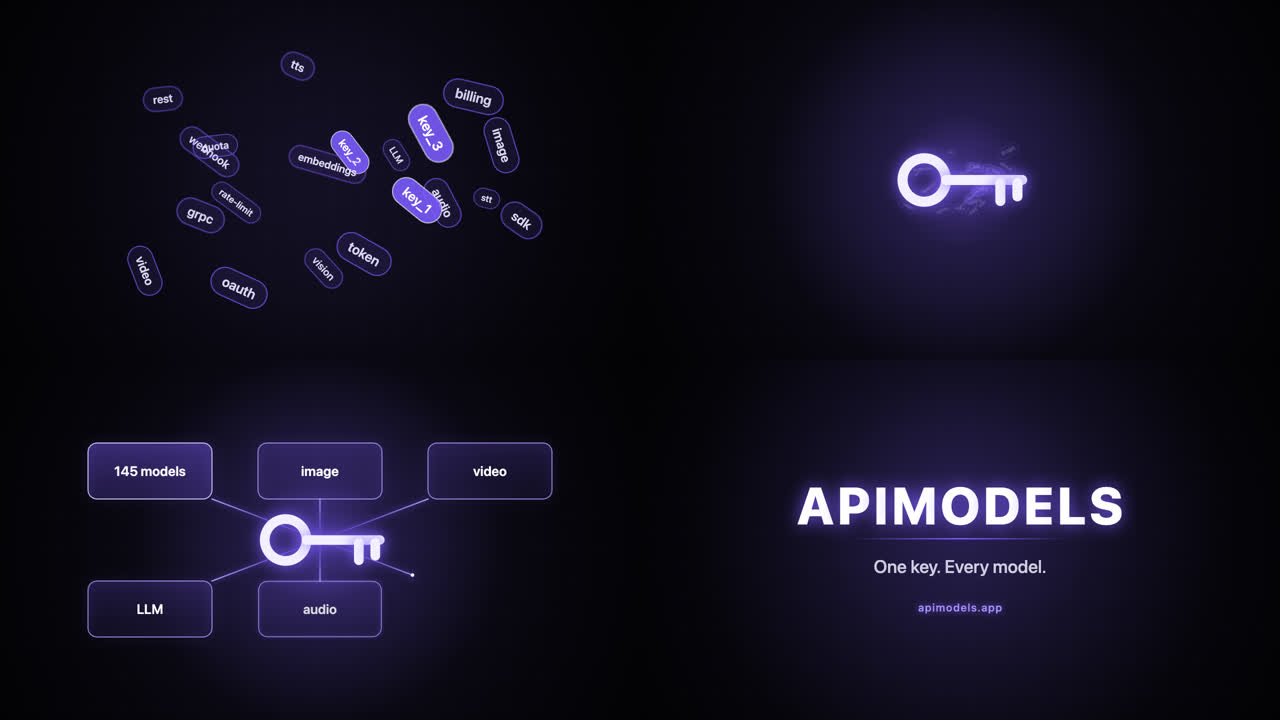
Motion design with Claude Opus 5.5 means code, not generated pixels. The model outputs text, so it writes a program that draws every frame (an HTML canvas page with a renderFrame(t) or seek(t) function, or a Remotion composition), and a headless browser plus ffmpeg turns those frames into an MP4. We ran the whole pipeline once through apimodels.app on 30 September 2026: one API call, a 12-second 1280x720 promo, 360 frames rendered with headless Chrome, encoded with ffmpeg. This is exactly what we did and what it cost.
This run
- Model
- claude-opus-5-5
- First token
- 110 s
- Total time
- 6 min 37 s
- Output tokens
- 31,786
- Billed
- $0.368
- Frames / render time
- 360 / 14 s
- Video
- 12 s · 1280x720 · 30 fps · 1.8 MB
What Opus 5.5 motion design does well
- Kinetic typography: words that land on the beat, masked reveals, type that morphs into the next scene.
- UI and product walkthroughs: a cursor clicking through screens, one shape morphing through button, loader, player and chart states.
- Animated charts and data stories, where every number and axis has to be exact.
- Logo reveals and end cards with precise timing and brand colours.
- Explainer animations, including Manim-style maths and science lessons with narration added afterwards.
- Short social templates and loops (vertical or square) you can re-render with new text in seconds.
Opus 5.5 motion design prompts: 8 cases, 7 full creator briefs, with the videos →
What it is not for
Anything that has to look filmed: photoreal people, natural camera motion, physics, skin and fabric. Code draws shapes and type; it does not shoot footage. For those shots use a video model and let Opus 5.5 write the shot list and prompts, or add titles and graphics on top in code. On apimodels.app these run on the same key:
The prompt everyone is running
This one-liner, posted by @stephanlivera on 25 September 2026, passed 2 million views and has been re-run thousands of times. It is a good way to check your setup works; because so many people use it, the results tend to look alike, and the longer briefs in our case library hold up better.
make a dynamic 15-second motion graphics video that shows what an incredible motion designer you are, like it's your showreel for a résumé. go all out.Prompt by @stephanlivera, verbatim from the original post · x.com/stephanlivera
What a run like this costs: our own 12-second test billed $0.368 for 31,786 output tokens. At $2.40 / $12 per million tokens every 10,000 output tokens is $0.12, so a clip that takes 30,000 to 80,000 tokens of thinking and code costs roughly $0.36 to $0.96 per attempt, plus a few cents of input. Rendering happens on your machine and costs nothing.
1. Ask for a program with a frame contract, not for a video
The one rule that makes everything else work: the page must expose window.renderFrame(t) and draw frame t from scratch, with no clock, no randomness and no state carried between calls. Then a script can ask for frame 0, frame 1 … frame 359 in any order and get the same picture every time, which is what a video encoder needs. A page that animates itself with requestAnimationFrame looks fine in a browser but cannot be exported frame-accurately. We also fixed the rhythm in the prompt (120 BPM, a beat every 0.5 s) and asked the model to list its beat plan as a comment; it did, 24 beats, and every cut landed on one.
2. Tell the story in time ranges, then the style
Describe what happens in each time window (problem, turn, payoff) before any visual detail. Name the labels you want on screen and say what must not appear (we asked for plain rounded labels instead of real company logos). Style comes last and stays short: one accent colour, which easing functions, and an explicit "no clutter in the last 3 seconds". The full prompt we sent is below, unedited.
The prompt we sent (verbatim)
You are writing a program that renders a video. Output one complete, self-contained HTML file and nothing else.

Rules for the program (these make it renderable frame by frame):
1. A single <canvas> of exactly 1280x720, no CSS scaling, black page background.
2. Expose a global function window.renderFrame(t) that draws the frame at time t (seconds, 0 <= t < 12) from scratch. Everything on screen must be a pure function of t: no Date.now, no performance.now, no Math.random (use a seeded PRNG if you need noise), no accumulated state between calls, no requestAnimationFrame loop.
3. Also expose window.DURATION = 12 and window.FPS = 30. When the page is opened normally, play it once in a loop with requestAnimationFrame by calling renderFrame, so a human can preview it.
4. No external assets, fonts, images or libraries. Use system-ui for text.
5. The rhythm is 120 BPM: a beat every 0.5 s. Put every major cut, text entrance and impact on a beat time (a multiple of 0.5). List the beat plan as a comment at the top of the script.

The story (tell this, then decide the visuals):
A 12-second promo for "APIMODELS", an API gateway. Problem, then turn, then payoff:
- 0-3 s: a developer's screen is cluttered with many different API keys and SDK logos flying in from every side, overlapping, getting chaotic (draw them as simple rounded labels such as "image", "video", "LLM", "audio", "key_1", "key_2", "sdk", not real company logos).
- 3-4.5 s: everything snaps together on a beat and collapses into one glowing key.
- 4.5-9 s: from that one key, lines fan out to a grid of model cards that light up one per beat (label them "145 models", "image", "video", "LLM", "audio", "one endpoint").
- 9-12 s: clean end card: the word APIMODELS, the line "One key. Every model.", and "apimodels.app" small underneath; hold still for the last second.

Style: dark background, one accent colour (electric violet #7c5cff) plus white, motion with easing (easeOutCubic / easeInOutQuad written by you), subtle depth (scale and blur fall-off), no clutter in the final 3 seconds.

Before the code, do not explain. Return only the HTML.
3. Call Opus 5.5 with streaming and no max_tokens
Opus 5.5 thinks before it writes, and the thinking counts as output. On this prompt the first character of the answer arrived after 110 seconds and the whole reply took 6 minutes 37 seconds: 31,786 output tokens for about 16,000 characters of HTML. Stream the request so the connection stays alive, and do not send a small max_tokens; the gateway forwards none when you omit it, so the model uses its own limit. The call cost $0.368 at $2.40 / $12 per million tokens, and the exact amount is returned by GET /v1/records/{id}.
curl https://api.apimodels.app/v1/chat/completions \
  -H "Authorization: Bearer $APIMODELS_API_KEY" \
  -H "Content-Type: application/json" \
  -d "$(jq -n --rawfile p prompt.md \
        '{model:"claude-opus-5-5", stream:true, messages:[{role:"user", content:$p}]}')" \
  --no-buffer > stream.txt
# no max_tokens on purpose: this run used 31,786 output tokens, mostly thinking
4. Render every frame with headless Chrome
Open the page, stop its preview loop, then call renderFrame(i / 30) for every frame and read the canvas back as a PNG. 360 frames took 14 seconds on a laptop and the page threw no errors. Encoding to H.264 with faststart gave a 1.8 MB file that plays everywhere.
// render.mjs — pnpm add puppeteer-core; uses the Chrome you already have
import puppeteer from 'puppeteer-core'
import { mkdirSync, writeFileSync } from 'node:fs'

mkdirSync('frames', { recursive: true })
const browser = await puppeteer.launch({
  executablePath: '/Applications/Google Chrome.app/Contents/MacOS/Google Chrome',
})
const page = await browser.newPage()
await page.setViewport({ width: 1280, height: 720 })
await page.goto('file://' + process.cwd() + '/promo.html')
await page.evaluate(() => { window.requestAnimationFrame = () => 0 }) // stop the preview loop
const { DURATION, FPS } = await page.evaluate(() => ({ DURATION, FPS }))
for (let i = 0; i < DURATION * FPS; i++) {
  const png = await page.evaluate((t) => {
    window.renderFrame(t)
    return document.querySelector('canvas').toDataURL('image/png')
  }, i / FPS)
  writeFileSync(`frames/f${String(i).padStart(4, '0')}.png`, Buffer.from(png.split(',')[1], 'base64'))
}
await browser.close()
ffmpeg -framerate 30 -i frames/f%04d.png -c:v libx264 -pix_fmt yuv420p -crf 20 -movflags +faststart promo.mp4
# add a soundtrack afterwards if you have one:
# ffmpeg -i promo.mp4 -i beat.mp3 -c:v copy -shortest promo-with-audio.mp45. Check the frames before you judge the video
Pull a few frames at the story beats into one contact sheet and compare them with the brief: here 2.3 s (the clutter), 3.5 s (one key), 7.2 s (cards lighting up) and 11.3 s (end card). All four matched on the first try. To change something, ask for it by timecode and beat ("at 7.5 s the sixth card should light up with a pulse"), and ask for the whole file back so the frame contract stays intact.
Limits we hit
- No audio. The program draws pictures only; add a soundtrack with ffmpeg afterwards and keep the BPM you gave the model.
- Slow first token. Expect around two minutes before the first character on a prompt like this; streaming keeps the connection alive, a short client timeout will not.
- It does not check its own output. The model never ran the page; we did. Render it, look at the frames, and treat the HTML as untested code.
Files from this run
Related guides
Idea credit: the workflow was inspired by EianLu’s article on making motion videos with Opus 5.5 on X. Everything on this page (prompt, code, video, numbers) comes from our own run. Read the original article on X
Opus 5.5 motion design examples
See all 60 →Prompts shared by their authors — copy and adapt them. Each one credits its author and links back to the original post.

The 15-second motion-designer showreel
make a dynamic 15-second motion graphics video that shows what an incredible motion designer you are, like it's your showreel for a résumé.…
by @stephanlivera

Showreel brief that lists the techniques
Create a bold, dynamic 15-second motion graphics showreel that feels like the ultimate portfolio piece of an exceptionally talented motion d…
by @lukasersil

One shape morphs through a dozen UI states on the beat
<inputs> Ask me for: 8 to 12 UI states I want the shape to become (e.g. button, loader, player, slider, toggle, tabs, chart, command palette…
by @twoclipping
Need prompts?
We curate copy-ready prompt libraries — every entry shows its full text and a sample result, ready to adapt.
Related reading
How to get access, regional availability, and how this model compares with its alternatives.
- Claude API Pricing, Compared (2026) — Fable 5.1, Opus 5.5, Sonnet 5.5, Haiku 5.5
- Claude Opus 5.5 vs Sonnet 5.5 (and Sonnet 5): Benchmarks, Price and Which to Use
- Claude Opus 5.5 vs Fable 5.1: Benchmarks, Price and When Fable Is Still Worth It
- Claude Opus 5.5 vs GPT-6 and GPT-6.1 (Sol, Astra): Price, Specs and How to Choose
- Claude Code with Opus 5.5: Setup in Two Minutes, Cost per Session, Effort Settings
- Claude Sonnet 5.5 Pricing: $2 / $10 per Million Tokens, Cache Prices and Real Cost per Task (2026)
- Make Videos with Claude Opus 5.5: Code-Rendered Motion Graphics, Tested (Prompt, Cost, Result)
- Is Claude Opus 5.5 Free? Try It on Free Credit, No Subscription