

클로드 오퍼스 5.5(Claude Opus 5.5) API
claude-opus-5-5Claude Opus 5.5는 Anthropic의 Claude 5.5 제품군 첫 모델로 2026년 9월 22일에 공개되었습니다. APIMODELS에서는 입력 100만 토큰당 $2.40, 출력 100만 토큰당 $12.00로 공식 정가 $4 / $20보다 40% 저렴하며, 캐시 읽기 $0.12, 캐시 쓰기 $3.00입니다. Anthropic의 설명에 따르면 대부분의 작업에서 Claude Fable 5.1 수준의 결과를 내면서 일반적인 워크로드의 실행 비용은 Opus 5보다 40% 낮고, 장시간 실행되는 에이전트 코딩과 지식 작업을 위해 만들어졌습니다. 사양은 Fable 5.1과 같아 100만 토큰 컨텍스트, 최대 출력 128K, 텍스트와 이미지 입력, 신뢰할 수 있는 지식 기준일은 2026년 6월입니다. 적응형 사고는 항상 켜져 있고 끌 수 없으며 깊이는 effort 매개변수(기본 medium)로 조절합니다. Fable 5.1에서 이어진 네 가지 호환성 깨짐 변경에 유의하세요. 강제 도구 사용은 오류를 반환하고, thinking 블록은 그것을 만든 모델에 묶이며, 이전 computer_20251124 도구는 받지 않고, 도구 호출 사이의 텍스트는 thinking 블록 안에 담겨 돌아옵니다. /v1/messages 또는 OpenAI 호환 /v1/chat/completions을 키 하나로 호출하며 실패한 요청은 과금되지 않습니다.
API Documentation
View complete API reference with all parameters and examples.
Advanced Features
Streaming
Enable real-time streaming responses with Server-Sent Events.
{
  "model": "claude-opus-5-5",
  "stream": true,
  "max_tokens": 1024,
  "messages": [...]
}
Function Calling (Tools)
Enable Claude to use tools and call functions.
{
  "model": "claude-opus-5-5",
  "max_tokens": 1024,
  "tools": [{
    "name": "get_weather",
    "description": "Get current weather for a location",
    "input_schema": {
      "type": "object",
      "properties": {
        "location": {"type": "string", "description": "City name"}
      },
      "required": ["location"]
    }
  }],
  "tool_choice": {"type": "auto"},
  "messages": [{"role": "user", "content": "What's the weather in Tokyo?"}]
}
PDF Support
Analyze PDF documents by sending them as base64 encoded content.
{
  "model": "claude-opus-5-5",
  "max_tokens": 1024,
  "messages": [{
    "role": "user",
    "content": [{
      "type": "document",
      "source": {
        "type": "base64",
        "media_type": "application/pdf",
        "data": "<base64_encoded_pdf>"
      }
    }, {
      "type": "text",
      "text": "Summarize this document."
    }]
  }]
}
Structured Output (JSON Schema)
Get structured JSON responses that match your schema.
{
  "model": "claude-opus-5-5",
  "max_tokens": 1024,
  "output_format": {
    "type": "json_schema",
    "schema": {
      "type": "object",
      "properties": {
        "name": {"type": "string"},
        "age": {"type": "integer"}
      },
      "required": ["name", "age"]
    }
  },
  "messages": [{"role": "user", "content": "Extract info: John is 30 years old"}]
}
Web Search
Enable Claude to search the web for up-to-date information.
{
  "model": "claude-opus-5-5",
  "max_tokens": 1024,
  "tools": [{
    "type": "web_search_20250305",
    "name": "web_search",
    "max_uses": 5
  }],
  "messages": [{"role": "user", "content": "What's the latest news about AI?"}]
}
API Parameters Reference
| Parameter | Type | Required | Description |
|---|---|---|---|
| model | string | Yes | Model identifier (e.g., claude-opus-5-5) |
| messages | array | Yes | Array of message objects with role and content |
| max_tokens | integer | Yes | Maximum tokens in the response (1 - 128000) |
| system | string | No | System prompt to set context |
| stream | boolean | No | Enable streaming responses (SSE) |
| temperature | number | No | Sampling temperature (0.0 - 1.0) |
| top_p | number | No | Nucleus sampling threshold (0.0 - 1.0) |
| top_k | integer | No | Top-k sampling (0 - infinity) |
| stop_sequences | array | No | Sequences that stop generation |
| tools | array | No | Function calling tools definition |
| tool_choice | object | No | Tool selection strategy (auto/any/tool) |
| thinking | object | No | Enable extended thinking mode |
| output_format | object | No | Structured output with JSON schema |
Full API Documentation
View complete API reference with streaming, thinking, and more.
Pricing
Billing: Cost = (input_tokens * input_price + output_tokens * output_price) / 1,000,000
공식가보다 40% 저렴
100만 토큰당 $2.40 / $12.00, 공식 정가는 $4 / $20. 캐시 읽기 $0.12
Fable급 결과를 Opus 가격에
Anthropic: 대부분의 작업에서 Fable 5.1 수준, 실행 비용은 Opus 5보다 40% 낮음
컨텍스트 1M, 출력 128K
Fable 5.1과 같은 사양. 텍스트와 이미지 입력. 지식 기준일 2026년 6월
적응형 사고 항상 켜짐
끌 수 없음. 깊이는 effort(기본 medium)로 조절. 강제 도구 사용은 오류
코드로 모션 디자인
canvas·SVG·Remotion 코드를 써서 MP4로 렌더링. 12초 테스트 영상 실측 $0.368
Claude Opus 5.5 소개
Claude Opus 5.5은(는) Anthropic의 대규모 언어 모델 API입니다. Claude Opus 5.5는 Anthropic의 Claude 5.5 제품군 첫 모델로 2026년 9월 22일에 공개되었습니다. APIMODELS에서는 입력 100만 토큰당 $2.40, 출력 100만 토큰당 $12.00로 공식 정가 $4 / $20보다 40% 저렴하며, 캐시 읽기 $0.12, 캐시 쓰기 $3.00입니다. Anthropic의 설명에 따르면 대부분의 작업에서 Claude Fable 5.1 수준의 결과를 내면서 일반적인 워크로드의 실행 비용은 Opus 5보다 40% 낮고, 장시간 실행되는 에이전트 코딩과 지식 작업을 위해 만들어졌습니다. 사양은 Fable 5.1과 같아 100만 토큰 컨텍스트, 최대 출력 128K, 텍스트와 이미지 입력, 신뢰할 수 있는 지식 기준일은 2026년 6월입니다. 적응형 사고는 항상 켜져 있고 끌 수 없으며 깊이는 effort 매개변수(기본 medium)로 조절합니다. Fable 5.1에서 이어진 네 가지 호환성 깨짐 변경에 유의하세요. 강제 도구 사용은 오류를 반환하고, thinking 블록은 그것을 만든 모델에 묶이며, 이전 computer_20251124 도구는 받지 않고, 도구 호출 사이의 텍스트는 thinking 블록 안에 담겨 돌아옵니다. /v1/messages 또는 OpenAI 호환 /v1/chat/completions을 키 하나로 호출하며 실패한 요청은 과금되지 않습니다. APIMODELS 플랫폼을 거치면 통합 API와 투명한 종량 과금으로 이 모델을 호출할 수 있습니다. 현재 가격: Input: $2.40, Output: $12.00 per 1M tokens.
주요 기능
- 공식가보다 40% 저렴 -- 100만 토큰당 $2.40 / $12.00, 공식 정가는 $4 / $20. 캐시 읽기 $0.12
- Fable급 결과를 Opus 가격에 -- Anthropic: 대부분의 작업에서 Fable 5.1 수준, 실행 비용은 Opus 5보다 40% 낮음
- 컨텍스트 1M, 출력 128K -- Fable 5.1과 같은 사양. 텍스트와 이미지 입력. 지식 기준일 2026년 6월
- 적응형 사고 항상 켜짐 -- 끌 수 없음. 깊이는 effort(기본 medium)로 조절. 강제 도구 사용은 오류
- 코드로 모션 디자인 -- canvas·SVG·Remotion 코드를 써서 MP4로 렌더링. 12초 테스트 영상 실측 $0.368
활용 사례
챗봇과 고객 응대
문의에 자동으로 답하는 대화 시스템을 만들어 응대 효율을 높입니다.
콘텐츠 생성
기사와 이메일, 광고 카피 같은 글을 자동으로 써서 작업량을 줄입니다.
코딩 어시스턴트
코드 작성과 디버깅, 리뷰를 도와 개발 속도를 올립니다.
데이터 분석
비정형 데이터를 읽어내 핵심을 뽑고 요약 리포트로 정리합니다.
APIMODELS를 쓰는 이유
- 통합 API -- 키 하나로 모든 모델에 접근하며, 플랫폼마다 따로 가입할 필요가 없습니다
- 투명한 가격 -- 종량 과금이고 호출당 단가를 모델 페이지마다 공개합니다. 1인 개발자와 스타트업에 알맞습니다
- 바로 사용 -- 가입 직후부터 쓸 수 있고 Stripe와 Alipay로 결제합니다
- 충실한 문서 -- cURL / Python / Node.js 예제를 갖춘 상세한 API 문서를 제공합니다
자주 묻는 질문
Claude Opus 5.5 가격은 얼마인가요?
Claude Opus 5.5은(는) APIMODELS를 통해 Input: $2.40, Output: $12.00 per 1M tokens에 이용할 수 있습니다. 과금은 종량제라서 생성한 만큼만 냅니다.
Claude Opus 5.5 API는 어떻게 쓰나요?
APIMODELS에 가입해 API 키를 받고 통합 엔드포인트를 호출하면 됩니다. cURL / Python / Node.js 예제를 담은 상세 문서를 제공합니다.
APIMODELS와 Anthropic 공식 API는 무엇이 다른가요?
APIMODELS는 같은 Claude Opus 5.5을(를) 집약 플랫폼을 통해 제공합니다. API 인터페이스가 통합되어 있어 공급자마다 계정을 만들 필요가 없고, 키 하나로 모든 모델에 닿습니다.
apimodels에서 Claude Opus 5.5는 얼마이고 공식가보다 얼마나 싼가요?
입력 100만 토큰당 $2.40, 출력 100만 토큰당 $12.00이며 캐시 읽기 $0.12, 캐시 쓰기 $3.00입니다. Anthropic 정가는 $4 / $20, 캐시 읽기 $0.20이므로 40% 저렴합니다. 실제 토큰 수로 과금하고 실패한 요청은 무료이며 월 최소 결제도 없습니다.
Opus 5.5, Opus 5, Fable 5.1 중 어떻게 고르나요?
Anthropic 자체의 설명은 Opus 5.5가 대부분의 작업에서 Fable 5.1 수준의 결과를 내면서 일반적인 워크로드의 실행 비용은 Opus 5보다 40% 낮다는 것입니다. 여기서는 Opus 5.5가 $2.40 / $12.00, Opus 5가 $3 / $15, Fable 5.1이 $5 / $25입니다. 어떤 작업이 Fable 5.1에서만 제대로 된다는 것을 확인한 게 아니라면 Opus 5.5로 시작하는 것이 더 유리합니다. 셋 다 사양은 같아서 컨텍스트 100만, 출력 128K입니다.
Opus 5에서 Opus 5.5로 옮기면 무엇이 바뀌나요?
모델 이름을 claude-opus-5-5로 바꾸면 되지만 네 가지 호환성 깨짐 변경이 있습니다. 적응형 사고가 항상 켜져 있고 더 이상 끌 수 없습니다(깊이는 effort로 조절, 기본 medium). 특정 도구를 지정하는 tool_choice로 도구 사용을 강제하면 오류가 납니다. thinking 블록은 그것을 만든 모델에 묶이므로 대화에서 이전 thinking 블록을 모델 간에 가져갈 수 없습니다. 이전 computer_20251124 도구는 받지 않습니다. 또한 도구 호출 사이의 텍스트가 thinking 블록 안에 담겨 돌아오므로 이를 진행 표시로 쓰는 앱은 display를 설정해야 합니다.
어떻게 호출하나요? OpenAI 형식도 되나요?
둘 다 됩니다. Anthropic 네이티브 POST https://api.apimodels.app/v1/messages 또는 OpenAI 호환 /v1/chat/completions에 model을 claude-opus-5-5로, Authorization: Bearer에 apimodels 키를 넣어 보냅니다. 스트리밍, 도구 호출, 이미지 입력을 지원하며 프롬프트 캐시는 Anthropic의 cache_control 사용법을 따르고 적중 시 $0.12로 과금됩니다.
클로드 API 결제가 안 되거나 결제 버튼이 비활성화될 때는?
apimodels.app을 쓰면 Anthropic 콘솔 결제 없이 Claude Opus 5.5를 호출할 수 있습니다. 달러 잔액을 Stripe(카드), PayPal, 알리페이, USDT로 선불 충전하고, 그 잔액에서 입력 100만 토큰 $2.40, 출력 $12.00이 차감됩니다. 성공한 요청만 과금되고 API 키는 가입 후 바로 발급됩니다.
Claude Opus 5.5로 모션 디자인을 할 수 있나요? 어떻게 하나요?
할 수 있습니다. 다만 코드로 만듭니다. Opus 5.5는 영상이 아니라 텍스트를 출력하기 때문에, 모션 디자인을 할 때는 모든 프레임을 그리는 프로그램을 씁니다. renderFrame(t)나 seek(t)를 제공하는 HTML canvas / SVG 페이지, 또는 Remotion 컴포지션입니다. 헤드리스 브라우저가 프레임을 하나씩 렌더링하고 ffmpeg가 MP4로 인코딩합니다. 키네틱 타이포그래피, UI 워크스루, 차트 애니메이션, 로고 리빌, 설명 애니메이션에 강합니다. 실사 같은 장면, 실제 인물, 자연스러운 카메라 움직임은 Seedance 2.5나 Veo 3.1 같은 영상 모델에 맡기세요. 저희가 직접 돌려 본 전체 과정은 이 페이지와 https://apimodels.app/access/claude-opus-5-5-video에 있습니다.
가장 쓸 만한 Claude Opus 5.5 모션 디자인 프롬프트는?
대부분이 처음 쓰는 것은 @stephanlivera가 2026년 9월 25일에 올려 조회수 200만을 넘긴 한 문장입니다: "make a dynamic 15-second motion graphics video that shows what an incredible motion designer you are, like it's your showreel for a résumé. go all out." 환경이 제대로 돌아가는지 확인하기에는 좋지만, 누가 돌려도 비슷한 결과가 나옵니다. 오래 쓸 수 있는 건 긴 브리프입니다. 어떤 소재를 요청할지, 스타일과 강조색은 하나씩, 금지할 기본 효과 목록, 모든 컷을 박자 그리드에 맞추기, seek(t) 렌더링 규칙. 작성자 표기와 함께 원문 그대로인 브리프 7개와 완성 영상을 https://apimodels.app/claude-opus-5-5-video-prompts/motion-graphics에 모아 두었습니다.
API로 Opus 5.5 모션 디자인 영상 한 편을 만들면 비용은?
apimodels.app에서 실측한 결과는 스트리밍 호출 1회로 출력 31,786토큰, 6분 37초, 청구액 $0.368이었고 12초 1280x720 영상이 나왔습니다. 렌더링은 로컬에서 하므로 비용이 없습니다. 100만 토큰당 $2.40 / $12이면 출력 1만 토큰마다 $0.12이므로, 사고와 코드에 3만~8만 토큰이 드는 영상은 시도 한 번에 약 $0.36~$0.96이고 입력 비용이 몇 센트 더해집니다. 수정을 반복하는 긴 에이전트 세션은 더 비쌉니다. 제작자들이 밝힌 완성작 비용은 약 $2~$400입니다. 실패한 호출은 과금되지 않습니다.
Claude Opus 5.5은(는) 다른 대규모 언어 모델 모델과 비교하면 어떤가요?
APIMODELS에서는 Claude Opus 5.5이(가) 60개가 넘는 모델과 같은 API 키, 같은 잔액 위에 나란히 놓입니다. 그래서 선택은 궁합의 문제이지 종속의 문제가 아닙니다. 40% Below Official、1M Context、Agentic Coding、Adaptive Thinking을(를) 지원하며 다른 대규모 언어 모델 모델과 가격·성능을 나란히 놓고 따져볼 수 있습니다. 갈아타기는 모델 이름 문자열 하나만 바꾸면 되고 새 계정도 추가 작업도 필요 없습니다. 대규모 언어 모델 선택지와 실시간 가격은 apimodels.app/models에서 볼 수 있습니다.
Claude Opus 5.5으로 무엇을 할 수 있나요?
Claude Opus 5.5은(는) 다음을 지원합니다: 40% Below Official、1M Context、Agentic Coding、Adaptive Thinking. 전체 파라미터와 호출 예제는 APIMODELS 문서를 참고하세요.
Claude Opus 5.5 API를 어디서든 쓸 수 있나요?
네. APIMODELS는 Claude Opus 5.5을(를) 하나의 통합 API와 키 한 개로 제공합니다. 공급자별 계정도 필요 없고, 각 공급자의 지역별 네트워크 경로를 직접 챙길 필요도 없습니다.
어떤 결제 수단을 지원하나요?
Stripe(Visa, Mastercard 등 해외 카드)와 Alipay를 지원합니다. 결제 후 잔액은 즉시 반영됩니다.
Related models
Claude Opus 5.5 motion design: how it works, what it is good at, and a tested run with the full prompt
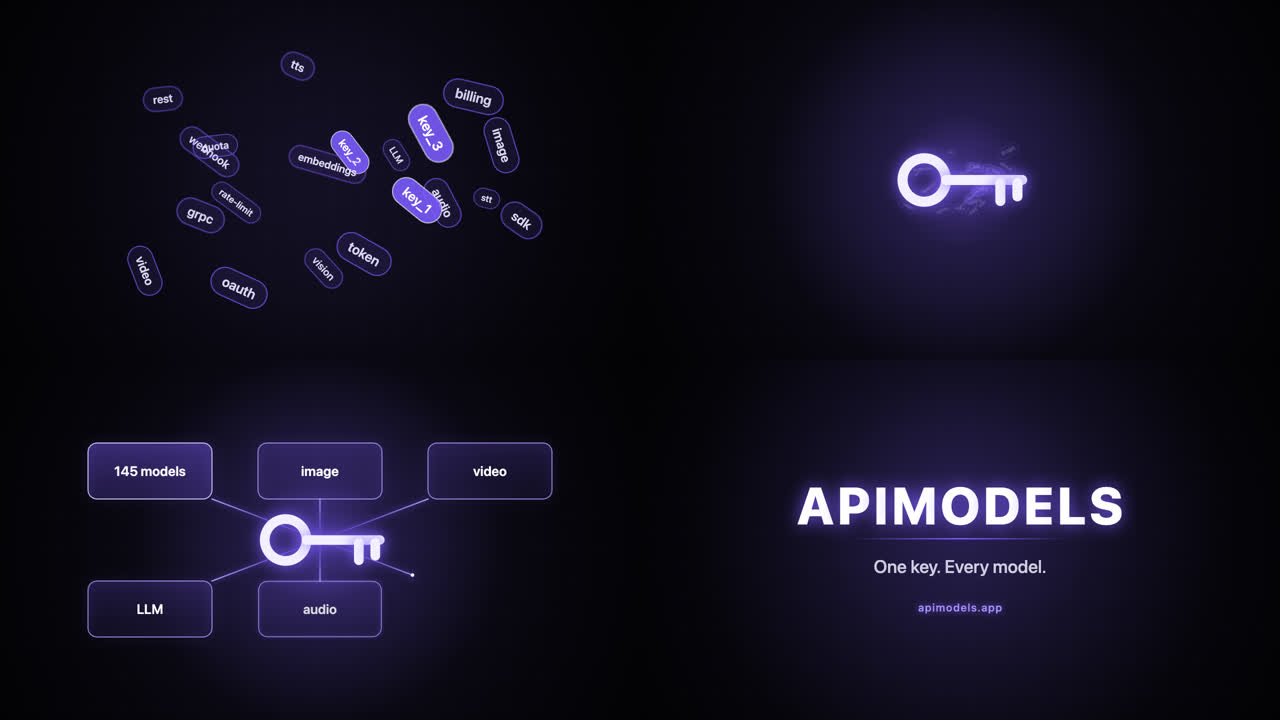
Motion design with Claude Opus 5.5 means code, not generated pixels. The model outputs text, so it writes a program that draws every frame (an HTML canvas page with a renderFrame(t) or seek(t) function, or a Remotion composition), and a headless browser plus ffmpeg turns those frames into an MP4. We ran the whole pipeline once through apimodels.app on 30 September 2026: one API call, a 12-second 1280x720 promo, 360 frames rendered with headless Chrome, encoded with ffmpeg. This is exactly what we did and what it cost.
This run
- Model
- claude-opus-5-5
- First token
- 110 s
- Total time
- 6 min 37 s
- Output tokens
- 31,786
- Billed
- $0.368
- Frames / render time
- 360 / 14 s
- Video
- 12 s · 1280x720 · 30 fps · 1.8 MB
What Opus 5.5 motion design does well
- Kinetic typography: words that land on the beat, masked reveals, type that morphs into the next scene.
- UI and product walkthroughs: a cursor clicking through screens, one shape morphing through button, loader, player and chart states.
- Animated charts and data stories, where every number and axis has to be exact.
- Logo reveals and end cards with precise timing and brand colours.
- Explainer animations, including Manim-style maths and science lessons with narration added afterwards.
- Short social templates and loops (vertical or square) you can re-render with new text in seconds.
Opus 5.5 motion design prompts: 8 cases, 7 full creator briefs, with the videos →
What it is not for
Anything that has to look filmed: photoreal people, natural camera motion, physics, skin and fabric. Code draws shapes and type; it does not shoot footage. For those shots use a video model and let Opus 5.5 write the shot list and prompts, or add titles and graphics on top in code. On apimodels.app these run on the same key:
The prompt everyone is running
This one-liner, posted by @stephanlivera on 25 September 2026, passed 2 million views and has been re-run thousands of times. It is a good way to check your setup works; because so many people use it, the results tend to look alike, and the longer briefs in our case library hold up better.
make a dynamic 15-second motion graphics video that shows what an incredible motion designer you are, like it's your showreel for a résumé. go all out.Prompt by @stephanlivera, verbatim from the original post · x.com/stephanlivera
What a run like this costs: our own 12-second test billed $0.368 for 31,786 output tokens. At $2.40 / $12 per million tokens every 10,000 output tokens is $0.12, so a clip that takes 30,000 to 80,000 tokens of thinking and code costs roughly $0.36 to $0.96 per attempt, plus a few cents of input. Rendering happens on your machine and costs nothing.
1. Ask for a program with a frame contract, not for a video
The one rule that makes everything else work: the page must expose window.renderFrame(t) and draw frame t from scratch, with no clock, no randomness and no state carried between calls. Then a script can ask for frame 0, frame 1 … frame 359 in any order and get the same picture every time, which is what a video encoder needs. A page that animates itself with requestAnimationFrame looks fine in a browser but cannot be exported frame-accurately. We also fixed the rhythm in the prompt (120 BPM, a beat every 0.5 s) and asked the model to list its beat plan as a comment; it did, 24 beats, and every cut landed on one.
2. Tell the story in time ranges, then the style
Describe what happens in each time window (problem, turn, payoff) before any visual detail. Name the labels you want on screen and say what must not appear (we asked for plain rounded labels instead of real company logos). Style comes last and stays short: one accent colour, which easing functions, and an explicit "no clutter in the last 3 seconds". The full prompt we sent is below, unedited.
The prompt we sent (verbatim)
You are writing a program that renders a video. Output one complete, self-contained HTML file and nothing else.

Rules for the program (these make it renderable frame by frame):
1. A single <canvas> of exactly 1280x720, no CSS scaling, black page background.
2. Expose a global function window.renderFrame(t) that draws the frame at time t (seconds, 0 <= t < 12) from scratch. Everything on screen must be a pure function of t: no Date.now, no performance.now, no Math.random (use a seeded PRNG if you need noise), no accumulated state between calls, no requestAnimationFrame loop.
3. Also expose window.DURATION = 12 and window.FPS = 30. When the page is opened normally, play it once in a loop with requestAnimationFrame by calling renderFrame, so a human can preview it.
4. No external assets, fonts, images or libraries. Use system-ui for text.
5. The rhythm is 120 BPM: a beat every 0.5 s. Put every major cut, text entrance and impact on a beat time (a multiple of 0.5). List the beat plan as a comment at the top of the script.

The story (tell this, then decide the visuals):
A 12-second promo for "APIMODELS", an API gateway. Problem, then turn, then payoff:
- 0-3 s: a developer's screen is cluttered with many different API keys and SDK logos flying in from every side, overlapping, getting chaotic (draw them as simple rounded labels such as "image", "video", "LLM", "audio", "key_1", "key_2", "sdk", not real company logos).
- 3-4.5 s: everything snaps together on a beat and collapses into one glowing key.
- 4.5-9 s: from that one key, lines fan out to a grid of model cards that light up one per beat (label them "145 models", "image", "video", "LLM", "audio", "one endpoint").
- 9-12 s: clean end card: the word APIMODELS, the line "One key. Every model.", and "apimodels.app" small underneath; hold still for the last second.

Style: dark background, one accent colour (electric violet #7c5cff) plus white, motion with easing (easeOutCubic / easeInOutQuad written by you), subtle depth (scale and blur fall-off), no clutter in the final 3 seconds.

Before the code, do not explain. Return only the HTML.
3. Call Opus 5.5 with streaming and no max_tokens
Opus 5.5 thinks before it writes, and the thinking counts as output. On this prompt the first character of the answer arrived after 110 seconds and the whole reply took 6 minutes 37 seconds: 31,786 output tokens for about 16,000 characters of HTML. Stream the request so the connection stays alive, and do not send a small max_tokens; the gateway forwards none when you omit it, so the model uses its own limit. The call cost $0.368 at $2.40 / $12 per million tokens, and the exact amount is returned by GET /v1/records/{id}.
curl https://api.apimodels.app/v1/chat/completions \
  -H "Authorization: Bearer $APIMODELS_API_KEY" \
  -H "Content-Type: application/json" \
  -d "$(jq -n --rawfile p prompt.md \
        '{model:"claude-opus-5-5", stream:true, messages:[{role:"user", content:$p}]}')" \
  --no-buffer > stream.txt
# no max_tokens on purpose: this run used 31,786 output tokens, mostly thinking
4. Render every frame with headless Chrome
Open the page, stop its preview loop, then call renderFrame(i / 30) for every frame and read the canvas back as a PNG. 360 frames took 14 seconds on a laptop and the page threw no errors. Encoding to H.264 with faststart gave a 1.8 MB file that plays everywhere.
// render.mjs — pnpm add puppeteer-core; uses the Chrome you already have
import puppeteer from 'puppeteer-core'
import { mkdirSync, writeFileSync } from 'node:fs'

mkdirSync('frames', { recursive: true })
const browser = await puppeteer.launch({
  executablePath: '/Applications/Google Chrome.app/Contents/MacOS/Google Chrome',
})
const page = await browser.newPage()
await page.setViewport({ width: 1280, height: 720 })
await page.goto('file://' + process.cwd() + '/promo.html')
await page.evaluate(() => { window.requestAnimationFrame = () => 0 }) // stop the preview loop
const { DURATION, FPS } = await page.evaluate(() => ({ DURATION, FPS }))
for (let i = 0; i < DURATION * FPS; i++) {
  const png = await page.evaluate((t) => {
    window.renderFrame(t)
    return document.querySelector('canvas').toDataURL('image/png')
  }, i / FPS)
  writeFileSync(`frames/f${String(i).padStart(4, '0')}.png`, Buffer.from(png.split(',')[1], 'base64'))
}
await browser.close()
ffmpeg -framerate 30 -i frames/f%04d.png -c:v libx264 -pix_fmt yuv420p -crf 20 -movflags +faststart promo.mp4
# add a soundtrack afterwards if you have one:
# ffmpeg -i promo.mp4 -i beat.mp3 -c:v copy -shortest promo-with-audio.mp45. Check the frames before you judge the video
Pull a few frames at the story beats into one contact sheet and compare them with the brief: here 2.3 s (the clutter), 3.5 s (one key), 7.2 s (cards lighting up) and 11.3 s (end card). All four matched on the first try. To change something, ask for it by timecode and beat ("at 7.5 s the sixth card should light up with a pulse"), and ask for the whole file back so the frame contract stays intact.
Limits we hit
- No audio. The program draws pictures only; add a soundtrack with ffmpeg afterwards and keep the BPM you gave the model.
- Slow first token. Expect around two minutes before the first character on a prompt like this; streaming keeps the connection alive, a short client timeout will not.
- It does not check its own output. The model never ran the page; we did. Render it, look at the frames, and treat the HTML as untested code.
Files from this run
Related guides
Idea credit: the workflow was inspired by EianLu’s article on making motion videos with Opus 5.5 on X. Everything on this page (prompt, code, video, numbers) comes from our own run. Read the original article on X
Opus 5.5 motion design examples
See all 60 →Prompts shared by their authors — copy and adapt them. Each one credits its author and links back to the original post.

The 15-second motion-designer showreel
make a dynamic 15-second motion graphics video that shows what an incredible motion designer you are, like it's your showreel for a résumé.…
by @stephanlivera

Showreel brief that lists the techniques
Create a bold, dynamic 15-second motion graphics showreel that feels like the ultimate portfolio piece of an exceptionally talented motion d…
by @lukasersil

One shape morphs through a dozen UI states on the beat
<inputs> Ask me for: 8 to 12 UI states I want the shape to become (e.g. button, loader, player, slider, toggle, tabs, chart, command palette…
by @twoclipping
Need prompts?
We curate copy-ready prompt libraries — every entry shows its full text and a sample result, ready to adapt.
Related reading
How to get access, regional availability, and how this model compares with its alternatives.
- Claude API Pricing, Compared (2026) — Fable 5.1, Opus 5.5, Sonnet 5.5, Haiku 5.5
- Claude Opus 5.5 vs Sonnet 5.5 (and Sonnet 5): Benchmarks, Price and Which to Use
- Claude Opus 5.5 vs Fable 5.1: Benchmarks, Price and When Fable Is Still Worth It
- Claude Opus 5.5 vs GPT-6 and GPT-6.1 (Sol, Astra): Price, Specs and How to Choose
- Claude Code with Opus 5.5: Setup in Two Minutes, Cost per Session, Effort Settings
- Claude Sonnet 5.5 Pricing: $2 / $10 per Million Tokens, Cache Prices and Real Cost per Task (2026)
- Make Videos with Claude Opus 5.5: Code-Rendered Motion Graphics, Tested (Prompt, Cost, Result)
- Is Claude Opus 5.5 Free? Try It on Free Credit, No Subscription