
Blog · 2026-11-20
LTX 2.5 vs Seedance 2.0: LTX Finished Every Clip in About a Minute, Seedance Followed the Prompt Better
Model pages: LTX 2.5 Fast API · Seedance 2.0 API — pricing, specs and the playground
The short answer: pick LTX 2.5 Fast when speed and price matter or you want a presenter to speak your own voice track; pick Seedance 2.0 when the shot must follow a detailed prompt. On four identical 720p, 6-second prompts, LTX 2.5 Fast finished in 27 to 73 seconds and Seedance 2.0 in 7.5 to 8.8 minutes. Seedance staged scenes more faithfully and gave image-to-video real sound. Per second, LTX 2.5 Fast costs $0.081 and Seedance 2.0 $0.197.
LTX 2.5 is the newest video model from Lightricks. It comes in a Fast tier and a Pro tier, and the weights are also released openly, so it can run on your own GPUs as well as through an API. Seedance 2.0 is ByteDance's all-round multimodal video model. Both generate sound together with the picture, but they lean different ways: LTX 2.5 is built for speed and can animate a picture around an audio file you supply, while Seedance 2.0 accepts far more reference material, up to nine images plus video and audio, and can start from a first and a last frame.
A word on who we are: we run apimodels.app, a platform where one API key calls LTX 2.5, Seedance 2.0 and other image, video, audio and language models. Every clip in this article was generated on that platform on 20 November 2026. Apart from joining each pair into one player and labelling the model in the corner, nothing was edited. Spoken lines were checked with two different speech-to-text models.
How we tested: four everyday jobs with word-for-word identical prompts, namely a two-person dialogue scene, a three-shot action sequence, a vertical product clip and a product photo turned into video. Both models ran at 720p for 6 seconds with sound, once each, and we kept whatever came back. We also ran LTX 2.5 Pro on two of the prompts and tried the audio-to-video mode of LTX 2.5 Fast. Times run from creating the job to the finished file on our platform, queue included.
Results at a glance
- Dialogue: LTX 2.5 Fast and Seedance 2.0 both spoke the two lines word for word; only Seedance 2.0 put the cook behind the counter as written. 41 seconds against 8.8 minutes.
- Three-shot action: both models cut to three shots inside 6 seconds; Seedance 2.0 looked more cinematic but lost the rider in the last shot. 27 seconds against 8.8 minutes.
- Vertical product clip: Seedance 2.0 matched the brief, with a dark stone, a cap twist and clear ice; LTX 2.5 Fast gave a pale background, lumpy ice and a bottle that changes shape. 64 seconds against 8.4 minutes.
- Photo to video: neither model did the requested orbit; Seedance 2.0 added the café and birdsong we asked for, while LTX 2.5 Fast was almost silent. 73 seconds against 7.5 minutes.
- Your own voice track: LTX 2.5 Fast turned a 4.8-second voice line and a portrait into a talking presenter in 86 seconds, for 39 cents.
- Cost of one 6-second 720p clip: LTX 2.5 Fast 48.6 cents, LTX 2.5 Pro 64.8 cents, Seedance 2.0 about $1.19.
Which one fits your job
- You generate many takes or build an interactive feature: LTX 2.5 Fast. Under a minute and a quarter per clip in our test, against 7.5 to 8.8 minutes.
- The shot must match a detailed brief, such as who stands where or what the product looks like: Seedance 2.0. It got the staging and the product right where LTX 2.5 drifted.
- You have a voice-over and need someone on screen to say it: LTX 2.5 Fast audio-to-video. Your recording becomes the soundtrack.
- You want to steer the shot with several reference images, a reference video, or a first and last frame: Seedance 2.0. LTX 2.5 takes one first frame only.
- You need 1440p or 48 or 50 fps: LTX 2.5 Fast. Seedance 2.0 stops at 1080p.
- You need 4K, or more than 20 seconds in one clip: neither, through our API. See the section on when neither fits.
How LTX 2.5 and Seedance 2.0 differ on paper
- Resolution: LTX 2.5 Fast 720p, 1080p and 1440p; LTX 2.5 Pro 720p and 1080p; Seedance 2.0 480p, 720p and 1080p.
- Length: LTX 2.5 Fast 6 to 20 seconds in even steps, but only 6, 8 or 10 at 1440p or 48 and 50 fps; LTX 2.5 Pro 6, 8 or 10; Seedance 2.0 any whole number from 4 to 15.
- Frame rate: LTX 2.5 offers 24, 25, 48 or 50 fps; Seedance 2.0 delivered 24 fps in our tests.
- What you can feed it: LTX 2.5 takes a prompt and one first-frame image, plus an audio file on Fast; Seedance 2.0 takes a prompt, a first frame or a first and last frame, up to nine reference images, a reference video, reference audio and web search.
- Sound: both generate sound with the picture; only LTX 2.5 Fast can use your audio file as the finished soundtrack.
- Weights: LTX 2.5 is released as open weights, which LTX says are free for organisations under $10 million in annual revenue; Seedance 2.0 is available only as a hosted service.
- Price at 720p on apimodels.app: LTX 2.5 Fast $0.081, LTX 2.5 Pro $0.108, Seedance 2.0 $0.197 per second. Seedance 2.0 also has a 480p tier at $0.092; LTX 2.5 has no 480p.
Dialogue: both said the lines, only Seedance 2.0 staged it as written
In the ramen-shop dialogue, LTX 2.5 Fast and Seedance 2.0 both spoke the two lines word for word, but only Seedance 2.0 staged the scene the way the prompt described it. We asked for a cook in his fifties behind the counter of a tiny ramen shop at night, wiping it down, who looks up at a young woman across from him and says "Last bowl of the night, on the house". She laughs and replies "You say that every night". Rain, lanterns and simmering broth fill in the background.
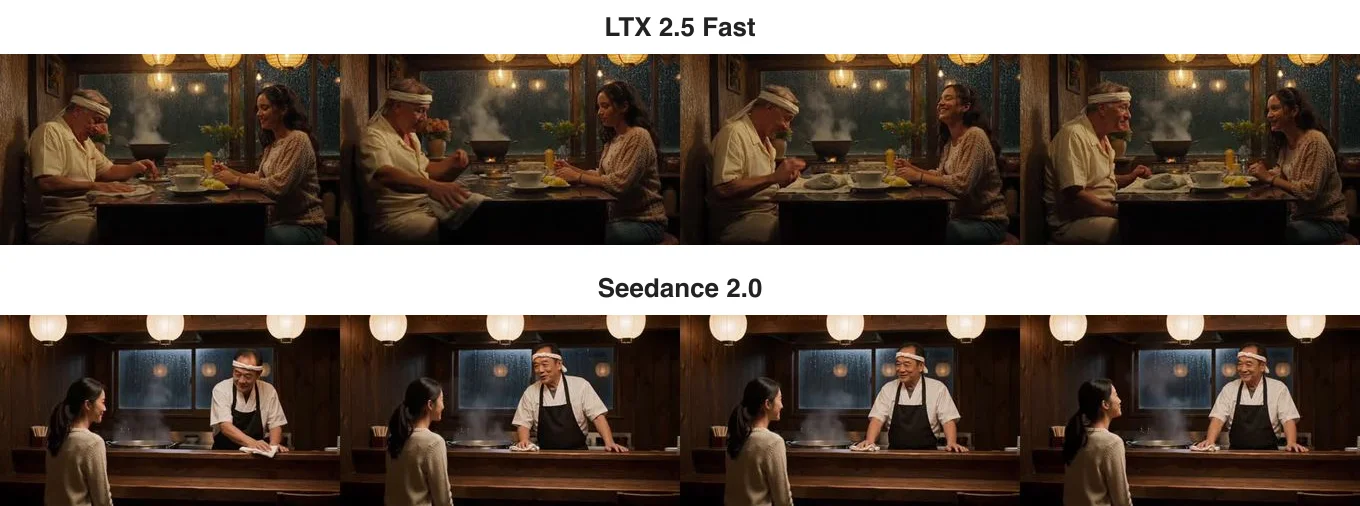
Both clips have the lantern light, the steam and rain on the window, and both voices come in at the right moment. Seedance 2.0 put the cook behind a long wooden counter with a towel under his hand and the customer on the other side, which is what we wrote. LTX 2.5 Fast sat the two of them at the same small table; the cook does wipe it and talks with real energy, but the counter is gone. LTX 2.5 Fast took 41 seconds and Seedance 2.0 took 8.8 minutes.
If positions matter with LTX 2.5, spell them out and repeat them, for example "standing behind the counter, on the far side from her", rather than mentioning the counter once.
Three shots in six seconds: both cut on cue, Seedance 2.0 looked more cinematic
In the cyclist prompt, LTX 2.5 Fast and Seedance 2.0 both cut to three different shots inside six seconds, which is the hard part of this brief. The prompt asked for a cyclist in a yellow jacket on a coastal cliff road at sunrise: a side tracking shot, then a low close-up of the front wheel splashing through a puddle, then a wide high shot of the road curving along the sea, with wind, a clicking chain and waves on the soundtrack.
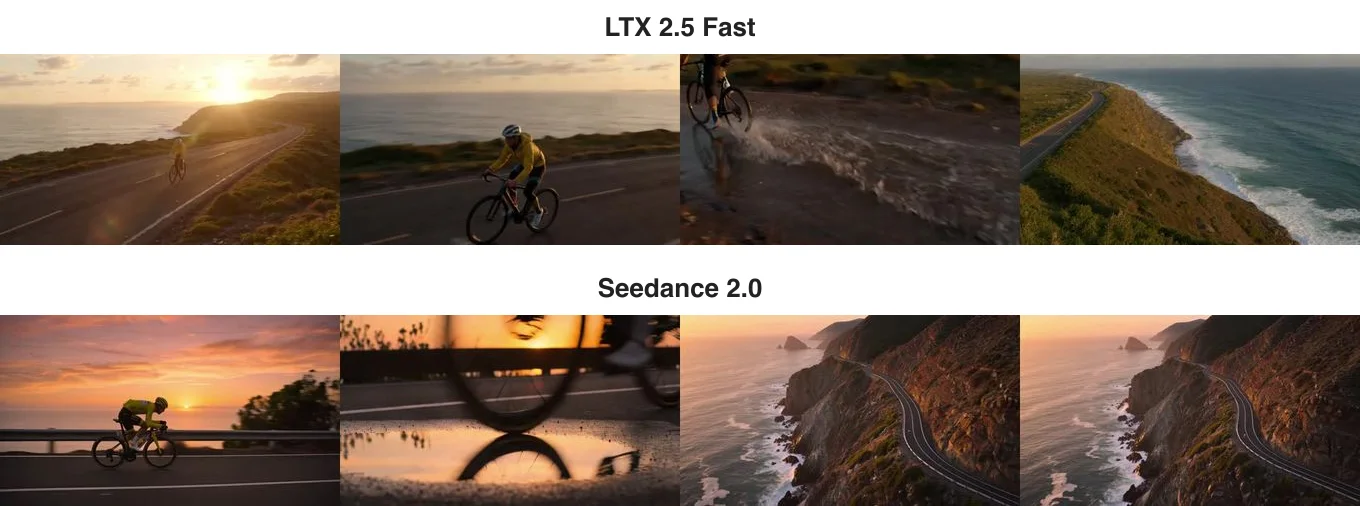
Seedance 2.0 made the more striking version: a silhouette against an orange sky, the wheel reflected in the puddle, then a drone-style view of the road hugging the cliffs. The rider is missing from that last shot, though. LTX 2.5 Fast is plainer but complete: the rider is visible in the opening wide, the splash close-up is clear and the closing aerial follows the coastline. Both soundtracks have wind and splashing water. LTX 2.5 Fast took 27 seconds and Seedance 2.0 took 8.8 minutes.
Vertical product clip: Seedance 2.0 followed the brief, LTX 2.5 drifted
For the 9:16 product clip, Seedance 2.0 matched the brief closely while LTX 2.5 Fast drifted on the background, the ice and the bottle. We asked for a glass bottle of cold brew coffee on a wet black stone with cold mist around it; a hand twists off the cap with a hiss and pours the coffee over ice into a tall glass while the camera slowly pushes in.
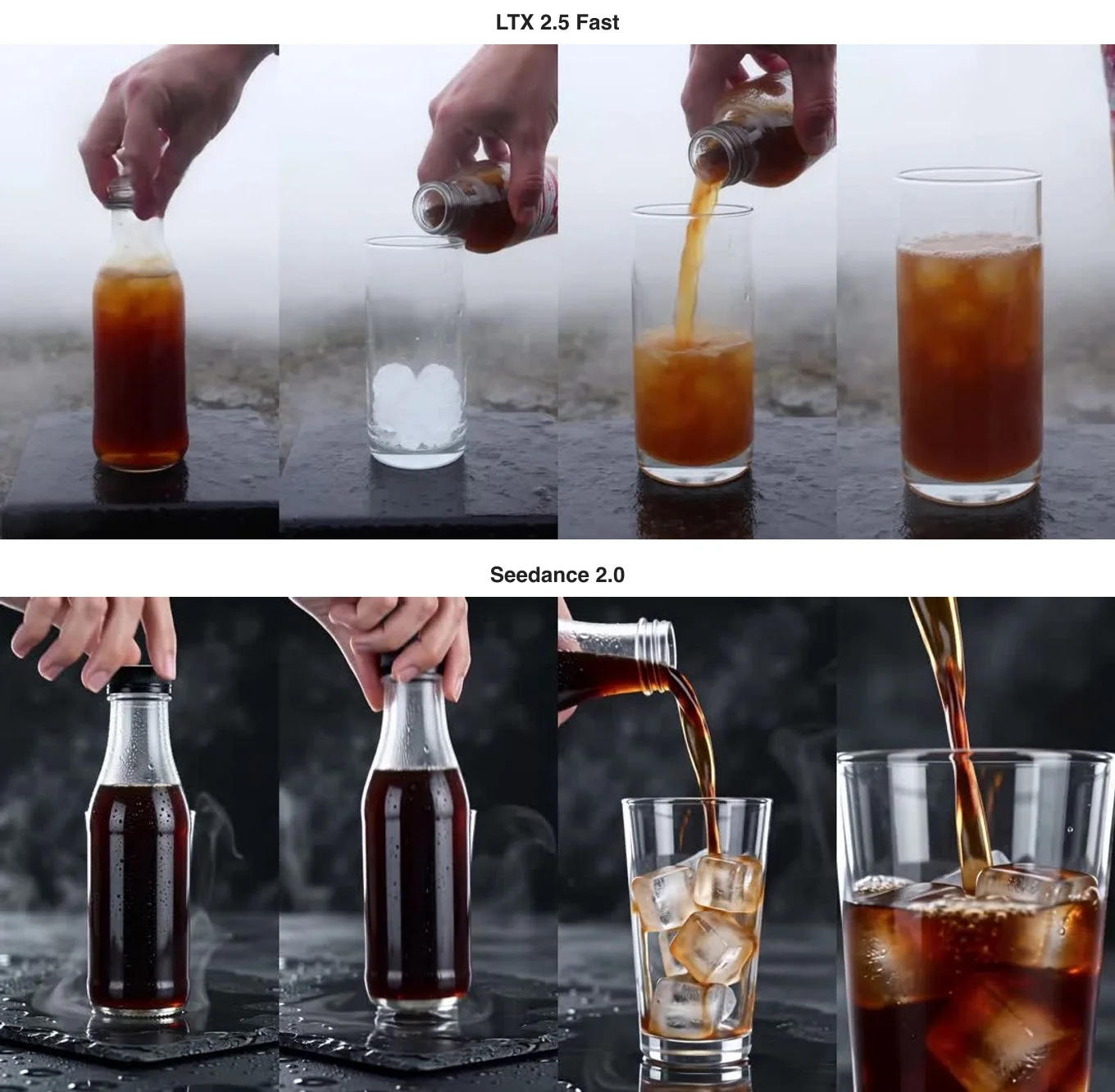
Seedance 2.0 delivers the dark slab, drifting mist, fingers twisting the cap and clear square ice cubes as the coffee pours, and the bottle stays the same from start to finish. It also added background music we did not ask for. LTX 2.5 Fast set the scene against pale fog instead of a dark backdrop, the ice looks like white lumps, and the bottle changes shape and gains a label between the first and second shot. The hiss and the pour are in both soundtracks. LTX 2.5 Fast took 64 seconds and Seedance 2.0 took 8.4 minutes.
For product shots a client will check frame by frame, Seedance 2.0 is the safer first try. LTX 2.5 Fast is still useful for quick drafts of the motion and timing before you spend on a slower model.
Photo to video: both kept the mug intact, only Seedance 2.0 added the sound we asked for
Starting from the same product photo, LTX 2.5 Fast and Seedance 2.0 both kept the mug intact, but only Seedance 2.0 produced the café sound in the prompt. The first frame is a green ceramic mug with an embossed leaf on an oak table, the same image we used in our Kling 4.0 vs Seedance 2.5 test. The prompt asks for rising steam, sunlight moving across the table and a slow orbit to the right, with café ambience and birds outside.

Neither model performed the orbit; both made a slow, slight drift instead, and both kept the leaf logo sharp. The difference is the audio. Seedance 2.0 has birdsong and distant chatter, while the LTX 2.5 Fast track is close to silent, about 17 dB quieter on average, with only faint crickets and wind. LTX 2.5 Pro, run on the same photo, moved the camera a little more but was just as quiet. LTX 2.5 Fast took 73 seconds and Seedance 2.0 took 7.5 minutes.
Only LTX 2.5 can do this: make a presenter speak your voice-over
LTX 2.5 Fast has an audio-to-video mode that Seedance 2.0 does not offer in this form: you send an audio file and, optionally, a picture, and the clip is built around your recording. We sent a 4.8-second voice line and an AI-generated portrait of a podcast host, with a short prompt about her talking warmly to camera.
The host keeps the face, hair and sweater from the portrait, her lips move with the words and her hands gesture in time with the speech. The soundtrack is our recording, unchanged; a transcript of the output matched the script word for word. The clip came back 4.79 seconds long, we were billed for 4.81 seconds, which is 39 cents, and it took 86 seconds. Seedance 2.0 accepts reference audio among its inputs, but we did not test lip sync with it here.
Only Seedance 2.0 can do this: steer a shot with many references
Seedance 2.0 takes much richer input than LTX 2.5. Besides a single first frame, it accepts a first and last frame together, up to nine reference images, a reference video, reference audio and web search, so one request can pin down a character, a product and a camera move. LTX 2.5 takes one first-frame image and no other visual reference. Seedance 2.0 also has a 480p tier at $0.092 per second for drafts. One limit to know: Seedance 2.0 rejects a raw photo of a real person; on our platform you register the photo in the asset library and pass it as an asset:// reference. We did not test real-person photos on LTX 2.5.
LTX 2.5 Fast or LTX 2.5 Pro?
On these prompts LTX 2.5 Pro was not a clear step up from LTX 2.5 Fast. In the dialogue, Pro framed the two faces closer and the cook is more expressive, but it also sat them at one table and spoke the same lines. On the mug photo, Pro moved the camera slightly more and was just as quiet. Pro took 65 and 104 seconds against 41 and 73 for Fast, and costs $0.108 per second at 720p against $0.081. Pro also stops at 1080p and 10 seconds and has no audio-to-video. LTX's own benchmark scores Pro lower on visible artifacts (next section), so it may pay off on longer, busier shots than ours.
What LTX's own benchmark says
LTX publishes its own comparison of LTX 2.5 against Seedance 2.0 and other video models, and it is worth reading with the source in mind. In its speed test, a 10-second image-to-video clip took 23.7 seconds through the LTX API at 1080p, against 196 seconds for Seedance 2.0 at 720p measured on a third-party hosting service, queue included. In a separate check of 98 text-to-video prompts graded automatically for visible artifacts per clip, where lower is better, LTX reports 0.28 for LTX 2.5 Pro, 0.39 for LTX 2.5 Fast and 0.60 for Seedance 2.0, and calls the results preliminary. These are vendor-published figures, not our tests. On our platform both models were slower than LTX reports, and the gap was wider: LTX 2.5 Fast finished 6 to 19 times sooner than Seedance 2.0.
What each clip costs and how long it takes
On apimodels.app, LTX 2.5 Fast costs $0.081 per second at 720p, $0.117 at 1080p and $0.171 at 1440p, which is 10% below LTX's own API prices; LTX 2.5 Pro costs $0.108 at 720p and $0.153 at 1080p. Seedance 2.0 costs $0.092 at 480p, $0.197 at 720p and $0.492 at 1080p, and is billed by tokens, so each of our 6-second 720p clips came to about $1.19 rather than exactly 6 × $0.197. Failed generations are not charged. Prices as of 20 November 2026.
A budget for 100 six-second clips at 720p: LTX 2.5 Fast comes to 100 × 6 × $0.081 = $48.60, and Seedance 2.0 to about 100 × $1.19 = $119. Waiting times in our test were 27 to 73 seconds per clip for LTX 2.5 Fast, 65 to 104 seconds for LTX 2.5 Pro and 7.5 to 8.8 minutes for Seedance 2.0, queue included.
When neither model is the right choice
- 4K output: neither model offers 4K through our API. LTX 2.5's open weights can render 4K on your own hardware; LTX lists GPUs with 80 GB of memory for the full model.
- More than 20 seconds in one clip: LTX 2.5 Fast stops at 20 seconds and Seedance 2.0 at 15. Seedance 2.5 goes to 30 seconds in one pass.
- The same named character across a series of clips: neither model is built to keep a character consistent between separate jobs; Kling 4.0 is designed for that.
How to run this comparison yourself
You can repeat this LTX 2.5 vs Seedance 2.0 test with one API key, and only the model name changes between the two requests.
- Create an API key in the apimodels.app console. New accounts get $1 of credit, enough for two 6-second LTX 2.5 Fast clips at 720p.
- Send the same request body to the video generation endpoint twice, once with the model ltx-2.5-fast and once with seedance-2.0, keeping resolution, length and aspect ratio the same.
- Poll the task until its state is completed, then download the file from resultUrls; result links are temporary, so save what you want to keep.
- Write prompts in the order things happen, put spoken lines in quotes and end with a sentence that starts with "Sound:" and lists what you want to hear. With LTX 2.5, state positions plainly and repeat the ones that matter.
{
  "model": "ltx-2.5-fast",
  "prompt": "Static medium shot inside a tiny ramen shop at night ... Sound: broth simmering, light rain on the window, their two voices.",
  "resolution": "720p",
  "duration": 6,
  "aspect_ratio": "16:9"
}
Change the model to seedance-2.0 and send it again. For image-to-video, add image_url for LTX 2.5 or first_frame_url for Seedance 2.0. For LTX 2.5 audio-to-video, add audio_url and leave out duration so the clip follows your recording. The LTX 2.5 API docs and the Seedance 2.0 API docs list every parameter.
Sources
- LTX, "Fastest AI Video Generation Models (2026)", ltx.io/blog/ai-video-model-speed-comparison, read 20 November 2026: the speed test and the artifact scores quoted above.
- LTX, "LTX Video Generation API Pricing", ltx.io/model/api/pricing, read 20 November 2026: LTX 2.5 Fast at $0.09, $0.13 and $0.19 per second for 720p, 1080p and 1440p, and LTX 2.5 Pro at $0.12 and $0.17 for 720p and 1080p.
- Seedance 2.0 inputs, resolutions, lengths and prices: our Seedance 2.0 model page and API docs, checked 20 November 2026.
- All clips, timings and charges: our own runs on apimodels.app on 20 November 2026.
Related models
- LTX 2.5 Fast: text, image and audio to video at 720p to 1440p, from $0.081 per second.
- LTX 2.5 Pro: the higher-quality LTX 2.5 tier at 720p and 1080p, from $0.108 per second.
- Seedance 2.0: full multimodal input with native sound, 480p to 1080p, from $0.092 per second.
- Seedance 2.0 Fast: the same inputs at 480p and 720p, from $0.071 per second.
- LTX-2.3: the previous LTX generation for text and image to video, from $0.02 per second.
For more side-by-side tests with sound, see Kling 4.0 vs Seedance 2.5 and LTX 2.5 vs MiniMax H3.
Preguntas frecuentes
Is LTX 2.5 better than Seedance 2.0?
It depends on what the shot needs. In our four-prompt test on 20 November 2026, Seedance 2.0 followed staging and product details more closely and gave image-to-video richer sound, while LTX 2.5 Fast finished each 6-second 720p clip in 27 to 73 seconds against 7.5 to 8.8 minutes and costs $0.081 per second against $0.197.
How much do LTX 2.5 and Seedance 2.0 cost per second?
On apimodels.app, LTX 2.5 Fast costs $0.081 per second at 720p, $0.117 at 1080p and $0.171 at 1440p, and LTX 2.5 Pro costs $0.108 and $0.153. Seedance 2.0 costs $0.092 at 480p, $0.197 at 720p and $0.492 at 1080p, billed by tokens. A 6-second 720p clip came to 48.6 cents on LTX 2.5 Fast and about $1.19 on Seedance 2.0, and failed jobs are free.
Which is faster, LTX 2.5 or Seedance 2.0?
LTX 2.5 is much faster. In our test, LTX 2.5 Fast returned 6-second 720p clips in 27 to 73 seconds and LTX 2.5 Pro in 65 to 104 seconds, while Seedance 2.0 took 7.5 to 8.8 minutes, queue included. LTX's own benchmark reports 23.7 seconds for a 10-second 1080p clip against 196 seconds for Seedance 2.0.
Can LTX 2.5 lip sync to my own audio?
Yes. LTX 2.5 Fast has an audio-to-video mode: send an audio file of at least 2 seconds and, optionally, a portrait, and the clip follows your recording. In our test a 4.8-second voice line produced a talking presenter in 86 seconds for 39 cents. LTX 2.5 Pro does not have this mode.
Can I use LTX 2.5 and Seedance 2.0 with one API key?
Yes. On apimodels.app both run through the same video endpoint with the same API key, and you switch between them by changing the model name, for example from ltx-2.5-fast to seedance-2.0. Requests are asynchronous: you create a task, then poll it or receive a callback.