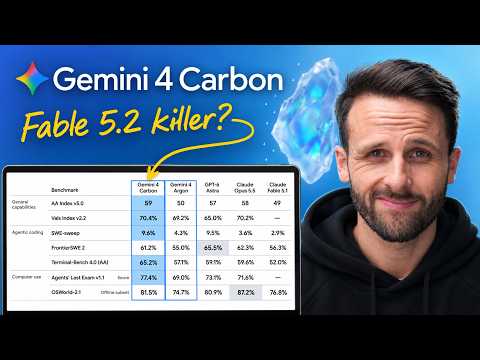
223+ prompts. 223 things people built, tested and compared with Gemini 4 Carbon in its first weeks: 3D scenes, games, simulations, films made from code, real bug fixes and research, and dozens of same-prompt tests against Claude Fable 5.2 and Gemini 4 Argon. Each is credited and linked to the original post, with the prompt where the creator published one.
Gemini 4 Carbon (model id gemini-4-carbon) is Google's deeper-reasoning Gemini 4 model. Google built it on Gemini 4 Argon and describes the difference as more thinking tokens per turn; it opened to vetted cybersecurity defenders on 28 October 2026 and to every paid Gemini API developer on 10 November. It reads text, images, video, audio and PDFs with a 1,048,576-token context and writes text, so the scenes, games and films here are code it wrote (Three.js, WebGL, Blender Python, CUDA C++, Web Audio), mostly run by Google's Antigravity agent. Of the 223 cases, 18 include the prompt as published, 33 only the creator's request and 172 no prompt; we never fill one in. In same-prompt tests creators usually found Claude Fable 5.2's results more polished and Carbon's cost a small fraction of Fable's. On apimodels.app Carbon costs $1.10 per 1M input tokens and $5.50 per 1M output through 30 November 2026 and $2.20 / $11 from 1 December, against Google's $2 / $10 and $4 / $20.
No prompt published. A side-by-side 3D test of Carbon's Arena version against Opus 5.5. The author says Carbon is seriously good at 3D and that no model is better at it.
Clip:
Video, 51 s. About 198K views and 2,010 likes on X as of 12 November 2026.
Compared with:
Claude Opus 5.5. Carbon is seriously good at 3D; no model beats it there.
Note:
Posted 28 Oct, before the 10 Nov API launch. Arena checkpoint. Subject (an airliner cutaway) is from the thumbnail.
Only the creator's request is public, not a full prompt: "rainbow jelly you can cut, nail and torch."
What it is:
Same prompt, rainbow jelly you can cut, nail and torch: Carbon took 32 minutes and $4.30, Opus 5.5 took 1h 20m and $14.00. The author found Carbon's jelly bright and sharp, throwing rainbow shadows, while Opus looked washed out.
Clip:
Video, 23 s. About 95K views and 969 likes on X as of 12 November 2026.
Numbers the author reported:
Gemini 4 Carbon - $4.30, 32 min · Opus 5.5 - $14.00, 1h 20m
Compared with:
Claude Opus 5.5. Carbon's jelly is bright and sharp; Opus looks washed out next to it.
Note:
Posted 29 Oct, before the 10 Nov API launch. The same Carbon result was later set against Fable 5.5 (2118415577299460432).
Voxel castle kingdom across Krypton, Carbon and Argon
Prompt not published
No prompt published. Three videos of the same voxel castle kingdom from Gemini 4 Krypton, Carbon and Argon, posted without commentary.
Clip:
Video, 45 s. About 102K views and 798 likes on X as of 12 November 2026.
Compared with:
Gemini 4 Krypton, Gemini 4 Argon. The verdict is only in the video.
Note:
Posted 9 Nov, before the 10 Nov API launch. Krypton is an unreleased internal checkpoint. Subject is from the thumbnails; the post text is only the model names.
Editing a founders' pitch clip, Fable 5.2 vs Carbon
Prompt not published
No prompt published. Both models got the same raw clip, the founders' first pitch two weeks into the company, and the same prompt; Fable 5.2's edit is on the left and Carbon's on the right.
Clip:
Video, 79 s. About 49K views and 713 likes on X as of 12 November 2026.
Compared with:
Claude Fable 5.2. The verdict is only in the video.
Note:
Posted by a video-editing startup; they ask viewers which edit they would ship.
Animated road cyclist, Carbon vs Argon vs GPT-6 Astra
Prompt not published
No prompt published. The Arena checkpoint of Carbon against Argon and GPT-6 Astra on the same animated cyclist. The author says Carbon is already better than Argon and Astra is starting to look dated.
Clip:
Video, 14 s. About 66K views and 586 likes on X as of 12 November 2026.
Compared with:
Gemini 4 Argon, GPT-6 Astra. Carbon is already better than Argon; Astra is starting to look outdated.
Note:
Posted 21 Oct, before the 10 Nov API launch. Arena checkpoint. Subject is from the thumbnail.
Chrome Dino remake across Carbon, Opus, Astra and Terra
Prompt not published
No prompt published. The author added Carbon to a Chrome Dino remake test: Carbon took 34m 41s and $5.20, Opus 5.5 38m 55s and $8.53, GPT-6 Astra 15m and $4.61, and GPT-6.1 Terra 4m and $0.17. Carbon even animated the pterodactyls' flight.
Clip:
Video, 27 s. About 113K views and 570 likes on X as of 12 November 2026.
Jelly DVD screensaver where Opus swapped in the Claude logo
Summary
Only the creator's request is public, not a full prompt: "the DVD screensaver, but out of jelly."
What it is:
Same prompt: the DVD screensaver, but made of jelly. Carbon used the DVD logo; Claude Opus 5.5 said the DVD logo is trademarked and used the Claude logo instead.
Clip:
Video, 25 s. About 26K views and 433 likes on X as of 12 November 2026.
Compared with:
Claude Opus 5.5. Carbon made the DVD logo; Opus cited the trademark and drew the Claude logo.
Only the creator's request is public, not a full prompt: "an animated cutaway of an airplane engine."
What it is:
Same prompt, one try each, for an animated cutaway of an airplane radial engine. All four models got the firing order right; the author rated Carbon the most polished, Opus 5.5 best on engineering detail, Argon the most atmospheric and GPT-6.1 Sol a clean blueprint with dim flames.
Clip:
Video, 11 s. About 88K views and 339 likes on X as of 12 November 2026.
Numbers the author reported:
one try each
Compared with:
Claude Opus 5.5, Gemini 4 Argon, GPT-6.1 Sol. Carbon is the most polished; Opus gets the engineering award.
Note:
Posted 31 Oct, before the 10 Nov API launch. Reposted in Chinese by @AndyL5cc.
Only the creator's request is public, not a full prompt: "9 tiny troublemakers, a dock full of tools, and one of them has to pop at the end."
What it is:
Same prompt, nine tiny troublemakers on a dock full of tools with one popping at the end: Carbon took 34 minutes and $4.10, Opus 5.5 took 1h 12m and $12.80. The author found Carbon brighter and shinier, and Opus more alive.
Clip:
Video, 29 s. About 42K views and 310 likes on X as of 12 November 2026.
Numbers the author reported:
Gemini 4 Carbon - $4.10, 34 min · Opus 5.5 - $12.80, 1h 12m
Compared with:
Claude Opus 5.5. Carbon is brighter and shinier; Opus feels more alive.
Animated road cyclist, Fable 5.5 vs Carbon in Arena
Prompt not published
No prompt published. Two unreleased models in the Arena, Claude Fable 5.5 (routed) and a Carbon checkpoint, on the same animated cyclist. For now the author sees Fable 5.5 slightly ahead.
Clip:
Video, 17 s. About 27K views and 266 likes on X as of 12 November 2026.
Compared with:
Claude Fable 5.5. Fable 5.5 edges out Carbon for now.
Note:
Posted 25 Oct, before the 10 Nov API launch. Arena checkpoints. Subject is from the thumbnail; the Carbon clip looks the same as in 2112916947923087364.
Stickman fight animation, DeepSeek V4.1 Flash vs Carbon
Prompt not published
No prompt published. A stickman fight animation from DeepSeek V4.1 Flash 1017 and from Carbon, posted to see how far the DeepSeek model gets; the author leaves the verdict to viewers.
Clip:
Video, 15 s. About 47K views and 212 likes on X as of 12 November 2026.
Compared with:
DeepSeek V4.1 Flash 1017. No need to say which is better; viewers can judge.
Note:
Posted 30 Oct, before the 10 Nov API launch. @xluchuan reposted the same video.
Night-city SUV scene, Fable 5.2 vs Carbon vs Argon
Prompt not published
No prompt published. Claude Fable 5.2, Carbon and Argon on the same scene. The author calls Fable 5.2 extraordinary and Carbon very close to it, and picks Carbon because it costs much less and runs faster.
Clip:
Video, 15 s. About 21K views and 196 likes on X as of 12 November 2026.
Compared with:
Claude Fable 5.2, Gemini 4 Argon. Fable 5.2 is extraordinary and Carbon very close; Carbon wins on cost and speed.
Note:
Subject (an SUV in front of a neon night city) is from the thumbnail.
Voxel Gru dodging rockets rebuilt from a movie clip
Prompt not published
No prompt published. Both models rebuilt Gru dodging rockets in 3D voxels from the same clip. Carbon cost $24.11 in API tokens and Fable 5.2 $53.34, but only Fable's Gru looks like the movie.
Clip:
Video, 21 s. About 34K views and 188 likes on X as of 12 November 2026.
Numbers the author reported:
Carbon cost $24.11 in API tokens · Fable 5.2 $53.34
Compared with:
Claude Fable 5.2. Only Fable's Gru looks like the movie.
Note:
Promotional post by the Atomic Chat team. @ai_ba_reza reposted the same video.
No prompt published. Carbon and Opus 5.5 each built the U.S. White House in 3D with Three.js. The author found both strong and could not pick a winner.
Clip:
Video, 57 s. About 21K views and 174 likes on X as of 12 November 2026.
Compared with:
Claude Opus 5.5. Both delivered strong outputs; no winner picked.
Pelican on a bicycle, Carbon vs Fable 5.5 in testing
Prompt not published
No prompt published. Pre-release Carbon and Fable 5.5 on the pelican-riding-a-bicycle test. Fable 5.5 went fully photorealistic while Carbon kept refining a comic style; the author finds Fable more striking but the styles too different to rank.
Clip:
Video, 8 s. About 54K views and 161 likes on X as of 12 November 2026.
Compared with:
Claude Fable 5.5. Fable 5.5 is more striking, but the styles differ too much to compare.
Note:
Posted 31 Oct, before the 10 Nov API launch. Both models were pre-release. @xiax0603 reposted it.
Rocket scene across Carbon, Fable 5.2, Opus 5.5 and Astra
Prompt not published
No prompt published. Carbon High got the same rocket-scene prompt as Fable 5.2, Opus 5.5 and GPT-6 Astra and took 35 minutes. The author places it near Opus 5.5 in quality, but more efficient.
Clip:
Video, 25 s. About 21K views and 153 likes on X as of 12 November 2026.
Numbers the author reported:
35 minutes
Compared with:
Claude Fable 5.2, Claude Opus 5.5, GPT-6 Astra. Somewhere near Opus 5.5 level, but more efficient.
Only the creator's request is public, not a full prompt: "rainbow jelly you can cut, nail and torch."
What it is:
The same rainbow-jelly prompt, now against Fable 5.5: Carbon took 32 minutes and $4.30, Fable 5.5 45 minutes and $48.50. Carbon's jelly stays cut; Fable's pulls itself back together after being cut, nailed and torched.
Clip:
Video, 37 s. About 28K views and 142 likes on X as of 12 November 2026.
Numbers the author reported:
Gemini 4 Carbon - $4.30, 32 min · Fable 5.5 - $48.50, 45 min
Compared with:
Claude Fable 5.5. Fable 5.5 won with jelly that grows back, at 11x the price.
Note:
Posted 5 Nov, before the 10 Nov API launch. Reuses the Carbon run from 2115891194383200515.
No prompt published. A side-by-side of Claude Fable 5.2 and Carbon, posted with no commentary.
Clip:
Video, 24 s. About 13K views and 139 likes on X as of 12 November 2026.
Compared with:
Claude Fable 5.2. The verdict is only in the video.
Note:
Subject (a sailing ship at sea) is from the thumbnail. Reposted by @Shannnu_18, @Stargridcompass and @qingzhoucloud; the last says Fable's water is far better.
Running tiger, Carbon vs Opus 5.5 vs Argon in Arena
Prompt not published
No prompt published. A Carbon checkpoint in the Arena against Opus 5.5 and Argon on the same scene; the author jokes that Carbon will make Opus 5.5 unemployed.
Clip:
Video, 17 s. About 12K views and 139 likes on X as of 12 November 2026.
Compared with:
Claude Opus 5.5, Gemini 4 Argon. Carbon will make Opus 5.5 unemployed.
Note:
Posted 5 Nov, before the 10 Nov API launch. Arena checkpoint. Subject (a running tiger) is from the thumbnail. An earlier post the same day (2118321845091160167) showed Carbon's clip alone and called it a win over Opus 5.5 in this Three.js test.
Floating island with a grazing cow, Opus 5.5 vs Carbon
Prompt not published
No prompt published. Same prompt, both one-shot: Opus 5.5 versus Carbon, again offered as proof that Carbon is not benchmark-tuned.
Clip:
Video, 26 s. About 12K views and 135 likes on X as of 12 November 2026.
Numbers the author reported:
both one-shot
Compared with:
Claude Opus 5.5. Proof that Carbon is not benchmark-tuned.
Note:
Posted 1 Nov, before the 10 Nov API launch. Subject is from the thumbnail (Opus labeled "opus 5.5 high"). The same Carbon island was later set against Fable 5.2 (2120616222140125635).
No prompt published. A stickman fight from Carbon and from Fable 5.2. The author finds Carbon much better than earlier Gemini models but still nowhere near Fable 5.2, or even Opus 5.5, for animation; it was the only model so far that destroyed and used part of the stage in the fight.
Clip:
Video, 15 s. About 23K views and 135 likes on X as of 12 November 2026.
Compared with:
Claude Fable 5.2. Still nowhere near Fable 5.2 (or even Opus 5.5) for animation.
No prompt published. Same prompt for Fable 5.2 and Carbon. The author says Carbon's run was 103x lower in cost and 5.3x faster, but Claude's graphical fidelity is in another galaxy; still the best Gemini model the author has seen.
Clip:
Video, 52 s. About 14K views and 126 likes on X as of 12 November 2026.
Numbers the author reported:
103x · 5.3x faster
Compared with:
Claude Fable 5.2. Claude's graphical fidelity is in another galaxy.
Note:
Subject (a ride-on mower at an English manor called Ashworth Hall) is from the thumbnail.
No prompt published. Who draws the best T-rex on a bike: Carbon built a volcano valley with a glowing sun, a waterfall and mushrooms; Opus 5.5 drew the most expressive T-rex; Argon a purple sunset with legs bending the wrong way; GPT-6 Astra a scarf with little contrast. The author picks Carbon, with Opus a close second.
Clip:
Video, 12 s. About 27K views and 122 likes on X as of 12 November 2026.
Compared with:
Claude Opus 5.5, Gemini 4 Argon, GPT-6 Astra. Carbon wins, Opus is a close second.
Only the creator's request is public, not a full prompt: "a working inline-4 engine. pistons, rods, crank, oil in the pan."
What it is:
Same prompt for Claude Fable 5.2, GPT-6 Astra, Carbon and Argon: a working inline-4 engine with pistons, rods, crank and oil in the pan. The author did not touch the outputs and does not reveal which cost the most.
Clip:
Video, 12 s. About 15K views and 115 likes on X as of 12 November 2026.
Compared with:
Claude Fable 5.2, GPT-6 Astra, Gemini 4 Argon. The verdict is only in the video.
No prompt published. After Opus 5.5 lost to Carbon on the Sisyphus Shark Blender prompt, the author also ran Claude Fable 5.2 on XHigh: Carbon 1h 29m and $8.82, Opus 5.5 1h 10m and $15.66, Fable 5.2 39m and $19.00. Fable finished twice as fast at 2.2x Carbon's cost.
Clip:
Video, 10 s. About 30K views and 114 likes on X as of 12 November 2026.
Only the creator's request is public, not a full prompt: "Dinosaur obstacle run"
What it is:
Same prompt, a dinosaur obstacle run, scored by the author: Fable 5.2 9.6/10 in 45m 12s, Opus 5.5 8.6/10 in 1h 12m 30s, Carbon 8.3/10 in 1h 20m 15s, GPT-6 Astra 7.6/10 in 1h 35m 40s.
Clip:
Video, 27 s. About 11K views and 111 likes on X as of 12 November 2026.
Only the creator's request is public, not a full prompt: "Voxel Floating Kingdom"
What it is:
Same prompt (Voxel Floating Kingdom) on high reasoning: Opus 5.5 took 1h 15m and about $12, Carbon 1h 15m and about $0.95. The author thinks Carbon looks like the better deal at that difference and asks which did better.
Clip:
Video, 58 s. About 6,033 views and 105 likes on X as of 12 November 2026.
Numbers the author reported:
Opus 5.5: high reasoning, 1h 15m, ~$12 · Gemini 4 Carbon: high reasoning, 1h 15m, ~$0.95
Compared with:
Claude Opus 5.5. At that price difference, Carbon looks like the better deal.
Note:
Same Carbon run as 2120245676760052149 (made in Cursor). @laopai1990 reposted it in Chinese.
Running tiger, Carbon vs Gemini 4 Hydrogen in Arena
Prompt not published
No prompt published. Gemini 4 Hydrogen against Carbon in the Arena on the same scene; the author says the comparison shows how good Hydrogen is.
Clip:
Video, 18 s. About 5,563 views and 100 likes on X as of 12 November 2026.
Compared with:
Gemini 4 Hydrogen. Shows how good Hydrogen is.
Note:
Posted 6 Nov, before the 10 Nov API launch. Arena checkpoints. Subject (a running tiger) is from the thumbnail; @xulijian1994 reposted it, preferring Hydrogen's motion but praising Carbon's sun and lighting.
Only the creator's request is public, not a full prompt: "a rainbow jelly pumpkin you can carve and light up."
What it is:
Same prompt, a rainbow jelly pumpkin you can carve and light up: Carbon took 31 minutes and $3.20, Opus 5.5 1h 50m and $28.73. Carbon turned it into a full Halloween night with stars, fireflies, a glowing face and candy you can feed it, while the author could barely see the face on Opus's pumpkin.
Clip:
Video, 26 s. About 6,582 views and 94 likes on X as of 12 November 2026.
Numbers the author reported:
Gemini 4 Carbon - $3.20, 31 min · Opus 5.5 - $28.73, 1h 50m
Compared with:
Claude Opus 5.5. Carbon built a full Halloween night; Opus's pumpkin looks washed out.
Only the creator's request is public, not a full prompt: "draw a sunset over a city in about 10 seconds, watch the color flood in, and park an old American muscle car in front."
What it is:
Same prompt, one try each: draw a sunset over a city in about 10 seconds, let the color flood in, and park an old American muscle car in front. The author calls Carbon's moody night city the most cinematic, Opus 5.5's skyline the most detailed, Argon's car nicely drawn and GPT-6 Astra's colors the palest.
Clip:
Video, 11 s. About 23K views and 88 likes on X as of 12 November 2026.
Numbers the author reported:
one try each
Compared with:
Claude Opus 5.5, Gemini 4 Argon, GPT-6 Astra. Carbon is the most cinematic; Opus has the most detail.
Note:
Posted 3 Nov, before the 10 Nov API launch. All four models painted the car teal.
Tropical-island first-person shooter, Fable 5.2 vs Carbon
Summary
Only the creator's request is public, not a full prompt: "build a hyper-realistic first person shooter set on a tropical island"
What it is:
Same prompt for both: a hyper-realistic first-person shooter set on a tropical island. Fable 5.2 is on top and Carbon at the bottom; the author leaves the call to viewers.
Clip:
Video, 15 s. About 10K views and 87 likes on X as of 12 November 2026.
Compared with:
Claude Fable 5.2. The verdict is only in the video.
No prompt published. Same prompt, same jelly, same nails: Claude Fable 5.5 took 52 minutes and $46.00, Carbon 24 minutes and $1.50. Fable hid raspberries inside and added a score and a jelly pulse meter; Carbon gave a red block and a hammer.
Clip:
Video, 19 s. About 23K views and 87 likes on X as of 12 November 2026.
Numbers the author reported:
Claude Fable 5.5 - $46.00, 52 min · Gemini Carbon 4 - $1.50, 24 min
Compared with:
Claude Fable 5.5. Fable 5.5 nailed it: the best jelly game the author has seen.
Running zebra across Carbon, Fable 5.5, Opus 5.5 and Argon
Prompt not published
No prompt published. Checkpoints of Carbon and Fable 5.5 next to the released Opus 5.5 and Argon; the author sees a clear gap between the upcoming checkpoints and the existing models.
Clip:
Video, 17 s. About 8,951 views and 77 likes on X as of 12 November 2026.
Compared with:
Claude Fable 5.5, Claude Opus 5.5, Gemini 4 Argon. A clear gap between the upcoming checkpoints and Opus 5.5 and Argon.
Note:
Posted 4 Nov, before the 10 Nov API launch. Arena checkpoints. Subject (a running zebra) is from the thumbnail.
Animated SVG octopus cooking breakfast with eight tentacles
Summary
Only the creator's request is public, not a full prompt: "an animated SVG of an octopus making breakfast with every single tentacle busy at once."
What it is:
Same prompt, one try: an animated SVG of an octopus making breakfast with every tentacle busy. The author ranks Carbon first for texture, warm lighting and mood, with Argon a close second for character design; all four models added the optional cat gag.
Clip:
Video, 13 s. About 8,711 views and 71 likes on X as of 12 November 2026.
Numbers the author reported:
one try
Compared with:
Gemini 4 Argon, Claude Opus 5.5, GPT-6 Astra. Carbon takes #1, Argon is a close second.
Only the creator's request is public, not a full prompt: "a running V8 you can X-ray, cut in half, explode and lay out part by part."
What it is:
Round 3 of the author's Carbon vs Opus 5.5 series, one shot each: a running V8 you can X-ray, cut in half, explode and lay out part by part. After a motorcycle and a watch, the author says Carbon swept all three rounds.
Clip:
Video, 29 s. About 3,257 views and 70 likes on X as of 12 November 2026.
No prompt published. Fable 5.2, Carbon, Opus 5.5 and GPT-6 Astra each built a '90s arcade fighter from the same prompt: Fable 5.2 $22 / 9 min, Carbon $9 / 10 min, Opus 5.5 $34 / 21 min, GPT-6 Astra $50 / 16 min.
Clip:
Video, 15 s. About 14K views and 68 likes on X as of 12 November 2026.
Numbers the author reported:
Fable 5.2 → $22 / 9 min · Gemini 4 Carbon → $9 / 10 min · Opus 5.5 → $34 / 21 min · GPT-6 Astra → $50 / 16 min
Compared with:
Claude Fable 5.2, Claude Opus 5.5, GPT-6 Astra. The verdict is only in the video.
Note:
Promotional post by Runable, where all four models are available.
Tiger, eagle and sports car, Carbon vs Argon in Arena
Prompt not published
No prompt published. A Carbon checkpoint against Argon in the Arena; the author sees a huge difference between the two.
Clip:
Video, 15 s. About 3,345 views and 64 likes on X as of 12 November 2026.
Compared with:
Gemini 4 Argon. There is a huge difference between Carbon and Argon.
Note:
Posted 8 Nov, before the 10 Nov API launch. Arena checkpoint. Subjects (a running tiger, a flying eagle and an orange sports car) are from the thumbnail.
No prompt published. With the same prompt, Claude Fable 5.2 cost $18 and Carbon $6.2; the author says time and results were about the same and asks what the extra $11.8 buys.
Clip:
Video, null s. About 17K views and 63 likes on X as of 12 November 2026.
Only the creator's request is public, not a full prompt: "a mechanical watch you can X-ray, cut in half, explode and lay out part by part."
What it is:
Round 2 against Opus 5.5, one shot each: a mechanical watch you can X-ray, cut in half, explode and lay out part by part. Carbon's balance wheel ticks and every gear turns at the right speed.
Clip:
Video, 30 s. About 2,551 views and 57 likes on X as of 12 November 2026.
Numbers the author reported:
2 for 2
Compared with:
Claude Opus 5.5. 2 for 2; Carbon is the 3D king right now.
Sisyphus Shark scene in Blender, Carbon vs Opus 5.5
Summary
Only the creator's request is public, not a full prompt: "What will Sisyphus Shark look like in Hungry Shark:World"
What it is:
The same Blender Python prompt on Carbon (High) and Claude Opus 5.5 (XHigh): what the Sisyphus Shark would look like in Hungry Shark World. Carbon took 1h 29m and $8.82, Opus 5.5 1h 10m and $15.66, counting coding only.
Clip:
Video, 10 s. About 6,603 views and 48 likes on X as of 12 November 2026.
Sewing machine that X-rays, explodes and makes a stitch
Summary
Only the creator's request is public, not a full prompt: "a sewing machine you can X-ray, cut in half, explode and lay out part by part. And it has to actually make a stitch."
What it is:
Round 4 against Opus 5.5, one shot each: a sewing machine you can X-ray, cut in half, explode and lay out, and it has to make a stitch. The author says Carbon made a great steel machine and is now 4 for 4.
Clip:
Video, 32 s. About 3,745 views and 47 likes on X as of 12 November 2026.
No prompt published. The author's animated peacock SVG test on Fable 5.2 and Carbon, with viewers asked to pick. In the quoted earlier post, the author called Carbon's peacock genuinely impressive in its feathers, bicycle and motion.
Clip:
Video, 10 s. About 2,011 views and 46 likes on X as of 12 November 2026.
Compared with:
Claude Fable 5.2. The verdict is only in the video.
3D soda animation in pure front-end code, Fable 5.5 vs Carbon
Prompt not published
No prompt published. A realistic 3D cola-soda animation in pure front-end code from Fable 5.5 and Carbon. The author finds Fable 5.5 more realistic, but Carbon's frosty dripping effect stands out.
Clip:
Video, 8 s. About 3,143 views and 38 likes on X as of 12 November 2026.
Compared with:
Claude Fable 5.5. Fable 5.5 is more realistic, but Carbon's frosty drips are striking.
No prompt published. A ruined-robot animation from Carbon and Fable 5.2 side by side. The poster thinks Fable 5.2 has dropped noticeably from Fable 5.5 but is still a bit stronger than Carbon.
Clip:
Video, 43 s. About 11K views and 36 likes on X as of 12 November 2026.
Compared with:
Claude Fable 5.2. Fable 5.2 is still a bit stronger than Carbon.
Note:
Carbon output by @itsPaulAi (credited in the post); side-by-side posted by @leo114119, whose post is the url here. Reposted by @Smlay_ero (who adds that Carbon's cost is far lower) and @xiax0603.
Pelican on a bicycle across Krypton, Carbon and Argon
Prompt not published
No prompt published. Gemini 4 Krypton, a new internal Google checkpoint, against Carbon and Argon; the author notes early reports that Krypton beats Carbon.
Clip:
Video, 12 s. About 2,314 views and 36 likes on X as of 12 November 2026.
Compared with:
Gemini 4 Krypton, Gemini 4 Argon. Early reports say Krypton is better than Carbon.
Note:
Posted 9 Nov, before the 10 Nov API launch. Subject is from the thumbnail and @leo114119's repost of the same video.
Robot that transforms into a car, Carbon vs Fable 5.1
Summary
Only the creator's request is public, not a full prompt: "a robot that transforms into a car, and you can X-ray it, cut it in half, explode it and lay it out part by part."
What it is:
Round 5, now against Claude Fable 5.1, one shot each: a robot that transforms into a car and can be X-rayed, cut in half, exploded and laid out. Carbon took 55 minutes and $11.2, Fable 1h10m and $7.34; the author left the pick to viewers.
Clip:
Video, 39 s. About 2,944 views and 34 likes on X as of 12 November 2026.
Numbers the author reported:
Carbon: 55m, $11.2 · Fable: 1h10m, $7.34
Compared with:
Claude Fable 5.1. The verdict is only in the video.
Note:
Posted 6 Nov, before the 10 Nov API launch. Rounds 2 to 4 of this series are separate cases.
No prompt published. Fable 5.2 and Carbon each generated this snow globe in a single shot, with no external assets and everything rendered in code in one HTML file. The author found it hard to decide.
Clip:
Video, 42 s. About 1,821 views and 33 likes on X as of 12 November 2026.
Shanghai Bund scene across Carbon, Argon, Fable 5.2 and Opus 5.5
Prompt not published
No prompt published. Same prompt, four models: Carbon took 41m 20s and 178k tokens (delicate river reflections, quiet and realistic), Argon 52m 41s and 162k, Fable 5.2 27m 28s and 149k (vivid street neon), Opus 5.5 12m 31s and 76k (fastest, clean reflections).
Clip:
Video, 12 s. About 11K views and 30 likes on X as of 12 November 2026.
Black hole simulation, Carbon vs Gemini 4 Hydrogen
Prompt not published
No prompt published. A black hole simulation demo from Carbon and from Gemini 4 Hydrogen (the Flash model), shared before both were expected to launch.
Clip:
Video, 59 s. About 3,209 views and 24 likes on X as of 12 November 2026.
Compared with:
Gemini 4 Hydrogen. The verdict is only in the video.
Note:
Posted 7 Nov, before the 10 Nov API launch. Made by "Inmersion" as credited in the post (X handle not given), shared by @leo114119.
No prompt published. A Bentley side view in Three.js from Carbon and Claude Opus 5.5. The author says Carbon finally outperformed Opus 5.5 and broke its streak, with higher quality at half the cost.
Clip:
Video, 16 s. About 1,177 views and 23 likes on X as of 12 November 2026.
Numbers the author reported:
Half the cost
Compared with:
Claude Opus 5.5. Carbon finally outperformed Opus 5.5: higher quality at half the cost.
Bicycle riding a pelican through the sky, Carbon vs Fable 5.5
Prompt not published
No prompt published. Carbon and Fable 5.5 on a bicycle riding a pelican through the sky. The poster finds Fable 5.5's pelican and overall animation better and Carbon's bicycle a bit more detailed, so Carbon loses this one.
Clip:
Video, 20 s. About 3,041 views and 22 likes on X as of 12 November 2026.
Compared with:
Claude Fable 5.5. Fable 5.5 wins on the pelican and overall animation.
Note:
Posted 5 Nov, before the 10 Nov API launch. Carbon output by @Haleeeemahh (credited in the post); comparison posted by @leo114119, whose post is the url here.
Rebuilding Anthropic's Fable 5.2 launch demo as a web page
Prompt not published
No prompt published. The author gave Carbon the video Anthropic had posted of a Fable 5.2 creation and asked it to rebuild it as a web page; the result was good. Takeaways: a big step up from earlier Gemini models, taste still behind Fable and Opus, and it needs detailed prompts or reference examples rather than one-line wishes.
Clip:
Video, 15 s. About 4,822 views and 14 likes on X as of 12 November 2026.
Compared with:
Claude Fable 5.2. Big progress, but taste is still behind Fable and Opus.
Motor and generator demo, Carbon vs a Fable 5.2 run
Prompt not published
No prompt published. A group member ran the same prompt on Fable 5.2 as the author's three-hour Carbon motor-and-generator demo. The author says Fable's result looks like a work of art and that a big gap remains between Carbon and Fable 5.2.
Clip:
Video, 34 s. About 2,353 views and 12 likes on X as of 12 November 2026.
Compared with:
Claude Fable 5.2. Fable's output looks like art; a big gap remains.
Note:
Carbon side is the author's own run (2120403057364369472); the Fable 5.2 run is by an unnamed group member.
Night-Tokyo drone coin game across Carbon, Fable and Opus
Summary
Only the creator's request is public, not a full prompt: "夜の東京をドローンで飛んで、60秒でネオンコインを集める"
What it is:
The same one-line instruction for a 3D game: fly a drone over night Tokyo and collect neon coins in 60 seconds. Carbon took 24m 28s and 2,753 lines, Fable 9m 42s and 833 lines, Opus 5.5 4m 13s and 793 lines; only Carbon added Tokyo Tower, a radar, combos and rankings unasked.
Clip:
Video, 35 s. About 396 views and 12 likes on X as of 12 November 2026.
No prompt published. Claude Fable 5.2 and Carbon each built a small interactive digital garden, from custom colors and lighting to picking leaves one by one.
Clip:
Video, 77 s. About 366 views and 12 likes on X as of 12 November 2026.
Compared with:
Claude Fable 5.2. The verdict is only in the video.
Note:
Promotional post by HIX AI; both runs were made on their platform.
World music tour animated video, Carbon vs Fable 5.2
Prompt not published
No prompt published. Two long videos, one by Carbon and one by Fable 5.2, posted as a guessing game; the author says the difference is obvious enough that nobody should guess wrong.
Clip:
Video, 218 s. About 2,105 views and 8 likes on X as of 12 November 2026.
Compared with:
Claude Fable 5.2. The difference is obvious.
Note:
Subject (an animated world-music "passport" tour through Japan, Spain, Italy and Scotland; 218 s and 284 s) is from frames of the videos; the post does not say which video is which.
Ramen stall in the rain in Blender across three models
Summary
Only the creator's request is public, not a full prompt: "a ramen stall in the rain, with a moped riding through."
What it is:
Same prompt, one run each in the same Blender on High: a ramen stall in the rain with a moped riding through. Carbon (in Cursor) made the cleanest stall for $2.78 but took about 4 hours of wall clock, much of it provider errors; Fable 5.2 had mirror puddles but a dark stall ($18.60 est., 39m); Opus 5.5 had real steam ($7.54 est., 27m).
Clip:
Video, 15 s. About 287 views and 5 likes on X as of 12 November 2026.
Tool:
Cursor
Numbers the author reported:
$2.78 in Cursor credits · ~4h wall clock · $18.60 est. · 39m · $7.54 est. · 27m
Compared with:
Claude Fable 5.2, Claude Opus 5.5. Carbon cost the least and won the stall.
Note:
Carbon ran in Cursor; Fable and Opus ran in Claude Code. All Python, procedural materials only.
15 Antigravity projects, from a GTA-style game to an ink page
制作一个高还原度的cs游戏,建模精美,玩法高度还原,地图高度还原dust2
What it is:
Carbon High in Google Antigravity (Turbo mode, Google AI Ultra) built 15 projects, including a GTA-style game, CS Dust2, a Minecraft sunset, promo films, a course-selection redesign, a holo card opener, a video editor, a rabies explainer and an ink web page. The verdict: strong at long tasks, average taste, and one-line wishes rarely work.
Where:
YouTube video, 2026-11-11
Tool:
Google Antigravity, Carbon High, Turbo mode
Numbers the author reported:
GTA-style game: 34 min · CS: 36 min · self-intro: 43 min · promo: 2 rounds, ~45 and ~56 min · Minecraft rerun: 32 min in one pass (Argon took 6 rounds, ~2 h 18 min) · course system: 22 min · holo cards: 48 min · video editor: 1 h 13 min · headphone site: 1 h 49 min · rabies explainer: ~1 h 33 min (2 rounds) · ink page: ~42 min · India-city short: ~1 h 10 min · after ~5 h and 17 sessions: 75% of the 5-hour quota and 78% of the weekly quota left
Compared with:
Argon, Opus 5.5. Strong at long tasks with average taste; one-line wishes rarely work.
Note:
All prompts are published verbatim in each folder's PROMPT.md; the one shown is for the CS project. Two items (01_gta6, 05_minecraft-sunset) were first run on Argon and redone on Carbon; the Opus 5.5 comparison is the author's earlier GTA build.
Three hard builds with full cost receipts across four models
Prompt not published
No prompt published. Three hard builds, one run each: a pixel-for-pixel clone of agrumeafarm.it, a 30-45 s launch film for Motion, and a browser 1940s dogfight flight sim with a Blender coastline (plus a bonus Eiffel Tower build). Carbon in Antigravity cost the least in total of the four models but ranked 4th, 4th and 3rd.
Where:
YouTube video, 2026-11-11
Tool:
Antigravity
Numbers the author reported:
Carbon $27.68 / 269 min · Fable $883.30 / 1,024 min · Opus $181.29 / 564 min · Astra $126.43 / 181 min (API-equivalent) · Carbon ranked 4th, 4th and 3rd
Compared with:
Fable 5.2, Opus 5.5, GPT-6 Astra. A clear step up from Argon that costs much less, but behind Opus and Fable; the author still prefers Opus 5.5.
Note:
Astra ran in Codex, Opus and Fable in Claude Code. Prompts are published in full on the blog (each well over 600 characters).
No prompt published. KingBench 4 scored six app builds, including a Pokemon Red build and a 3D room designer: Carbon placed 8th of 13 models at 53.3%, while Fable 5.2 was first at 70%. Every one of Carbon's six final messages claimed at least one feature the reviewer found broken or overstated, because Carbon only tested via its own tests and never clicked through the apps.
Where:
YouTube video, 2026-11-11
Numbers the author reported:
Carbon 32/60 (53.3%), 8th of 13 models · Fable 5.2 first at 70% · Argon 54.3% on the same builds · Pokemon Red 8.2 vs 8.4 · 3D room designer 6.3 vs 9.2 · Carbon's six builds about $23 and 76M tokens vs Fable 212M tokens and about $222
Compared with:
Fable 5.2, Argon. Fable when it has to work; Carbon for fast first drafts that cost little and that you check yourself.
No prompt published. Carbon and Fable 5.2 took on five builds: a desktop OS, a browser game, a launch ad, tank AIs and Split or Steal. Carbon cost about $3.40 in total versus about $29.50 for Fable, but broke the tank rules sheet twice.
Where:
YouTube video, 2026-11-11
Numbers the author reported:
Carbon about $3.40 vs Fable about $29.50 in total · Carbon broke the tank rules sheet twice
Compared with:
Fable 5.2. Fable for one big, careful build; Carbon when you need many builds and spend matters.
Neon arcade racer, night-market voxel diorama and channel intro
Excerpt
Make a browser arcade racer "Neon Night Racer": a night highway, a neon synthwave city, the 80s. The main thing is the feeling of insane speed at night, when one mistake means a crash. Imagine it's a game for a real arcade cabinet: you want to play it again. Surprise me. Music and sounds in code, no external files. …
Carbon in Antigravity (High) and Fable 5.2 in Claude Code 2.1.321 (High) each built a neon arcade racer, a Shenzhen night-market voxel diorama and a channel intro made in OpenMontage. Carbon won the race and the diorama (judged blind) for a 2:1 result; Fable won the intro, which is now the channel's real intro.
Where:
GitHub, 2026-11-11
Tool:
Antigravity (High)
Numbers the author reported:
Carbon ~2 h 07 min, $7.54 (up to $12.36 counting the Flash browser helper) · Fable ~2 h 05 min, $41.71 · paid image/video generation capped at $1 · Carbon's first race attempt broke 3 times on network timeouts ($0.68, excluded) · 2:1 to Carbon
Compared with:
Fable 5.2. Carbon won the race and the diorama (judged blind); Fable won the intro.
Note:
Prompts were written in Russian; the quoted race prompt is the author's English translation (all translations in prompts/en/). Fable used a headless Playwright browser. A Russian video is promised.
No prompt published. With identical prompts and no intervention, Carbon and Fable 5.2 each coded a horror game, an EV landing page and a walkable 3D loft in their own folders. Each round is worth one point, then time and API cost are compared.
Where:
YouTube video, 2026-11-11
Compared with:
Fable 5.2. The verdict is only in the video.
Note:
Russian-language video; results only in the video.
Korean learning app, automation dashboard, animated explainer: Carbon vs Opus 5.5
Prompt not published
No prompt published. Opus in Claude Code and Carbon in Antigravity, both at High, did the same 3 jobs: a Korean learning app, an automation dashboard and a code-made animated explainer. Time and API cost are shown for every run at today's and December prices, with a blind round for the explainer.
Six projects in the Antigravity CLI with real API cost
Prompt not published
No prompt published. Six projects built with Carbon in the Antigravity CLI, with real API cost: a watch landing page, a full-stack app with login and AI, a 3D kart race, a 3D delivery game, a 3D tower defense and a browser music studio.
Where:
YouTube video, 2026-11-11
Tool:
Antigravity CLI
Numbers the author reported:
prompts gist: one file, 12,210 characters
Note:
Portuguese-language video. The prompts are in the linked gist (one file, 12,210 characters); results and costs are only in the video.
Ultra-realistic Minecraft-style game in Three.js after 5 hours of agents
Prompt not published
No prompt published. Agents ran for 5 hours to build an ultra-realistic Minecraft-style game in Three.js, and the video also shows real pull requests on production code. It used Antigravity and Cursor, and compares latency across a third-party API, Vertex and AI Studio.
Where:
YouTube video, 2026-11-11
Tool:
Antigravity (prompts shown), Cursor
Numbers the author reported:
5 hours of agents
Note:
Portuguese-language video. Prompts are shown in the video; results only in the video.
Nine complex builds in the Antigravity CLI at medium effort
Prompt not published
No prompt published. Carbon in the Antigravity CLI (medium) took on nine complex builds: a pixel cloud castle, a native macOS music player, a Unity 3D archer, a Godot 4 Jurassic sandbox, a floor plan to 3D room, the Sagrada Familia, an AAA shooter, a starship and a black hole eating a star.
Where:
YouTube video, 2026-11-11
Tool:
Antigravity CLI (medium)
Compared with:
Fable 5.2, Opus 5.5. The verdict is only in the video.
Note:
Same tasks were run on Claude Fable 5.2 and Opus 5.5; results only in the video.
Carbon vs Argon: novel writing, front-end code, SVG, animated short
Prompt not published
No prompt published. Carbon and Argon compared on novel writing, front-end code, SVG and an animated short. Writing and animation improved, the front-end test flopped, and a peacock SVG used a lot of tokens.
Where:
YouTube video, 2026-11-11
Compared with:
Argon. Writing and animation improved; front-end flopped; the peacock SVG cost a lot of tokens.
Carbon vs Argon across five dimensions, including security
Prompt not published
No prompt published. Carbon and Argon compared on front-end, back-end, writing, 3D and security: front-end was a tie, Argon took back-end and the security deliverables, and Carbon took writing (slightly) and 3D. All five of Carbon's first attempts errored, and failed AI Studio previews were retested on a VPS.
Where:
Bilibili video, 2026-11-11
Numbers the author reported:
front-end: Carbon 24 min vs Argon 18 · writing: Argon 2.25x faster · security: both found 5/5 bugs · all five Carbon first attempts errored
Compared with:
Argon. Front-end tie; back-end and security deliverables to Argon; writing (slightly) and 3D to Carbon.
Note:
On back-end, Carbon's output was truncated and would not run; on security, Carbon refused a PoC and its patch was truncated.
Constrained sentences, archery SVG and browser OS UI: Carbon vs Fable 5.2
Prompt not published
No prompt published. Carbon and Fable 5.2 compared on long constrained sentences, a compound-bow archery SVG and a browser OS UI. Carbon's archery SVG beat the rival's, its browser OS UI was ordinary, and the whole Carbon test cost ¥73.
Where:
Bilibili video, 2026-11-11
Numbers the author reported:
whole Carbon test cost ¥73
Compared with:
Fable 5.2. The archery SVG beat the rival; the browser OS UI was ordinary.
Bench V3: seven tests at max reasoning through a third-party API
Prompt not published
No prompt published. Seven tests at max reasoning through a third-party API: an Elden Ring Margit boss fight, a Cybertruck showroom, a Banana Drama animated SVG, a Comic Book Studio, a Three.js Stone Labs site remake, an NBA 2K clone and a Pengi game trailer. Carbon averaged 83, just behind Claude Opus, and the whole benchmark cost $13.90.
Where:
YouTube video, 2026-11-10
Tool:
Third-party API
Numbers the author reported:
average 83 · whole benchmark $13.90
Compared with:
Claude Opus. Averaged 83, just behind Claude Opus.
Note:
Banana Drama had a real code bug, and the site remake had reproducible rendering glitches.
Same five tests as Fable 5.2, plus a ship simulator
Prompt not published
No prompt published. Carbon ran the same five tests the author had given Fable 5.2 the day before (3D room from photos, battle royale, stone age to future civilization, water simulation, game trailer), plus a ship simulator. Results are shown side by side with the earlier Fable video.
Where:
YouTube video, 2026-11-10
Compared with:
Fable 5.2. The verdict is only in the video.
Note:
Turkish-language video; verdict only in the video.
Duolingo-style app, automation plan, animated explainer: Carbon vs Fable 5.2
Prompt not published
No prompt published. Fable in Claude Code and Carbon in Antigravity, one shot each, did the same 3 jobs: a Duolingo-style app, an agency automation plan and a 30 s animated explainer. Time and API cost are on screen, with a blind round for the explainer.
Live vibe check: Notion backlog, Blender room rebuild, UI suite
Prompt not published
No prompt published. In a livestream, Carbon worked a frozen ~100-ticket Notion backlog, rebuilt the podcast room in Blender/Three.js/Unity over ~24 h (repeatedly crashing a Mac Studio), built a UI suite and took a Miami travel test, among other tasks. As reported by BigGo, it finished 15-16 tickets in ~4.5 h (others did 8-9 in under an hour), caught a clipped audio line and opened a PR that was merged, made a ginkgo-leaf macOS icon judged best of all models, and was the first Google model to pass Shipper's coffee-shop travel test.
Where:
YouTube video, 2026-11-10
Numbers the author reported:
15-16 tickets from a frozen ~100-ticket Notion backlog over ~4.5 h · others 8-9 tickets in under an hour · ~24 h Blender/Three.js/Unity rebuild
Compared with:
Fable 5.2. Mixed: its racing game was below Fable 5.2, but its Typeform-clone landing page was more distinctive than Fable's generic one.
Note:
The video description is empty; all details are second-hand from a BigGo write-up of the podcast. BigGo also reports Carbon timed out on many personal-dashboard tasks.
Early-access builds: open world, SDF dragon, fort rebuilt over 100+ passes
Prompt not published
No prompt published. Early-access interactive builds: a Three.js open world, an SDF dragon, a 1949 blueprint turned into a 3D walk-through, a fort rebuilt over 100+ unattended passes (~20 hours per the chapter list) in the 67.js engine, a galaxy collision, an RL quadruped and hand-written neural-net weights for Breakout. Four prompting rules for long tasks are shared in the video.
Where:
YouTube video, 2026-11-10
Numbers the author reported:
fort reconstruction: 100+ unattended passes · ~20 hours per the chapter list · four prompting rules for long tasks
Note:
The channel discloses that the author recently joined Google and had early access from Google DeepMind.
Two weeks of early access across games, apps and video editing
Prompt not published
No prompt published. After two weeks of early access, the video covers games and visuals, images made with code, business apps, fixing app bugs, writing and video editing, compared with Argon.
Where:
YouTube video, 2026-11-10
Compared with:
Argon. The verdict is only in the video.
Note:
Early access from Google. No numbers in the description; results only in the video.
3D Marina Bay Sands, Pomodoro Mac app, Bear + Obsidian mash-up
Prompt not published
No prompt published. Demos of a 3D Marina Bay Sands, a Pomodoro Mac app from one prompt and an app mashing up Bear and Obsidian. A benchmark section also covers Carbon vs Fable 5.2 cost per task.
Where:
YouTube video, 2026-11-10
Compared with:
Fable 5.2. The verdict is only in the video.
Note:
No numbers in the description for the demos; the cost comparison is only in the video.
Browser OS, C++ skate game, subway FPS and 3D printing tests
Prompt not published
No prompt published. Tests include a browser OS, a C++ skate game, Jerry's apartment, a subway FPS, a pool-party swarm, and 3D printing and engineering tasks.
Where:
YouTube video, 2026-11-10
Note:
No numbers in the description; results only in the video.
Blender airport, cable-car game, Golden Gate build and lease check
Prompt not published
No prompt published. Five things in a day: an SFO-style airport in Blender with a 737 take-off, a cable-car game, the Golden Gate Bridge 1933-37 from archive photos, a remixed AI Studio game, and a swarm checking a coffee shop's lease. The agent team reading four files flagged a lease line that keeps the shop closed during the morning rush.
Where:
YouTube video, 2026-11-10
Tool:
Antigravity (incl. swarm), AI Studio, Blender
Numbers the author reported:
737 take-off · Golden Gate Bridge 1933-37 · four files
Seven tests via Cursor and Droid, including a mooncake gift box
Prompt not published
No prompt published. Seven tests through Cursor and Droid: Along the River During Qingming, creative writing, a blind-box animation, a tuk-tuk ad, image recognition, a soft-furnishing designer and a glue-free mooncake gift box. The mooncake box (structure, die line, folding animation) took 3 hours; problems included image-recognition mistakes, slowness and an unstable connection.
3D pirate ship, Rube Goldberg machine and Newton's cradle
Prompt not published
No prompt published. Carbon, Opus 5.5 and Fable 5.2 got the same prompts for a 3D pirate ship, a Rube Goldberg machine and a Newton's cradle in Three.js.
Where:
YouTube video, 2026-11-10
Compared with:
Opus 5.5, Fable 5.2. The verdict is only in the video.
Note:
Turkish-language video; the winner is announced only in the video.
Video feedback, 3D games and slides via the API and Cursor
Prompt not published
No prompt published. Using the API and Cursor, the author tested video-input feedback on a past upload, 3D game and slide comparisons with Fable, LP/editor/SNS demos, and 3D fighting and goblin games. Given a past video, Carbon said where to cut for a 1-minute version and found noise the author had missed.
Where:
YouTube video, 2026-11-10
Tool:
API and Cursor
Numbers the author reported:
cut suggestions for a 1-minute version
Compared with:
Fable. The verdict is only in the video.
Note:
Japanese-language video; the comparison results are only in the video.
Pelican SVG with inverse kinematics and other code-native 3D demos
Prompt not published
No prompt published. Browser-native code demos: a pelican SVG with inverse kinematics, a zero-dependency 3D pelican backflip, a deforming buckyball/diamond/nanotube, and a one-sentence 3D neon canyon jet game, recorded at 1080p.
Where:
Bilibili video, 2026-11-10
Numbers the author reported:
recorded at 1080p
Note:
Only the 5 s intro is AI video; the rest is browser-native code.
Six fixed one-shot prompts through a third-party API, from pelican to Breakout
Make a Breakout game I can play right now with the keyboard or the mouse. Give it several levels, a score and some juice. It must be one complete, self-contained HTML file: inline all CSS and JavaScript, and make no network requests of any kind (no CDNs, web fonts or remote images). Reply with the file in a single `` ```html `` code block.
What it is:
hypeorcode.com, which runs daily, sends six fixed one-shot prompts (pelican, wristwatch, landing page, Breakout, logo, About copy) through a third-party API as one user message at medium effort with a 32,768 output-token limit. Carbon's runs took from 33 s to 5 min 21 s and cost from $0.020 to $0.27 each.
Where:
Web page, 2026-11-10
Tool:
Third-party API
Numbers the author reported:
Pelican 3 min 2 s, $0.12 · Watch 5 min 21 s, $0.22 · Landing 3 min 59 s, $0.27 · Breakout 2 min 25 s, $0.19 (109 in / 19,175 out tokens, 1,622 lines) · Logo 3 min 20 s, $0.23 · About 33 s, $0.020 · 32,768 output-token limit
Note:
The prompt shown is the Breakout one. Other models' runs are on the same site, with no verdict text.
Hotel website, skillet launch ad and Apollo 11 Mission Clock
Prompt not published
No prompt published. Carbon and Opus 5.5 built a hotel website, a cast-iron skillet launch ad and a "Mission Clock" from the 586-page Apollo 11 transcript. Opus won the website and Carbon won the ad and the long document for 2-1 overall, using ~29% fewer tokens for the same job.
Where:
YouTube video, 2026-11-01
Tool:
Runable
Numbers the author reported:
586-page Apollo 11 transcript · Carbon used ~29% fewer tokens for the same job · overall Carbon 2-1
Compared with:
Opus 5.5. Carbon won 2-1: Opus took the website, Carbon the launch ad and the long document.
Note:
Vendor test run inside Runable's own product, dated 2026-11-01, before the 11-10 public API.
First impressions: 3D landmarks, painting worlds, visual explainers and UI
Prompt not published
No prompt published. First-impression tests on 3D scenes (White House, Stonehenge, Golden Gate, cities), painting worlds, visual explainers and UI, compared with Argon, Opus 5.5, GPT-6.1 Sol, Muse Wonderful, Kimi and DeepSeek. In the first test Opus added more detail but cost $27.50 vs $2.70 for Carbon.
Where:
YouTube video, 2026-10-28
Numbers the author reported:
first test: Opus $27.50 vs Carbon $2.70
Compared with:
Argon, Opus 5.5, GPT-6.1 Sol, Muse Wonderful, Kimi, DeepSeek. A clear step up from Argon and "solidly in the top three"; Sol was more complete and precise.
Mechanical flower in Three.js with an unprompted bee
Prompt not published
No prompt published. A mechanical flower built entirely in Three.js in about 1 hour 43 minutes. The author only asked it to be creative without constraints, and it added a small bee that was not in the prompt; the author saw many improvements over Argon.
Clip:
Video, 44 s. About 59K views and 1,390 likes on X as of 12 November 2026.
Numbers the author reported:
~1hr 43mins
Note:
Posted 21 Oct, before the 10 Nov API launch. A week before Carbon was announced on 28 Oct; the post does not say how the author had access.
No prompt published. With early access, the author gave Carbon a video clip and it reproduced the scene in Three.js. The author calls Carbon a very good model that improves on Argon and thinks differently from Claude and GPT.
Clip:
Video, 14 s. About 61K views and 977 likes on X as of 12 November 2026.
Note:
The thumbnail shows the source, a train-cab clip credited to Dr. Akiyoshi Kitaoka, next to the Carbon recreation.
No prompt published. The first of 13 coding briefs (3D, websites and apps) the author ran with early access in Antigravity. One control drives the orrery's gears and folding petals, even in reverse, and one follow-up improved the framing.
Clip:
Video, 15 s. About 53K views and 717 likes on X as of 12 November 2026.
Tool:
Antigravity
Numbers the author reported:
13 coding briefs
Note:
First post of a thread; the other briefs are in the replies. @xbquan reposted another clip from it: a web page running 1.04 million particles from one prompt.
Open valley scene in custom C++ with no reused assets
Prompt not published
No prompt published. A scene made by Carbon on High reasoning effort in custom C++ with no reused assets, over two prompts; the author says the first result was already good enough and the second pushed it further.
Clip:
Video, 70 s. About 9,430 views and 337 likes on X as of 12 November 2026.
Numbers the author reported:
two rounds/user prompts
Note:
Subject (a green valley with a stone bridge) is from the thumbnail. @laopai1990 and @Sin_Yiyao reposted the same video; the former likens it to Zelda: Breath of the Wild.
No prompt published. With early access, the author built a 3D basketball court with no premade 3D assets. The author found Carbon much better than Argon at anything involving taste and visuals: 3D, websites and motion graphics.
Clip:
Video, 30 s. About 8,904 views and 308 likes on X as of 12 November 2026.
Jeweled sea creature sculpted and animated in Blender
Prompt not published
No prompt published. A 3D test that Argon failed weeks earlier, rerun in Antigravity on High. Carbon took 81 min and 186k output tokens (about $4.5 in API terms) versus Argon's 14 min, 11k tokens and about $1.8; the piece was made with the Higgsfield plugin in Blender.
Clip:
Video, 30 s. About 13K views and 295 likes on X as of 12 November 2026.
Tool:
Antigravity
Numbers the author reported:
Gemini 4 Carbon: 81 min, 186k output tokens, about $4.5 in API terms · Gemini 4 Argon: 14 min, 11k output tokens, about $1.8 in API terms
Compared with:
Gemini 4 Argon. Carbon delivered where Argon had left the author highly disappointed.
Note:
Subject (an ornate, jeweled seahorse-like creature) is from the thumbnail, which also reads "same prompt, rigged and animated in Blender".
No prompt published. A grass meadow built from scratch in CUDA and C++ with no game engine or 3D library: 52k blades plus wildflowers. The wind sound is also synthesized in C++, so the audio follows the same gusts as the grass.
Clip:
Video, 5 s. About 109K views and 200 likes on X as of 12 November 2026.
Island castle and dragon: first prompt vs three follow-ups
Prompt not published
No prompt published. The same island, castle and dragon after Carbon's first prompt and after three more follow-ups: in the first pass the fire is nine orange cubes, after the follow-ups it looks almost real. The author's takeaway is that the gap comes from the follow-ups, not the model.
Clip:
Video, 13 s. About 25K views and 178 likes on X as of 12 November 2026.
Aquarium with angelfish, snail and shrimp from a multi-tool pipeline
Prompt not published
No prompt published. Carbon built an entire aquarium, including the angelfish, snail and shrimp, using Blender, Three.js, build123d and a local image-to-3D pipeline. Total time was about 6 hours.
Clip:
Video, 64 s. About 4,332 views and 87 likes on X as of 12 November 2026.
Numbers the author reported:
approximately 6 hours
Note:
Part of the author's thread of 7 builds made with early access.
Koi courtyard with water reflections and swimming fish
Prompt not published
No prompt published. The author's Koi Courtyard test: the environment, water reflections, lighting and swimming koi all impressed the author. The only downside noted is that Carbon is a bit slower than Argon.
Clip:
Video, 42 s. About 3,777 views and 81 likes on X as of 12 November 2026.
Note:
@AnikaCodes reposted it, describing ripples on click, a Feed button that brings the koi over, and a camera that dives underwater.
No prompt published. Carbon recreated a Coca-Cola bottle with math alone: no 3D models, no external assets, everything in a single shader, and the cap has all 21 teeth.
Clip:
Video, 30 s. About 3,927 views and 74 likes on X as of 12 November 2026.
Minecraft-style test in Three.js using Antigravity voice mode
Prompt not published
No prompt published. First results from the author's Minecraft test, built with Three.js in Antigravity and driven partly by voice mode. The author says Carbon came close to Opus 5.5 on this test and now wants to try harder agent and coding tasks.
Clip:
Video, 65 s. About 2,376 views and 73 likes on X as of 12 November 2026.
No prompt published. Made while Carbon was shadow-routed under the name gemini-4-argon: 11,286,682 voxels at 60fps in one standalone HTML file, with moving viaduct trains, sky-harbor airships and three live lighting modes.
Clip:
Video, 45 s. About 2,242 views and 66 likes on X as of 12 November 2026.
Numbers the author reported:
11,286,682 voxels at 60fps
Note:
Pre-release: made while Carbon was served under the gemini-4-argon model name.
Destroyed Coventry Cathedral rebuilt from floorplans and photos
Prompt not published
No prompt published. Carbon rebuilt the destroyed Coventry Cathedral from scratch by reading historic floorplan drawings and photographs, then generated a cinematic walkthrough video.
Clip:
Video, 100 s. About 6,870 views and 51 likes on X as of 12 November 2026.
Procedural mechanical falcon with a working watch movement
Prompt not published
No prompt published. Built on early access: a fully procedural Three.js mechanical falcon with a live 28,800 VPH watch movement in its chest, a 4-bar wing rig and a 240 km/h dive. No 3D assets or external textures.
Clip:
Video, 35 s. About 1,386 views and 45 likes on X as of 12 November 2026.
Voxel floating kingdom with over three million voxels
Summary
Only the creator's request is public, not a full prompt: "Voxel Floating Kingdom"
What it is:
A voxel floating kingdom with over 3 million voxels, made on high reasoning in Cursor in about 1 hour 15 minutes. The author puts the API cost at about $0.95 for an estimated 11.7M tokens.
Clip:
Video, 54 s. About 1,732 views and 35 likes on X as of 12 November 2026.
Tool:
Cursor
Numbers the author reported:
~ 1h 15m · ~ $0.95 in API costs · over 3 million voxels · est. 11.7M tokens
Note:
Cost and token figures are the author's estimates. A follow-up post (2120479775764459951) compares the same run with Opus 5.5.
Eiffel Tower model built from old drawings and photos
Prompt not published
No prompt published. On launch day the author shared an Eiffel Tower model built with Carbon from old drawings and photos, saying the team found that Carbon's visual reasoning makes it strong at turning 2D into 3D.
Clip:
Video, 59 s. About 1,497 views and 33 likes on X as of 12 November 2026.
Note:
The author writes "we discovered", which suggests a Google team member. @choblin29 posted a quoted description of the same demo next to Sundar Pichai's launch post: Antigravity /swarm agents turned historical photos and engineering plates into an interactive Three.js exhibition of the 1887-1889 construction from a single prompt.
No prompt published. A space video the author made with Carbon using only code and Blender. The author argues Carbon is no worse than Fable 5.2 and is fast, capable and uses fewer tokens.
Clip:
Video, 35 s. About 2,475 views and 30 likes on X as of 12 November 2026.
Note:
The thumbnail caption reads "Blender MCP · procedural modeling · zero external assets".
Supercar chasing a steam train, scripted in Blender
Prompt not published
No prompt published. Part of the author's tests of Carbon on Blender scripts: from one prompt, a supercar chasing a steam train with wet-road reflections and camera cuts, which came out better than the author expected. It took about 1h54m and $11.80.
Clip:
Video, 10 s. About 2,122 views and 13 likes on X as of 12 November 2026.
Numbers the author reported:
~1h54m ($11.80)
Note:
Posted 8 Nov, before the 10 Nov API launch. Model listed as carbon-h.
Make a three js animation where yonkers stands up as a big mech (cool stand up motion) and stomps around manhattan and queens and Brooklyn, use openstreetmap mapping data
What it is:
Simon Willison asked Carbon in Antigravity for a Three.js animation of Yonkers standing up as a mech and stomping around Manhattan, Queens and Brooklyn using OpenStreetMap data. Willison also ran the pelican SVG at low, medium and high thinking, and had to add "build that into a standalone HTML file" to get a page with no external dependencies.
Clip:
About 410 views and 12 likes on X as of 12 November 2026.
Tool:
Antigravity
Note:
Made by Simon Willison (@simonw, original post https://x.com/simonw/status/2120258951594037732); shared with a Chinese summary by @ZSS_HK, whose post is the url here. Follow-up line used: "build that into a standalone HTML file".
Icelandic black-sand beach in Three.js over five rounds
Prompt not published
No prompt published. An Icelandic black-sand beach made from scratch in Three.js with no external assets; every basalt column, wave, sky and wet-sand reflection is generated in code. After 5 rounds the sky gradient, sea-stack reflections and wave bands worked, but the basalt close-ups still looked like plastic.
Clip:
Video, 54 s. About 757 views and 10 likes on X as of 12 November 2026.
Endless marble-run tower where every step plays a note
Summary
Only the creator's request is public, not a full prompt: "a marble run"
What it is:
Asked for a marble run with /swarm on, Carbon built an endless tower in one Three.js file: marbles roll through glass tubes, spin a paddlewheel and bounce down neon xylophone stairs that each play a note, then a lift carries them back up.
Clip:
Video, 15 s. About 1,072 views and 9 likes on X as of 12 November 2026.
Note:
The post mentions /swarm but does not name the tool.
No prompt published. The author modeled a barbecue stall with Carbon in Antigravity and felt the details were somewhat better than an earlier attempt with Argon.
Clip:
Video, 47 s. About 1,860 views and 7 likes on X as of 12 November 2026.
Rifle assembly and ballistics scene in Blender with no downloads
Prompt not published
No prompt published. Using only Python, Blender and Carbon with zero downloaded 3D assets: a part-by-part AK-47 assembly, live fire-mode switching, supersonic bullet-time and a ballistic watermelon destruction with custom foley audio.
Clip:
Video, 18 s. About 520 views and 7 likes on X as of 12 November 2026.
Note:
An earlier post by the same author (2120443587100049782) shows the Blender viewport mid-build.
Build a 5,000-drone light show over a night waterfront. One HTML file. No external assets.
What it is:
From one prompt in /swarm mode: 5,000 glowing drones in a single InstancedMesh at 60 FPS, with neon bloom, a skyline and reflective water. The drones swirl between four formations (spinning Earth, DNA helix, rainbow torus knot, flapping phoenix), with live FPS, formation buttons and sliders.
Clip:
Video, 30 s. About 906 views and 6 likes on X as of 12 November 2026.
Tool:
Antigravity
Note:
The quoted earlier post by the same author shows a playable Three.js Rubik's Cube that stays aligned after 100+ turns.
No prompt published. A swarm of Carbon agents built a hypercar in Three.js on its own in about an hour. The author calls it a step up from previous models, though the car looks a bit damaged.
Clip:
Video, 85 s. About 781 views and 5 likes on X as of 12 November 2026.
No prompt published. A sailing-boat test finished in 9 minutes in the Gemini mobile app. Materials, splashes and lighting are solid, and the model added many adjustable parameters on its own.
Clip:
Video, 97 s. About 545 views and 5 likes on X as of 12 November 2026.
Pure CUDA + C++20 ray tracer: raindrops on a lotus pond
Prompt not published
No prompt published. Carbon wrote a standalone macro optical ray tracer, shallow-water and droplet GPU physics and an audio synthesizer that render a 20 s 1080p60 clip with 48 kHz audio, with no engines, 3D libraries or external assets.
Where:
GitHub, 2026-11-11
Tool:
Google Antigravity with Gemini 4 Carbon
Numbers the author reported:
3,899 lines of CUDA/C++20 · renderer 1,431 lines · physics 737 lines · 65,536 particles · 1024x1024 pond grid · 20 s 1080p60 clip with 48 kHz audio
Note:
The author also posts on X, so this may overlap with X-sourced cases.
181-part Song Dynasty mortise-and-tenon pavilion with exploded view
Prompt not published
No prompt published. In one HTML file, Carbon built a millimetre-scaled pavilion from the 1103 AD Yingzao Fashi, with spring disassembly, a rain-night scene, a Kuwahara ink-painting shader and Karplus-Strong knock sounds. A live demo is online.
Where:
GitHub, 2026-11-11
Tool:
Google Antigravity with Gemini 4 Carbon
Numbers the author reported:
4,525 lines · 181 meshes
Note:
The author also posts on X, so this may overlap with X-sourced cases.
Create an SoC linux based motor controller using tscircuit
What it is:
In a YouTube short, both models were asked to design an SoC Linux-based motor controller in tscircuit. The author judged Fable slightly better but 20x more expensive ($200 vs $12).
Where:
YouTube video, 2026-11-11
Tool:
tscircuit
Numbers the author reported:
$200 vs $12 (Fable vs Carbon) · Fable 20x more expensive
Compared with:
Fable 5.2. Fable is slightly better but 20x more expensive.
Note:
The author adds that Carbon is better than Astra at PCB design, which this video does not show.
Reference-image 3D modelling and a Rube Goldberg machine vs Opus 5.5
Prompt not published
No prompt published. Carbon, through Factory AI's API (two accounts, each task tried twice), took on reference-image 3D modelling and a Rube Goldberg machine against Opus 5.5 in Claude Code at extra high, with DeepSeek 4.1 on the DSH platform as a floor. The video itself was made by Carbon.
Where:
Bilibili video, 2026-11-11
Tool:
Factory AI's API
Numbers the author reported:
two accounts, each task tried twice
Compared with:
Opus 5.5, DeepSeek 4.1. Carbon did not beat Opus 5.5 on these two tasks but was clearly stronger than DeepSeek 4.1.
No prompt published. Carbon at medium effort drove Blender for 6 hours to build a 3D model of Paimon. The author says the facial expression is not good but stopped the run because of token cost.
Chrome Dino upgraded by four rounds of self-review
Prompt not published
No prompt published. The author had Carbon judge its own screenshots like a VFX supervisor and fix whatever looked fake, four times. Over 4 passes (about 2 hours, about $7.4) the dino went from a voxel block to a striped raptor, the white void became golden hour, rocks became dead trees and cacti, and paper birds became flapping pterodactyls.
Clip:
Video, 40 s. About 13K views and 116 likes on X as of 12 November 2026.
Numbers the author reported:
4 passes· ~2h · ≈ $7.4
Note:
Posted 30 Oct, before the 10 Nov API launch. The author says the prompt is in the replies. Builds on the same author's Chrome Dino comparison (2115953941808550313); test run through a third-party API.
No prompt published. A cozy puzzle game built entirely with Carbon in Google AI Studio and published at a playable link; a full playthrough takes about 10 minutes.
Clip:
Video, null s. About 46K views and 90 likes on X as of 12 November 2026.
Tool:
AI Studio
Numbers the author reported:
about 10 mins for full playthrough
Note:
Playable at the-quiet-elevation.ai.studio (link in the post).
Playable V12 hypercar coastal racing game in one HTML file
Prompt not published
No prompt published. A playable 3D V12 hypercar racing game along a coast, in a single HTML file with Three.js. It includes a 9,250 RPM engine sound, dual-clutch shifts, tunnel reverb, hairpin drifts and 340 km/h viaduct overtakes at 60fps.
Clip:
Video, 32 s. About 1,871 views and 59 likes on X as of 12 November 2026.
Open-world pelican bike game across Google's campus
Prompt not published
No prompt published. The author took the pelican-riding-a-bicycle benchmark into a playable game using Carbon and /swarm in Antigravity. Multi-agent critique loops ran in 5 waves: subagents generated Nano Banana and Omni references, rigged assets in headless Blender, wired Three.js bike physics, wrote custom WebGL2 shaders and added procedural Web Audio effects with a Lyria track.
Clip:
Video, 77 s. About 1,249 views and 55 likes on X as of 12 November 2026.
Tool:
Antigravity
Numbers the author reported:
5 waves
Note:
The author calls it "our Mountain View campus"; the video is the one in Sundar Pichai's launch post. Reposted by many accounts (@choblin29, @alexmichael, @EnvolDev, @masahirochaen, @Saboo_Shubham_, @songguoxiansen); this is the post where the maker describes it.
No prompt published. A physics game called Glassy Jenga with shattering glass blocks. You can play by tapping the blocks for sound, or switch to a sandbox and smash things; it is live at a public link.
Clip:
Video, 57 s. About 18K views and 42 likes on X as of 12 November 2026.
Note:
Playable at vitrail.andrewvoirol.com (link in the post).
Rebuilding a Fable-made shooter from its gameplay video
Summary
Only the creator's request is public, not a full prompt: "能不能做一个一模一样,或者正面超越它的东西?"
What it is:
The author fed Carbon in Antigravity the gameplay video of Saltline, a 3D web shooter Fable 5.2 built in an 8-hour, $550 run, and asked for an identical or better game. After 48 minutes and $3.82 it produced a 638.5KB single HTML file with Three.js inlined plus new mechanics; a visual self-check loop with headless Chrome screenshots caught and fixed three bugs, such as a barrel rotated 22.5 degrees.
Clip:
Video, 52 s. About 7,165 views and 33 likes on X as of 12 November 2026.
Saltline was made with Fable 5.2 by Anthropic engineer Felix Rieseberg. Not like-for-like: that run started from a three-line prompt, while Carbon got the finished game's video. $7.64 is the author's estimate at the post-promo price.
Game rebuild from an Omni video that became a new game
Prompt not published
No prompt published. The source was a video made with Omni, so the author expected Carbon to recreate it even better than Fable did. Instead Carbon built a completely different game, which is playable at a public link.
Clip:
Video, 50 s. About 779 views and 14 likes on X as of 12 November 2026.
Compared with:
Claude Fable 5.2. Instead of recreating the video like Fable, Carbon built a completely different game.
Note:
Playable at gigabitgamelab.com (link in the post).
No prompt published. One shot with no external tools, through Vertex AI: a playable Mario-style 3D platformer with multi-joint skeletal animation, 4 levels, moving-platform physics, Web Audio music and 10 sound effects. It came to 2,599 lines (99.6 KB) in one HTML file, 73,907 tokens in total and 558.7 seconds end to end, at a reported bill of $0.45.
Clip:
Video, 37 s. About 4,366 views and 13 likes on X as of 12 November 2026.
Billed at the promo rates valid until 30 Nov. @KOF97AI later posted a near-identical write-up with the same figures but said it ran in Antigravity. The quoted earlier post by this author compares Carbon and Argon on a one-line pelican SVG prompt via Vertex AI.
Only the creator's request is public, not a full prompt: "build a 3D racing game"
What it is:
Asked to build a 3D racing game, Carbon made Desk Racer, a miniature kart racer that runs in the browser: 4 game modes, Rapier3D physics, Three.js graphics, multiple camera angles, dynamic engine sounds and 60 FPS play.
Clip:
Video, 76 s. About 1,022 views and 9 likes on X as of 12 November 2026.
NIGHTSHIFT highway racing game built twice: Carbon vs Fable 5.2
Prompt not published
No prompt published. From one long prompt, Carbon (High) in Google Antigravity chose the stack, wrote a rainy midnight highway racing game (WebGL2, three.js, Rapier), modelled the player car in Blender with a Python script, pulled in CC0 assets and tested it in a browser, with no human-written code. Fable 5.2 built the same game in Claude Code at xhigh as a lead agent delegating to Opus 5.5 subagents.
Where:
Blog post, 2026-11-11
Tool:
Google Antigravity (the write-up says the Antigravity CLI)
Numbers the author reported:
Carbon: about 2 h 8 min · Carbon: about $10 (estimated at third-party per-token prices) · Carbon: 20 source files / 7,705 lines · Car model: 89,900 triangles · Fable: about 16 h 36 min · Fable: "$300+" ($236 logged) · Fable: 119 files / 35,831 lines
Compared with:
Fable 5.2. No single winner: Carbon costs far less and built a decent game, while Fable treated it as a full project with planning, parallel subagents and a self-playing test driver.
Note:
Described as one long prompt, not published. Carbon's cost is the author's estimate at third-party per-token prices.
Cozy medieval diorama builder in a single 930 KB HTML file
/swarm 请你做一个类似 tiny glade 游戏的 AAA 级别的游戏,画质要用上所有最新的手段,能在浏览器环境运行的, html 版本
What it is:
A /swarm multi-agent run in Antigravity built a browser diorama builder with procedural stone walls, auto-carved arches and bridges, 195k-blade GPU grass and procedural WebAudio, with every asset generated in code. A making-of report is linked from the README.
Where:
GitHub, 2026-11-11
Tool:
/swarm (Antigravity's multi-agent mode, per the prompt)
Numbers the author reported:
1 h 41 min swarm run · 9 agents · 22,910 LOC with 0 merge conflicts · 4.14x peak parallel speedup · 4-round visual/shader QA loop · final file 929.6 KB · 195k-blade GPU grass
Note:
Clone of an existing commercial game's concept and name (Tiny Glade).
Showing the first 150 of 223. The other 73 live on the use-case pages above — each one lists its category in full.
How to write great Gemini 4 Carbon prompts
1Write a spec, not a wish. Creators who gave Carbon one vague line mostly got average results; one who ran 15 projects summed it up as: don't make wishes at it. The striking results came from briefs that named the stack, the deliverable and what done looks like, up to a spec of about 10,000 characters for a three-minute violin concert film.
2Show it a reference. Carbon reads video. One creator gave it the gameplay video of a shooter Claude Fable 5.2 had built and asked for the same game or better; another gave it Anthropic's own Fable 5.2 demo video to rebuild as a web page.
3Make it look at its own output. The shooter rebuild ran a headless-Chrome screenshot loop that caught and fixed three bugs on its own, in 48 minutes for $3.82. Another creator had Carbon review its screenshots like a VFX supervisor four times, about two hours and $7.40, turning a block of voxels into a convincing dinosaur.
4Name the format. "One HTML file. No external assets." is half of the 5,000-drone light show prompt. Simon Willison had to add "build that into a standalone HTML file" to get a page he could open on its own.
5Split big builds across agents. The largest builds used Antigravity's multi-agent /swarm mode: nine agents and 22,910 lines for a diorama builder in 1 hour 41 minutes, and five waves of agent critique for an open-world game.
6Follow up. One creator posted the same island and castle after the first prompt and after three follow-ups; the fire went from nine orange cubes to something close to real. The gap, in the author's words, came from the follow-ups.
7Check what it says it finished. In one six-app test every one of Carbon's final summaries claimed at least one feature that turned out broken or overstated. Ask it to click through the result in a browser and report what it saw.
Prompt formula
Carbon build brief = the deliverable and format (one HTML file, an MP4, a repo) + the stack and constraints + what done looks like + a reference (an image or video it should match) + a self-check (open it in a browser, screenshot, fix) + a stop condition or time and token cap
Example (our template, not a creator's prompt): Build a browser game: a night-time arcade racer on a neon highway. Three.js from a CDN, music and sound in Web Audio, everything else in one index.html. Match the mood of the attached video. Done means: it loads with no console errors, steering and crashes work, and a lap takes about 90 seconds. Open it in a headless browser, take screenshots at the start and mid-lap, fix what looks wrong, then tell me what you checked. Do not ask questions.
Frequently asked questions
Can Gemini 4 Carbon make 3D scenes, games or videos by itself?
Not directly. Carbon takes text, images, video, audio and PDFs and returns text. Every scene, game and film here was rendered from code it wrote: Three.js and WebGL pages, Blender Python, CUDA or C++ programs, Web Audio for sound. In a chat window you get the code or an HTML file; an agent such as Antigravity, Cursor or GitHub Copilot can run, render and test it.
Which tool did people use with Carbon?
Mostly Google's Antigravity, often with its /swarm multi-agent mode. Others used Cursor, GitHub Copilot, AI Studio, Vertex AI or the API from their own harness. Where the creator said, the card names the tool.
Is Carbon better than Claude Fable 5.2 for this kind of work?
Usually not on polish, often yes on cost. In most same-prompt tests here Fable 5.2 produced the better-looking, more complete result, while Carbon cost a fraction as much and sometimes won outright: $7.54 against $41.71 for three jobs in one test, where Carbon won two of the three.
Is Carbon better than Gemini 4 Argon?
Mostly yes, at the cost of time and tokens. The two cost the same per token; in these tests Carbon usually produced the stronger result and took several times longer, for example 81 minutes against 14 in one Blender test that Argon had failed. Google still recommends Argon for most everyday coding.
How much did these builds cost?
As the creators reported: $0.45 for a one-shot 3D platformer of 2,599 lines, $3.82 for the shooter rebuild, about $7.40 for four rounds of self-review and $27.68 for three long builds. Cost depends on the thinking level and how long the agent runs; thinking tokens are billed as output.
How do I run Gemini 4 Carbon?
On apimodels.app, call model gemini-4-carbon on the OpenAI-compatible /v1/chat/completions endpoint or the native Gemini endpoint with one key, from anywhere including mainland China. Raise the output limit to at least 32,768 tokens, stream long answers and allow a 15-minute timeout, because Carbon thinks for a while before it writes.
Can I reuse these prompts and videos?
The works belong to their creators. Clips from X play from X's own servers, videos on YouTube and Bilibili play in their own players, and every card links to the original; we do not host or re-upload any of them. Published prompts are quoted with credit, in full when short and excerpted when long. If you made one of these and want the card removed or the credit corrected, email us.
Run these prompts on apimodels.app
Gemini 4 Carbon is live here alongside 160+ other image, video, audio and language models — one API, one key, pay as you go, with $0.10 of trial credit on sign-up.
The whole collection is on GitHub as Markdown and JSON: all 223 cases with credits and links to the original posts and pages, the tools and numbers each creator reported, and a summary of the same-prompt tests. The videos and images stay with their creators and are linked, not re-hosted. Prompts up to 400 characters are quoted in full; longer ones are excerpted, and unpublished ones are left out. Our own write-ups are licensed CC BY 4.0. Open an issue to add a case or correct a credit.