
Blog · 2026-11-19
Kling 4.0 vs Seedance 2.5: Kling Followed the Prompt More Closely, Seedance Finished in a Third of the Time
Model pages: Kling 4.0 API · Seedance 2.5 API — pricing, specs and the playground
The short answer: pick Kling 4.0 when details must match your prompt or you need 1080p; pick Seedance 2.5 for speed, a photographic look or editing existing video. On three identical prompts, Kling tossed the noodles and got the green apron right; Seedance missed both but delivered each clip in about 2.7 minutes, against 5 to 19 for Kling. Both spoke the line word for word. At 720p Kling costs $0.157 per second and Seedance $0.270; Seedance's 480p tier is $0.120.
Kling 4.0 is Kuaishou's newest Kling video model and Seedance 2.5 is ByteDance's long-form and editing tier. Both add sound and run up to 30 seconds, but they are built for slightly different jobs. Kling 4.0 is one model for text-to-video, multi-reference and keyframe work, and its strength is keeping named characters and voices consistent across clips. Seedance 2.5 leans towards long clips and editing: up to 50 reference assets in one job, plus the ability to edit or extend a video you already have.
A word on who we are: we run apimodels.app, a platform where one API key calls Kling 4.0, Seedance 2.5 and other image, video, audio and language models. Every clip in this article was generated on that platform on 19 November 2026. The images are unretouched frames from the original videos, and the spoken lines were checked word for word with a speech-to-text model.
How we tested: three everyday jobs, namely action and camera movement from text, turning a product photo into a short clip, and a person speaking one line to camera. Each pair used word-for-word identical prompts, one run per model, no cherry-picking. To keep costs down each model ran at its lowest setting. Kling 4.0 starts at 720p, so it ran 720p for 3 seconds; Seedance 2.5 ran 480p for 4 seconds, its minimum length. Because the resolutions differ, we do not judge sharpness, only how well each followed the prompt and how the motion and look came out.
The three tests at a glance
- Night-market wok: Kling 4.0 tossed the noodles out of the wok, very close to the shot we described; Seedance 2.5 made a bigger fire but never showed the toss. 299 seconds against 162.
- Product photo to video: neither model warped the mug; Seedance 2.5 swept a patch of sunlight across it, while Kling 4.0 moved little beyond the steam, and neither did the orbit the prompt asked for. 1,136 seconds against 161.
- Barista speaking to camera: both spoke the line word for word and slid the cup forward; only Kling 4.0 got the green apron, while Seedance 2.5 looked more like a real cafe shoot. 395 seconds against 162.
Overall, Kling 4.0 followed details such as actions and colours more closely and looked like a polished ad; Seedance 2.5 was fast and consistent, delivering all three clips in about 2.7 minutes, and looked more like real footage.
How the two differ
- Resolution and length: Kling 4.0 makes 720p or 1080p clips of 3 to 30 seconds. Seedance 2.5 makes 480p or 720p clips of 4 to 30 seconds, with no 1080p (that stays on Seedance 2.0), and it can pick the length itself.
- Sound: every clip from either model comes with sound: dialogue, effects and ambience.
- References: Kling 4.0 takes up to 10 images and 5 videos, and lets you name characters and voices and call them by @name in the prompt. Seedance 2.5 takes up to 50 references per job: 30 images, 10 videos and 10 audio clips.
- What only one does: Kling has keyframe-to-video with a first frame, up to 8 middle frames and a last frame. Seedance can edit an existing video and extend it forwards or backwards.
- Billing: Kling bills per second, $0.157 at 720p and $0.235 at 1080p. Seedance bills on real usage converted to seconds, $0.120 at 480p and $0.270 at 720p. Neither charges for failed jobs.
Night-market wok: Kling tossed the noodles, Seedance filmed the fire
On the night-market wok, Kling 4.0 tossed the noodles out of the wok as the prompt asked, while Seedance 2.5 made a bigger fire but no toss. The prompt: a night-market food stall where a vendor tosses noodles in a flaming wok, flames leaping, sparks and steam rising, while the camera slowly pushes in from a medium shot to a close-up of the wok, with the sound of sizzling oil, crackling fire, a clanging spatula and a lively crowd.
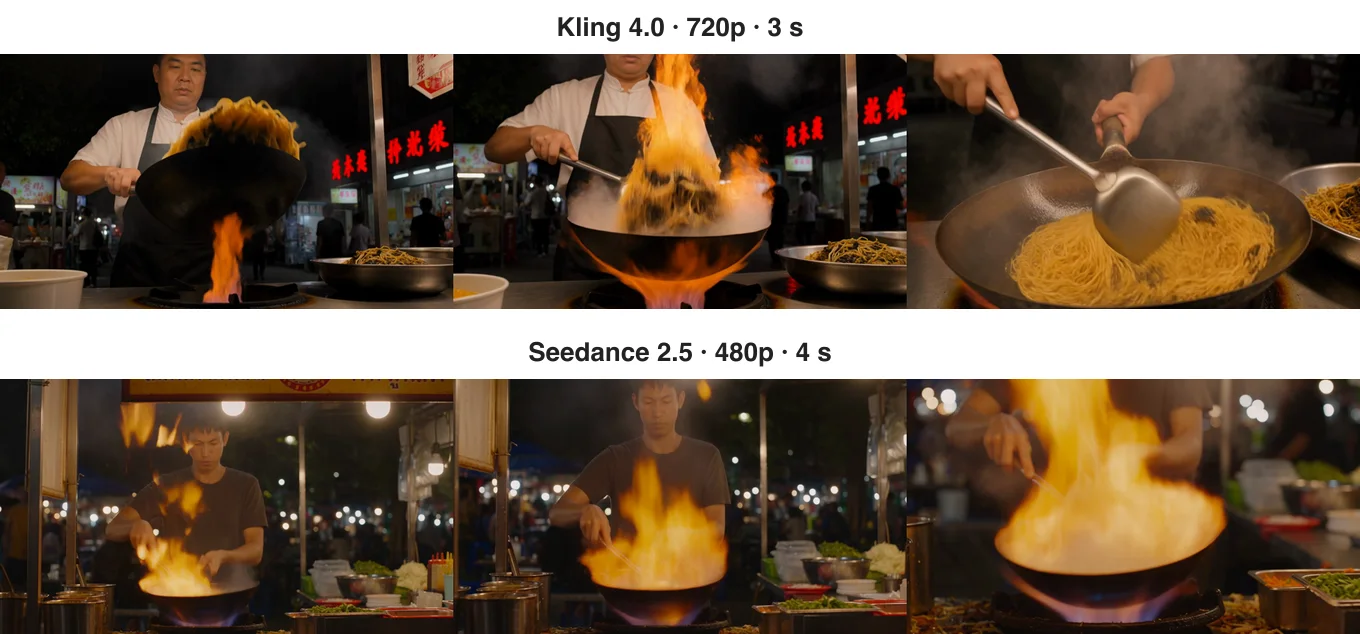
Both got the setting right, with night, the stall and the flames, and both pushed the camera in. The difference is the toss. Kling opens with a big bundle of noodles flying out of the wok, then pushes in until you see the spatula turning the noodles, very close to the shot we described. Seedance's fire is much bigger and the vendor keeps stirring, with the camera ending inside the flames, but you never see the noodles and the toss never happens.
There is one small flaw in the background. Kling's red neon signs look like Chinese characters, but up close they do not form real words. On Seedance's yellow sign the lettering is simply a blur. If a sign has to be legible, plan to fix it in post with either model. Kling took 299 seconds for this clip and Seedance 162.
Animating a product photo: both kept the mug intact, Seedance moved the sunlight
Turning a product photo into video, neither Kling 4.0 nor Seedance 2.5 warped the mug, and Seedance showed more motion. For this one we first made a product photo with an image model: a matte sage-green ceramic mug with a small embossed leaf, on a light oak table by a window. It became the first frame, with this prompt: steam rises gently from the mug, morning sunlight slowly moves across the table, and the camera orbits slowly to the right, with quiet cafe ambience and birds outside.

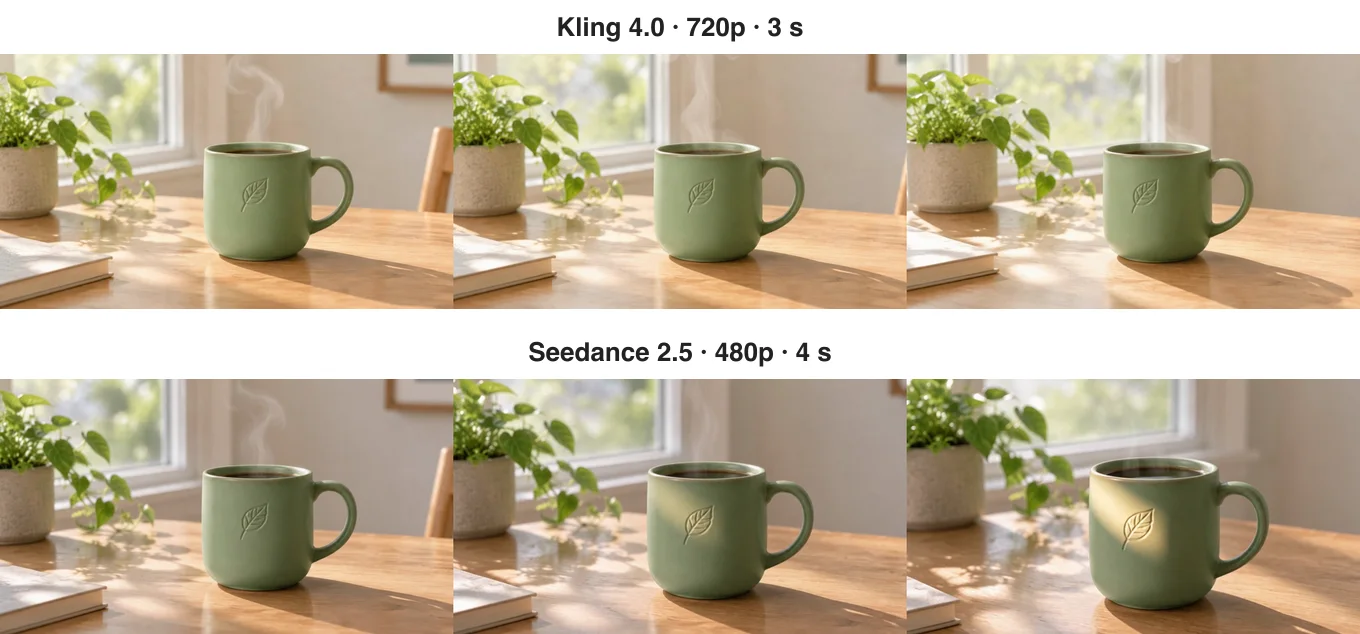
The worst thing in a product clip is a mug that warps or a logo that changes, and both held up: colour, shape and the embossed leaf stay the same throughout, and the steam rises in both. Seedance shows more motion, with a patch of sunlight sweeping across the mug from the left and a slight push-in. Kling barely moves apart from the steam. The prompt asked for an orbit to the right, though, and neither really orbited.
The soundtracks differ in one way. When we ran the audio through a transcription model, Seedance's clip had people talking in the background, clear enough for a few words to be picked up; Kling's had no voices. The prompt said a quiet cafe, so if you want no speech, say "no voices" outright. The biggest gap here was waiting time: Kling took 1,136 seconds, close to 19 minutes, and Seedance 161.
A barista speaks to camera: both got the line exact, only Kling got the apron colour
With a barista speaking to camera, Kling 4.0 and Seedance 2.5 both got the line word for word, but only Kling got the green apron. The prompt: a cheerful young barista in a green apron behind a cafe counter looks straight into the camera and says in English, "Your oat latte is ready, have a great morning!", then slides the paper cup across the counter, with espresso-machine hiss and soft chatter behind.
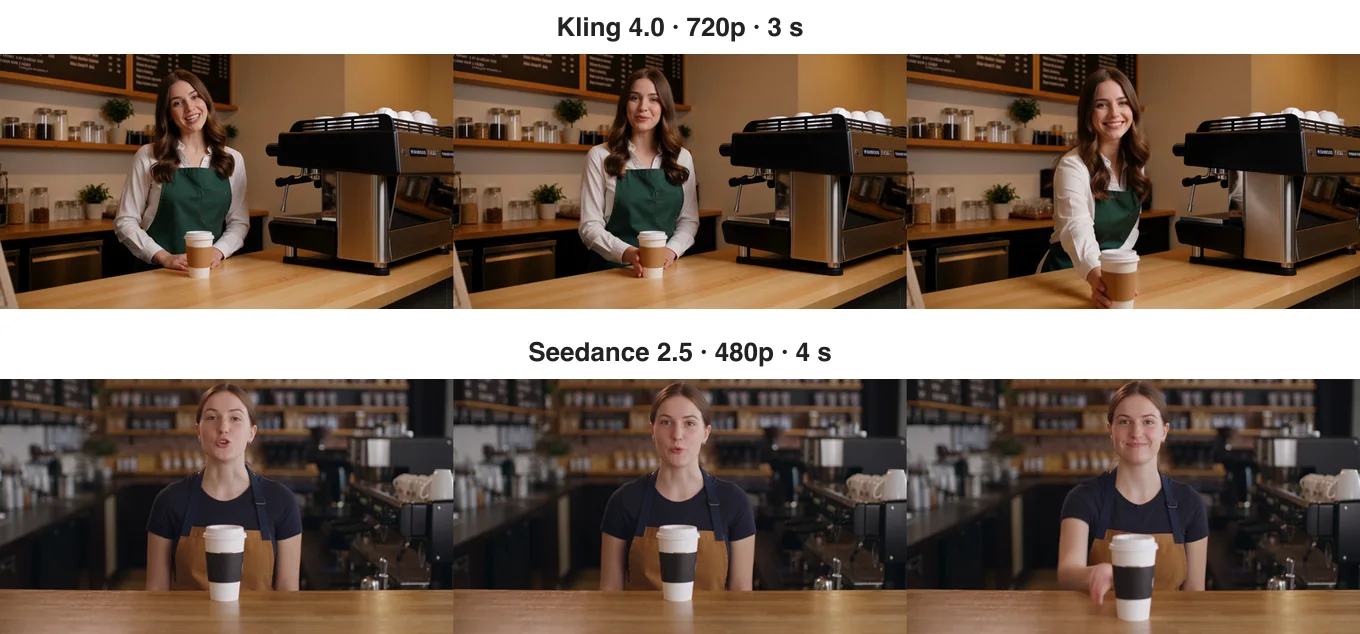
This is where the two came closest. Transcribing both soundtracks gave the same word-perfect "Your oat latte is ready. Have a great morning.", the lips move with the words, and both end by pushing the cup towards the camera. Kling's 3 seconds just fit the line; Seedance's 4 left a short pause after it.
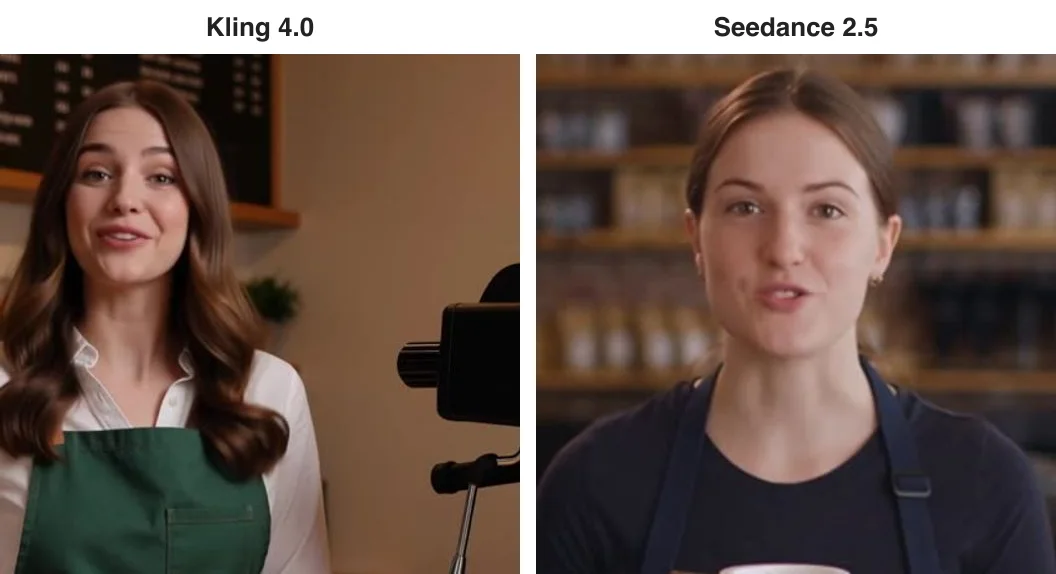
The differences are detail and style. Kling's barista wears the green apron we asked for over a white shirt, with polished make-up, hair and lighting, like an ad. Seedance's wears a brown apron over a navy T-shirt, missing the word "green", but the skin texture, natural light and shallow depth of field look like a real cafe shoot. For brand work with set colours, Kling is the safer bet; for a casual, filmed-on-the-spot feel, Seedance looks more natural.
What only one of them can do
- Kling 4.0: 1080p output; named characters and voices called by @name, so the same person and the same voice stay consistent across clips; keyframes, with a first frame, up to 8 middle frames and a last frame; and clips as short as 3 seconds.
- Seedance 2.5: editing an existing video, replacing, adding or removing things in the frame and editing the audio track; extending a video forwards or backwards over several rounds; up to 50 references in one job, including 10 audio clips; and a lower-cost 480p tier.
What a clip costs and how long it takes
At prices as of 19 November 2026, Kling 4.0 costs $0.157 per second at 720p and $0.235 at 1080p; Seedance 2.5 costs $0.120 per second at 480p and $0.270 at 720p. In this test a 3-second 720p Kling clip cost 47.1 cents, and a 4-second 480p Seedance clip, billed on real usage, cost 48.6 cents.
For budgeting, 100 five-second clips cost 100 × 5 × $0.157 = $78.5 on Kling at 720p, and 100 × 5 × $0.120 = $60 on Seedance at 480p, or $135 at 720p. At the same 720p, Kling costs about 60% of Seedance per second. Failed jobs are free on both, and jobs with a reference video are billed differently on each, so check the docs for the call name you use.
Waiting time differs even more. All three Seedance clips arrived within 161 to 162 seconds, very consistent. The Kling clips took 299, 395 and 1,136 seconds, the longest close to 19 minutes. Each scene ran only once, so the sample is small, but if your users wait on screen for results, test this gap on your own jobs first.
Which one should you pick
- Colours, props and actions must match the prompt: Kling 4.0. Across our three clips it got both the noodle toss and the green apron right.
- You need 1080p: Kling 4.0; Seedance 2.5 tops out at 720p.
- The same character or voice must appear across several clips: Kling 4.0, using @name references.
- You want a photographic look: Seedance 2.5, with more natural skin, light and depth of field.
- Fast drafts in bulk: Seedance 2.5 at 480p, about 2.7 minutes a clip and $0.120 per second.
- Editing or extending a video you already have: only Seedance 2.5 does it.
- A 720p budget: Kling 4.0, $0.157 per second against $0.270 for Seedance, about 40% less.
Using both is common: try shots and pacing quickly with Seedance 2.5 at 480p, then render the final in Kling 4.0 at 1080p, or extend it into a longer piece with Seedance 2.5. The call names are kling-4.0 and seedance-2.5, on the same API key and the same video endpoint; parameters are in the Kling 4.0 docs and the Seedance 2.5 docs.
Related models
- Kling 4.0 Flash: the lighter Kling 4.0 tier, 720p, 3 to 20 seconds, $0.094 per second.
- Seedance 2.5 Flash: the faster Seedance 2.5 tier, from $0.091 per second.
- Seedance 2.0: the Seedance to use when you need 1080p, from $0.092 per second.
- Wan 3.0: Alibaba's video model, from $0.045 per second.
- Kling V3: the previous Kling generation, from $0.12 per second.
For a full test of another video model, see our Wan 3.0 test: word-perfect Chinese dialogue, the most accurate first and last frames, and a fast tier that turned out slower than the standard one.
Preguntas frecuentes
Which is better, Kling 4.0 or Seedance 2.5?
It depends on the job. In our three identical tests Kling 4.0 followed the prompt more closely, getting the noodle toss and green apron right, and it offers 1080p. Seedance 2.5 looked more like real footage, delivered each clip in about 2.7 minutes and can edit or extend existing video. Both spoke the line word for word.
How much do Kling 4.0 and Seedance 2.5 cost?
On APIMODELS, Kling 4.0 costs $0.157 per second at 720p and $0.235 at 1080p; Seedance 2.5 costs $0.120 per second at 480p and $0.270 at 720p, as of 19 November 2026. A 5-second 720p clip is 78.5 cents on Kling and $1.35 on Seedance. Failed jobs are not charged.
Which is faster, Kling 4.0 or Seedance 2.5?
Seedance 2.5 was faster in our test: all three clips arrived in 161 to 162 seconds. Kling 4.0 took 299, 395 and 1,136 seconds. Each scene ran once, so test with your own jobs too.
Which one can edit or extend an existing video?
Seedance 2.5 can: it replaces, adds or removes things in the frame, edits the audio track, and extends a clip forwards or backwards over several rounds. Kling 4.0 does not edit video, but it supports keyframe-to-video and fixed characters and voices called by @name.
Can one API key call both Kling 4.0 and Seedance 2.5?
Yes. On APIMODELS both models use the same API key and video endpoint, with the call names kling-4.0 and seedance-2.5, and you do not need a Kuaishou or ByteDance account.