Updated 8 October 2026 · Google prices from the Gemini API pricing page (7 Oct 2026) · latency and success rates from apimodels.app production traffic, 1–8 Oct 2026
| Nano Banana 2.1 | Nano Banana Pro | |
|---|---|---|
| Gemini API model id | gemini-nano-banana-2.1 | gemini-3-pro-image |
| Google price, 1K / 2K / 4K | $0.0336 / $0.0504 / $0.113 | $0.134 / $0.134 / $0.24 |
| apimodels.app price, 1K / 2K / 4K | $0.024 / $0.04 / $0.064 | $0.08 / $0.08 / $0.13 |
| Object reference images | up to 10 | up to 6 |
| Character reference images | up to 4 | up to 5 |
| Style reference images | up to 3 | not documented |
| Thinking | minimal / medium / high (default medium) | always on |
| Google Search grounding | Web and Image Search | Web Search |
| Panoramic ratios 1:4, 4:1, 1:8, 8:1 | yes | no |
| Median time at 2K (our traffic) | about 25 s | about 40 s |
| Success rate, 1–8 Oct 2026 | 97.6% (41 requests) | 98.9% (971 requests) |
On Google's standard tier Pro costs four times as much as 2.1 at 1K, 2.7 times at 2K and 2.1 times at 4K; Google's batch tier halves both. Reference limits, thinking and grounding are from Google's image-generation guide and the 2.1 model page.
Both at 2K and 16:9, one run each on 8 October 2026; both models returned 2752 × 1536 images. The images are AI-generated by the two models being compared.
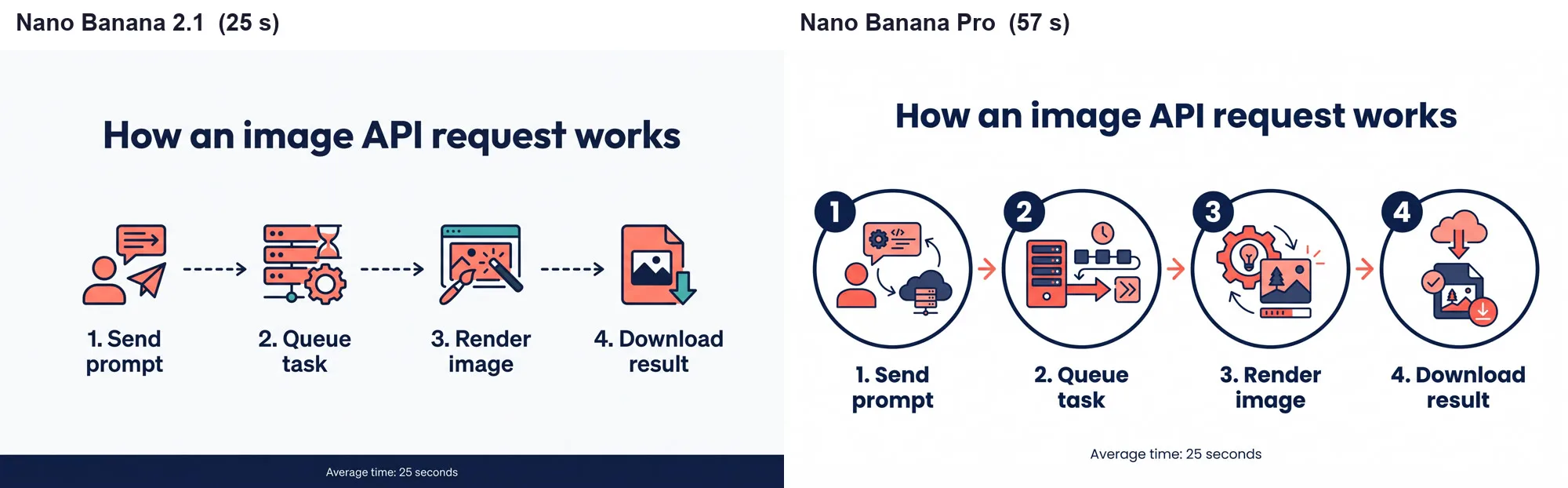
Prompt: a flat-design infographic titled "How an image API request works", four numbered steps and a footer line. Both models spelled the title, all four labels and the footer correctly. Pro drew richer icons inside numbered circles; 2.1 went flatter and set the footer in a navy bar.
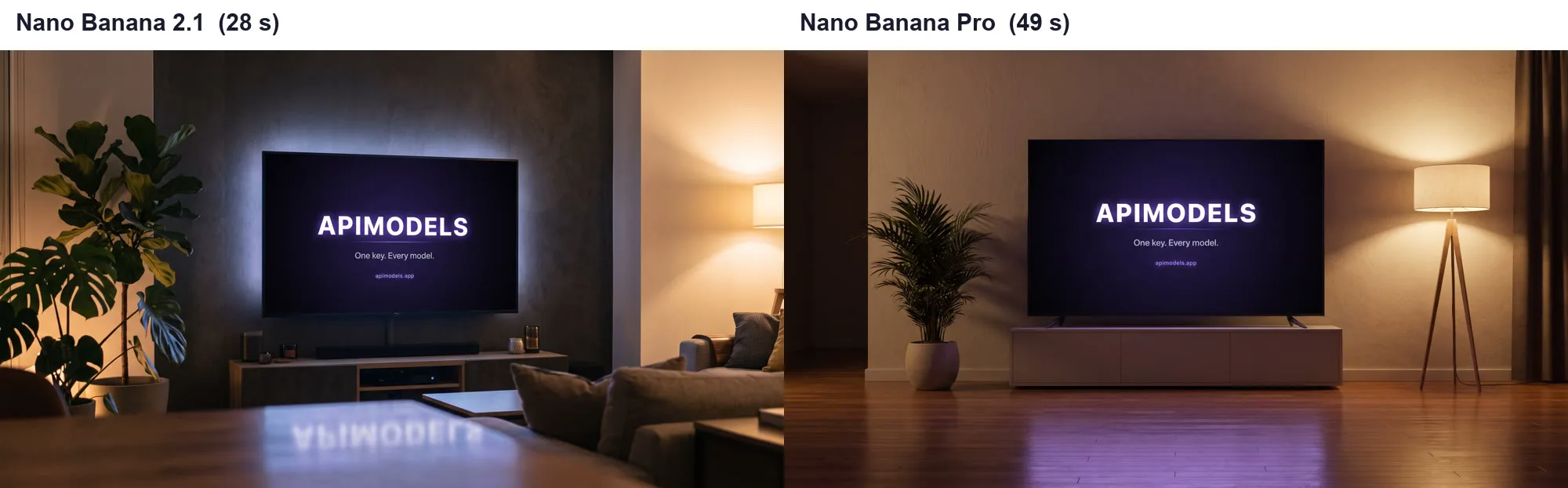
Prompt: place the reference on a wall-mounted TV in a living room at night, with a plant on the left, warm lamp light and a soft reflection on the floor. Each model missed one instruction: 2.1 mounted the TV on the wall but put the reflection on a coffee table; Pro got the floor reflection but stood the TV on a cabinet. Both kept the on-screen text exact.
Two prompts are anecdotes, not a benchmark; the production data below is the larger sample.
| Model and job | Requests | Median | 90th percentile |
|---|---|---|---|
| Pro · 4K with references | 617 | 61 s | 252 s |
| Pro · 2K with references | 203 | 40 s | 76 s |
| Pro · 2K text only | 83 | 38 s | 143 s |
| 2.1 · 4K with references | 16 | 45 s | 50 s |
| 2.1 · 2K | 6 | ~25 s | 35 s |
| 2.1 · 1K text only | 2 | 13 s | 15 s |
Success rate over 1–8 October 2026: Nano Banana Pro 98.9% of 971 requests (all 11 failures were content-moderation refusals); Nano Banana 2.1 97.6% of 41 requests since it went live on 7 October (one upstream failure). The number to design around is Pro's 90th percentile at 4K: 252 seconds, so one request in ten takes more than four minutes. If a user waits on screen, use 2.1 or move Pro jobs to a queue with a webhook.
Neither model is reliable for small text at 1K or a full paragraph of copy. Google lists both as known limits of 2.1; render at 2K or 4K, or add long copy in a design tool afterwards.
apimodels.app is a multi-model API gateway: one API key and OpenAI- and Anthropic-compatible endpoints for about 150 image, video, audio and language models. Over 1–8 October both models ran here at the success rates above, failed calls are not charged, and per-image prices are below Google’s standard tier. Switching models is one field.
# Same request, two models: swap "model"
curl https://api.apimodels.app/v1/images/generations \
  -H "Authorization: Bearer $APIMODELS_API_KEY" \
  -H "Content-Type: application/json" \
  -d '{"model": "nano-banana-2-1", "prompt": "A clean flat-design infographic poster ...", "aspect_ratio": "16:9", "resolution": "2K"}'
# -> {"data": {"taskId": "..."}}; poll GET /v1/images/generations?task_id=... until state is "completed"
# Pro: "model": "gemini-3-pro-image". To edit, add "image_urls": ["https://.../reference.jpg"]
Nano Banana 2.1 API docs · Image API docs (Nano Banana Pro)
Not across the board. Nano Banana 2.1 is faster and costs a third to a half as much per image, and in our 2K infographic test it matched Pro on spelling. Nano Banana Pro still produces richer detail and is Google's recommendation for complex scenes that rely on world knowledge or exact brand assets. For volume work 2.1 is the better default; for a hero image that has to be right the first time, Pro remains the safer pick.
On Google's standard tier (pricing page updated 7 October 2026), Nano Banana 2.1 costs $0.0336, $0.0504 and $0.113 per image at 1K, 2K and 4K; Nano Banana Pro costs $0.134 at 1K and 2K and $0.24 at 4K. Pro is four times the price at 1K, 2.7 times at 2K and 2.1 times at 4K. Google's batch tier halves both. On apimodels.app the prices are $0.024 / $0.04 / $0.064 for 2.1 and $0.08 / $0.08 / $0.13 for Pro.
Google documents up to 10 object, 4 character and 3 style references for Nano Banana 2.1 (14 in total), and up to 6 object and 5 character references for Nano Banana Pro. Pick Pro if you need a fifth recurring character; pick 2.1 if you are combining many product shots. On apimodels.app, Nano Banana 2.1 accepts up to 10 reference images per request.
In our 2K infographic test both models spelled every label correctly. Google's model card reports infographic factuality of 0.521 for Nano Banana 2.1 against 0.179 for the previous Flash model, but lists blurry small text at 1K and long paragraphs as known limits. For text-heavy images, render at 2K or 4K with either model, or add long copy in a design tool afterwards.
On apimodels.app between 1 and 8 October 2026, median times at 2K were about 25 seconds for Nano Banana 2.1 and 40 seconds for Nano Banana Pro. At 4K with reference images, Pro's median was 61 seconds and its 90th percentile 252 seconds; 2.1's were 45 and 50 seconds, on a much smaller sample of 16 requests.
Previous generation: Nano Banana Pro vs Nano Banana 2 →
