
Blog · 2026-11-07
GPT-6 Astra API Tested Against GPT-6.1 Sol: What 3.4x the Price Buys You
Model page: GPT-6 Astra API — pricing, specs and the playground
Is GPT-6 Astra worth it? OpenAI's GPT-6 flagship is built for long-running terminal and ops agents, inputs past 500K tokens and hard maths. On November 7 we ran it against GPT-6.1 Sol on everyday work: code, tool calls, a 75K-token document and a Chinese chat turned into JSON. Both got everything right, and Astra was slower. At $3.40 / $17 per 1M tokens it costs 3.4 times as much, so default to Sol and save Astra for the hard jobs.
GPT-6 Astra is the flagship of OpenAI's GPT-6 family, released in September 2026 alongside the balanced Sol and the high-volume Luna. An upgraded GPT-6.1 Sol followed at the end of that month. Astra is already available through the API, with a 1.05M-token context window, up to 128K output tokens, and text plus image input.
The two things people ask most about Astra are what it costs and whether it beats GPT-6.1 Sol. Astra is priced at 3.4 times Sol, so the real question is what the extra money buys. We gave both models the same four everyday tasks with the same prompts at default reasoning effort, then looked at how long real requests to each model take on our platform.
A word on who we are: we run apimodels.app, a platform where one API key calls GPT-6 Astra, GPT-6.1 Sol and other image, video, audio and language models. Every task in this article was run on that platform on November 7, 2026. The latency figures come from the platform's production calls over the last 30 days, with our own accounts excluded and the sample size not disclosed.
The short answer
On four everyday tasks the two models tied. Both passed all 37 hidden tests on the coding task, both handled the refund agent correctly, both found all 7 answers in a 75K-token log, and both got all 11 fields right when turning a Chinese order chat into JSON. The difference was time: the coding task took Astra 56 seconds and Sol 28. In real production traffic, Astra also takes 30% to 50% longer for an answer of the same length.
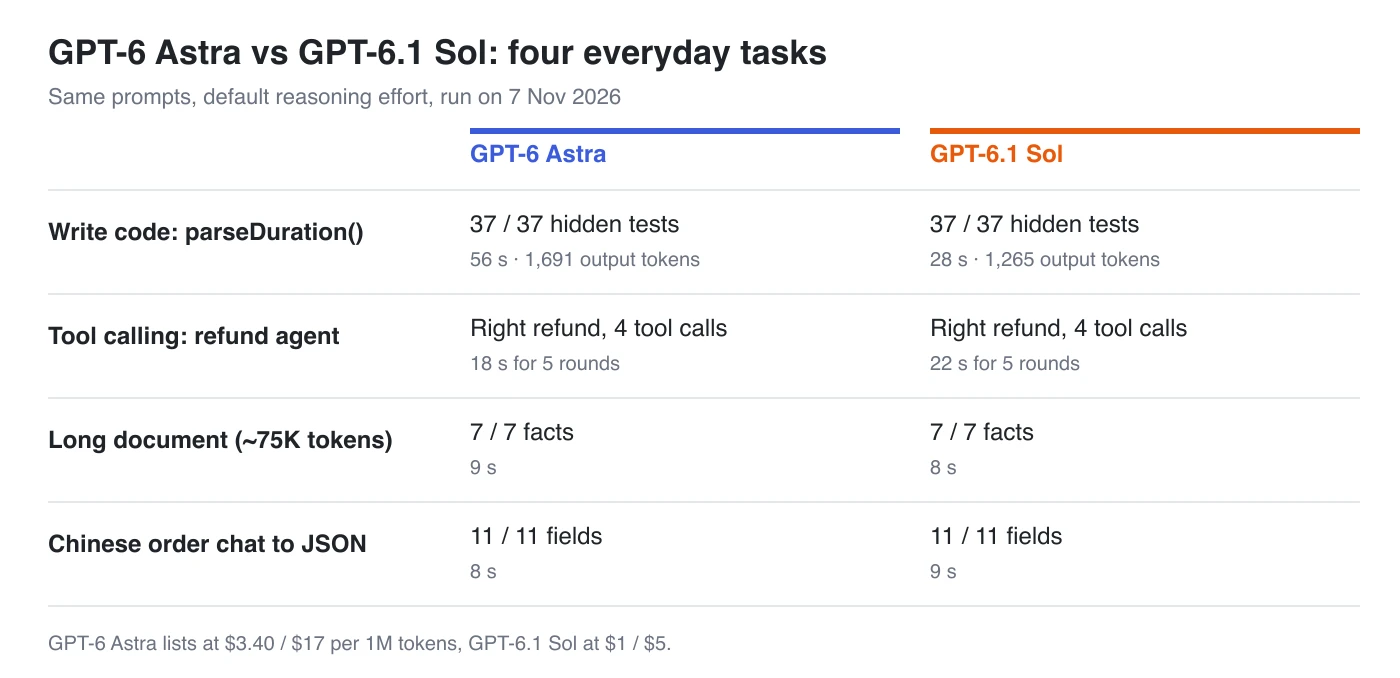
Astra's strengths sit beyond what these four tasks reach. In OpenAI's published results it clearly leads the previous generation on terminal work (57.7% on Terminal-Bench 4.0), on-call ops (88.0% on SRE-Bench) and retrieval across 500K to 1M tokens (96.3% on MRCR v2 8-needle). For writing code alone, though, it scores 74.1% on DeepSWE v1.1, slightly below GPT-6.1 Sol's 75.2%.
So the choice is simple. For everyday coding, structured extraction and tool calls of three to five steps, use GPT-6.1 Sol, where a typical call costs about a quarter of Astra's. Switch to Astra for terminal or ops agents that run dozens of steps, for inputs of hundreds of thousands of tokens, or for genuinely hard maths and science.
What it can do, and its limits
- Specs: a 1,050,000-token context window and up to 128,000 output tokens; text and image in, text out.
- Tools: function calling, the built-in web_search tool and code_interpreter all work; we checked each one on September 6. Function calling works on both chat/completions and responses.
- Tools you cannot use: Computer Use (the model operating a computer or browser itself) and file_search are not available through the apimodels.app API. The eye-catching 72.6% on OSWorld 2.0 depends on Computer Use, so leave it out of your reasons to pick Astra.
- Adjustable reasoning effort: on our coding task, setting reasoning effort to low cut the time from 56 to 28 seconds and reasoning tokens from 696 to 214, and all 37 tests still passed.
- Long-context surcharge: when a single request has more than 272,000 input tokens, the whole request bills at 2x input and 1.5x output, not only the part above the line.
- The 99.9% on ARC-AGI-3: that score needs OpenAI's own stateful adapter, and a plain API call will not reproduce it.
- Stream long answers: a request that writes a few thousand tokens can take minutes, and a non-streaming request that waits too long will time out.
Coding: all 37 hidden tests passed, and Astra took twice as long
The first task asked for a JavaScript function, parseDuration, that converts durations written in many ways into seconds: "1h30m", "90 min", "1.5 hours", ISO 8601 such as "PT1H30M", and clock form such as "1:02:03". It also had to throw where it should, for example on "P1M" (in ISO notation an M before the T means months, which are not supported, and only an M after the T means minutes) and on "1:60", where the seconds are out of range. We scored it with 37 test cases of our own that the models never saw.
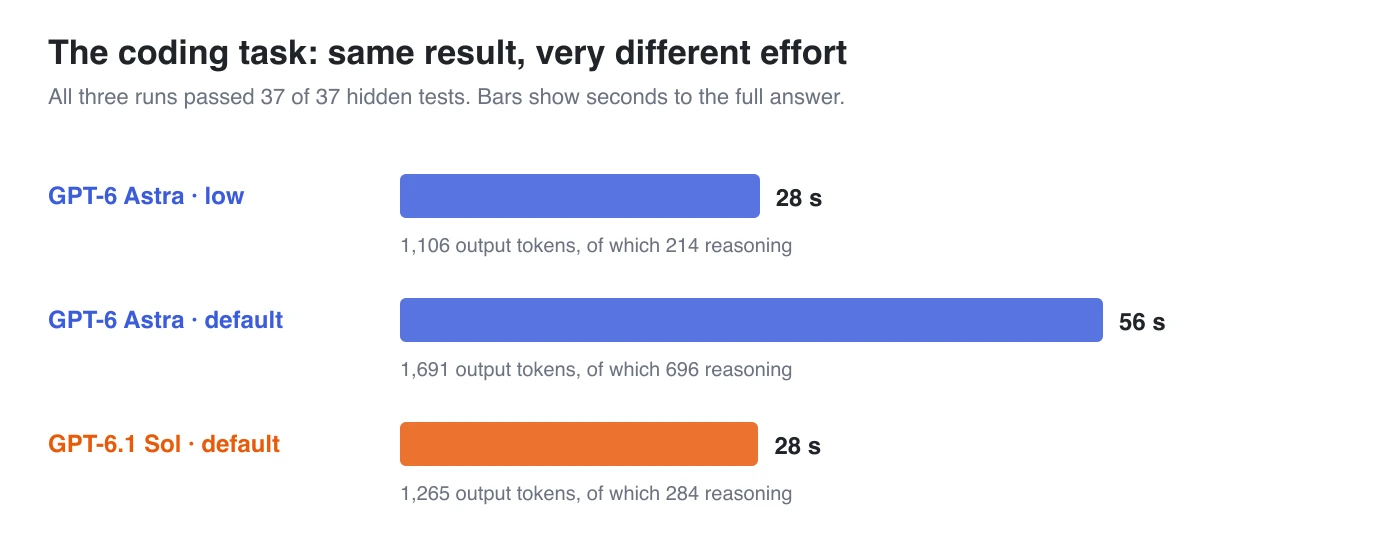
Both models got it right first time, with similar amounts of code (152 lines from Astra, 134 from Sol). The difference was effort. At default reasoning effort Astra spent 696 reasoning tokens and 56 seconds; Sol spent 284 and 28 seconds. With Astra set to low effort it also finished in 28 seconds and still passed all 37. This task simply was not hard enough to need Astra's extra thinking.
Earlier the same day we ran the same prompt once before. In that round Sol missed one case: "1:60" should have thrown, and it returned 120 seconds instead. Astra passed every case in both rounds. On code full of edge cases Astra is a little steadier, but a set of unit tests closes that gap. In a data-analysis test in October we saw the same pattern: asked to write a pandas script and list the expected results, Sol's own expected-results table had 3 wrong numbers while Astra got all 12 right, and both scripts were correct.
Tool calling: the refund agent took the same four steps on both
The second task was a support agent handling a refund. The system prompt set the rules: refund only items from delivered orders, hand any single refund above $100 to a human, never refund shipping, and refund only what the customer reports as damaged. The customer wrote that their most recent order arrived yesterday (November 6), the ceramic lamp was smashed and the candles were fine. The agent had five tools (look up the customer, list orders, get an order, issue a refund, escalate to a human), and we set a trap: the newest order, A1050, is still processing and also contains a ceramic lamp.
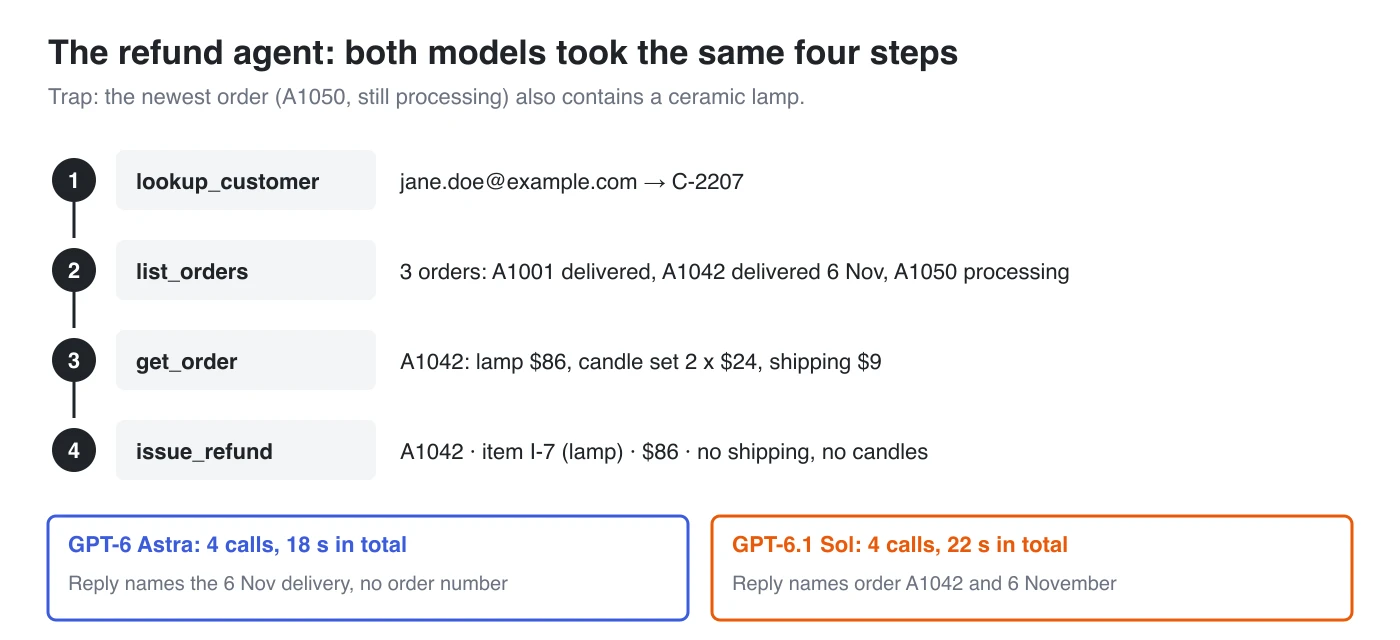
Both models took exactly the same four steps: found the customer ID, listed the three orders, recognised that the one delivered on November 6 was A1042 rather than the newer A1050, opened A1042, and refunded $86 for the lamp only, leaving the candles and the $9 shipping alone and not escalating. The five rounds took Astra 18 seconds in total and Sol 22. The replies to the customer differed in one detail: Sol quoted the order number, Astra mentioned only the delivery date.
For tool calls of three to five steps, Sol is enough. Where Astra pulls ahead in the published results is long tasks of dozens of steps that run and debug commands in a terminal, such as 88.0% against the previous generation's 55.9% on SRE-Bench. If your agent looks like that, it is worth running a batch of your own tasks on Astra to compare.
A 75K-token log: both found all seven answers
The third task was a 120-day project operations log of about 75K tokens, mostly routine entries. We planted facts that later entries change: a freight budget revised from €48,000 to €52,500, a warehouse door code changed from 2290 to 4471, a new QA lead, and a launch date moved from March 14 to April 2. The models also had to count how many times the staging server was actually restarted: four real restarts, plus one restart that was proposed and postponed and one that was planned and cancelled.
Both models got all seven answers, used the revised values every time, counted four restarts with the right four days, and were not misled by the postponed and cancelled ones. Astra took 9 seconds and Sol 8.
75K tokens is easy for both. By OpenAI's numbers, Astra's long-context advantage opens up between 500K and 1M tokens: 96.3% on MRCR v2 8-needle against 73.8% for the previous GPT-5.6 Sol. If you need to load a whole codebase or a few hundred pages of contracts and search them in one go, that is where Astra earns its price, keeping in mind that past 272K tokens the whole request bills at twice the input rate.
A Chinese order chat to JSON: all 11 fields right
The fourth task was a messy WeChat order conversation in Chinese. The customer first asked for 3 cases of shampoo and 2 of conditioner, then changed it to 5 cases of shampoo, dropped the conditioner and added 1 case of body wash, placed a second order of hand cream for a colleague, asked for the invoice on their own order only, and finally asked whether it could arrive before Friday. We required a fixed JSON schema with one order per person.
Both models got all 11 fields right: 5 cases of shampoo after the change, no conditioner, the body wash added, spaces stripped from the phone number, the invoice on the first order only, the second order holding just the 10 hand creams, and "before Friday" recorded as the delivery request. Astra took 8 seconds and Sol 9. For structured extraction like this, Astra only adds cost.
How real users call it, and how long they wait
Those were our own tasks. Real traffic on the platform looks different: most requests to both models come from agent and coding sessions that carry a lot of context. The median request has about 90K input tokens, around 85% of input is billed at the cached rate, and more than 90% of requests stream their output.
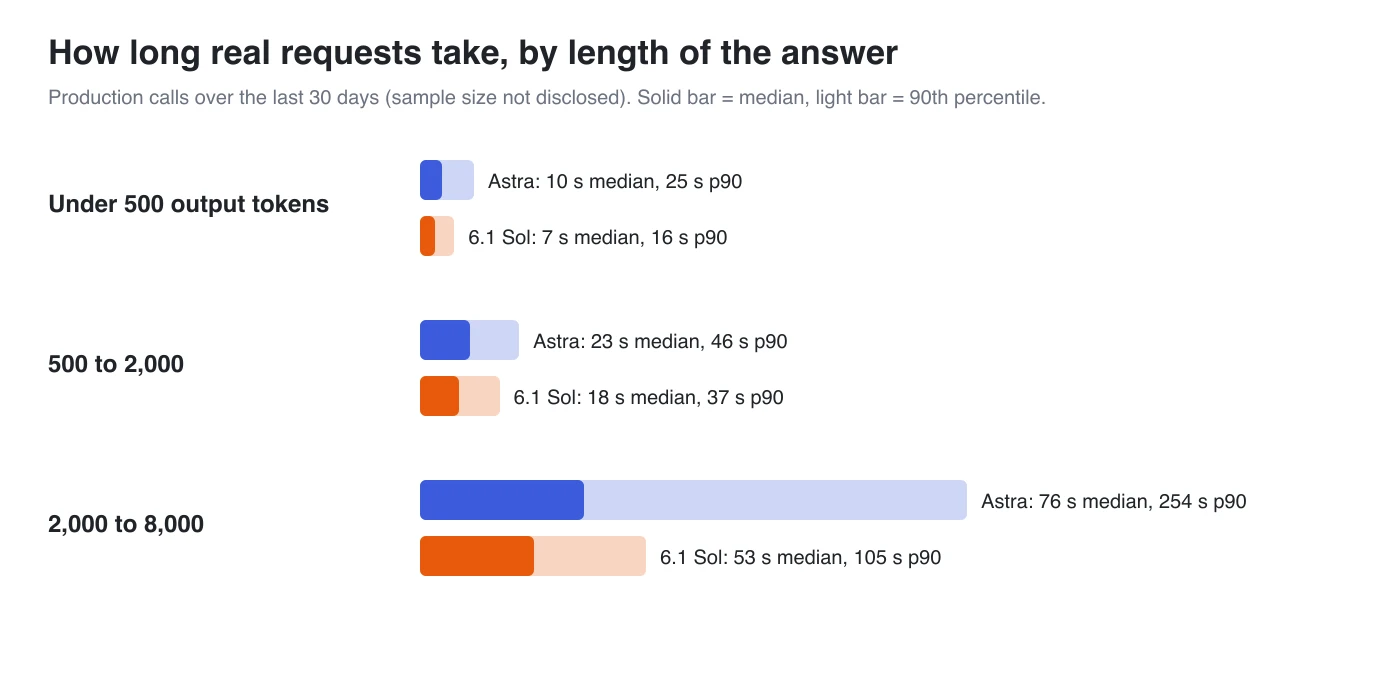
Overall, Astra's median is 12 seconds and its 90th percentile 42 seconds, against 9 and 33 for GPT-6.1 Sol. Split by answer length, answers under 500 tokens take a median of 10 seconds on Astra and 7 on Sol. For long answers of 2,000 to 8,000 tokens the medians are 76 and 53 seconds, and Astra's 90th percentile stretches to 254 seconds against Sol's 105. Where a user is waiting for a live reply, Astra's wait is noticeably longer.
How it compares with similar models
- Against GPT-6.1 Sol: the same results on everyday tasks at about a third of the unit price, and faster. On DeepSWE v1.1 for coding it even scores 75.2% to Astra's 74.1%. Start here by default.
- **Against GPT-5.6 Sol**: the previous generation, and the model all of Astra's official comparisons are made against. New projects have no reason to stay on 5.6.
- **Against GPT-6 Luna**: $0.09 / $0.45 per 1M tokens for high-volume simple work such as classification and summaries; a different job from Astra's.
- **Against Claude Fable 5.1**: nearly identical on FrontierCode 1.1 for coding (53.5% against 53.3%), but on Humanity's Last Exam with tools Fable 5.1 scores 65.0% to Astra's 57.2%, so Claude is stronger for deep reasoning that leans on broad knowledge.
For how the three tiers of one family divide the work, see our earlier GPT-5.6 Sol vs Terra vs Luna comparison; the same logic carries over to GPT-6.
What one call costs
GPT-6 Astra is billed per token: $3.40 per 1M input tokens, $17.00 per 1M output tokens and $0.34 per 1M cached input tokens, which is 34% of OpenAI's own $10 / $50 list (cached $1.00). GPT-6.1 Sol is $1.00 input, $5.00 output and $0.05 cached. Reasoning tokens bill as output. Prices as of November 7, 2026.
Take a typical real request: 90K input tokens with 85% cached, and a 220-token answer. On Astra that is 13.5K × $3.40/1M + 76.5K × $0.34/1M + 220 × $17/1M ≈ $0.076. The same request on GPT-6.1 Sol is about $0.018, roughly a quarter. A thousand agent calls like that come to about $76 on Astra and $18 on Sol.
Very long inputs need their own sum. A 600K-token request crosses the 272K line, so Astra's input rate doubles to $6.80 per 1M and the input alone costs about $4.08. Failed requests are not charged.
When not to use it
- Everyday coding, structured extraction and three-to-five-step tool calls: our four tasks were a tie, and a call to GPT-6.1 Sol costs about a quarter as much and returns sooner.
- You need the model to operate a computer or browser itself, or to search files with file_search: neither tool is available through our API.
- Latency-sensitive live chat: for longer answers, Astra's 90th percentile runs past four minutes.
- Deep reasoning that leans on broad knowledge: on Humanity's Last Exam with tools Astra trails Claude Fable 5.1 by nearly 8 points.
How to call it
The model name is gpt-6-astra. It speaks the OpenAI-compatible API, on both /v1/chat/completions and /v1/responses, so existing OpenAI SDK code runs once you point the base URL at apimodels.app and swap in your API key; no OpenAI account is needed. The same key calls GPT-6.1 Sol, Claude and Gemini, and switching models means changing one field, model. Turn on streaming for longer answers. Parameters, endpoints and the price table are in the LLM API docs.
Related models
- GPT-6.1 Sol: the everyday default, enough for coding and tool calls, $1 / $5 per 1M tokens.
- GPT-6.1 Terra: the middle tier of the 6.1 generation, $0.50 / $2.50 per 1M tokens.
- GPT-6 Luna: high-volume simple work, $0.09 / $0.45 per 1M tokens.
- Claude Fable 5.1: long-running agents and deep reasoning, $5 / $25 per 1M tokens.
- Claude Opus 5.5: Claude's Opus tier for general work, $2.40 / $12 per 1M tokens.
To call GPT, Claude and Gemini with one key, see one API key for Claude, GPT and Gemini.
FAQ
Has GPT-6 Astra been released, and can I call it through an API?
Yes. OpenAI released GPT-6 Astra in September 2026, and apimodels.app has offered it through the API since September 5. The model name is gpt-6-astra, it runs on the OpenAI-compatible chat/completions and responses endpoints, and you need only one API key, no OpenAI account.
How much does the GPT-6 Astra API cost?
$3.40 per 1M input tokens, $17.00 per 1M output tokens and $0.34 per 1M cached input tokens, 34% of OpenAI's own $10 / $50 list; reasoning tokens bill as output. When one request exceeds 272K input tokens, the whole request bills at 2x input and 1.5x output. A typical real agent request (90K input tokens, 85% cached) costs about $0.076. Failed requests are not charged.
Which is better, GPT-6 Astra or GPT-6.1 Sol?
They tie on everyday work, and Astra wins on hard work. On our four tasks (code, tool calls, a 75K-token log and Chinese-to-JSON extraction) both got everything right, while GPT-6.1 Sol was faster at about a quarter of the cost per call. Astra leads on terminal and ops agents of dozens of steps, retrieval beyond 500K tokens and hard maths; for coding alone, Sol scores slightly higher on DeepSWE v1.1.
Can GPT-6 Astra operate a computer through the API?
Not on apimodels.app. Computer Use and file_search are not available through our API; function calling, the built-in web search and the code interpreter are. The 72.6% on OSWorld 2.0 in the launch materials depends on Computer Use, so through the API you build the agent loop yourself with function calling.
How do I make GPT-6 Astra faster and less expensive?
Three ways. First, set reasoning effort to low: on our coding task that cut the time from 56 to 28 seconds and reasoning tokens from 696 to 214, with the same full marks. Second, keep the system prompt and fixed material at the start and identical across turns, so cached input bills at only $0.34 per 1M. Third, stream longer answers so you receive them as they are written and avoid timeouts.