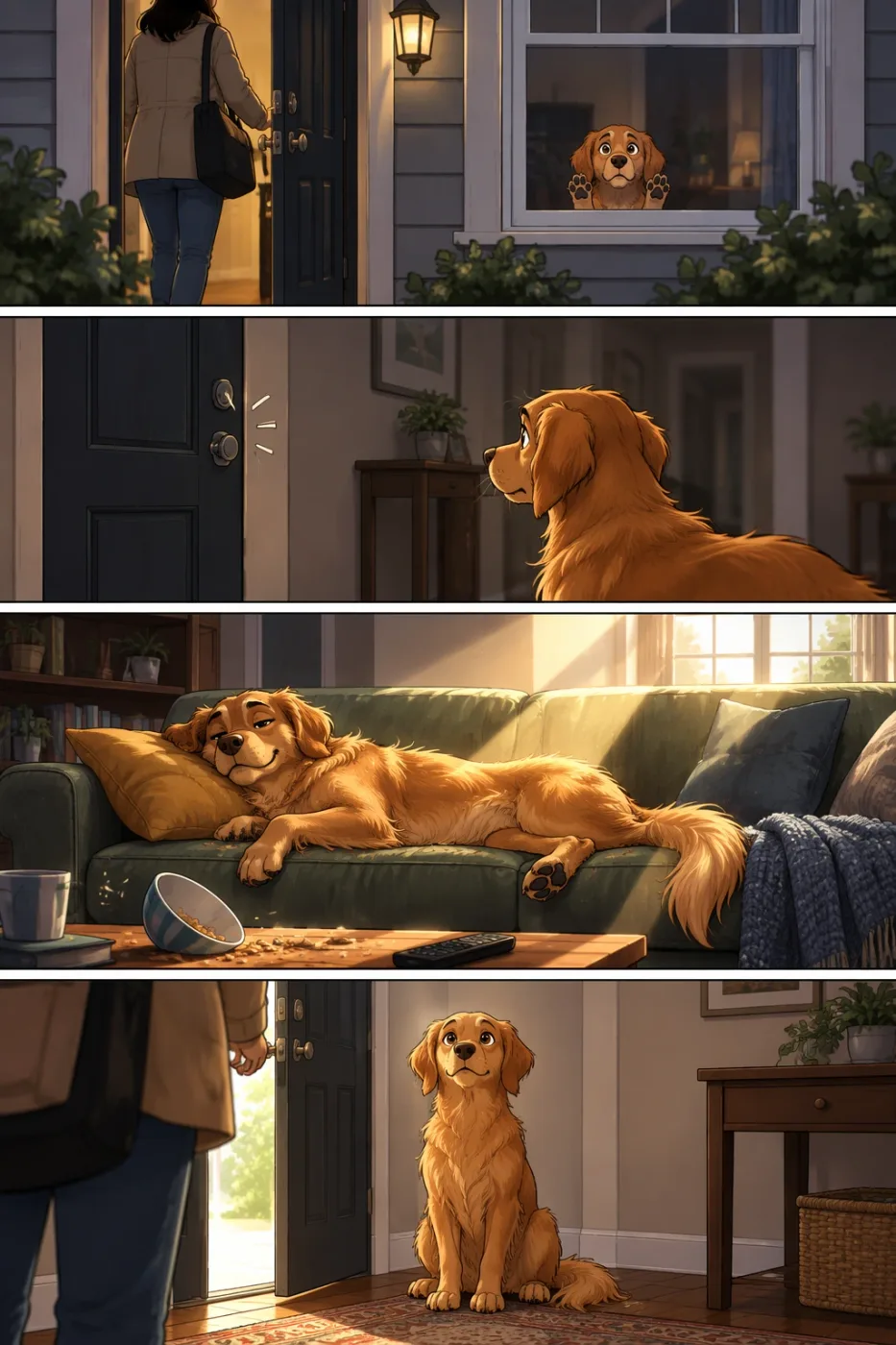
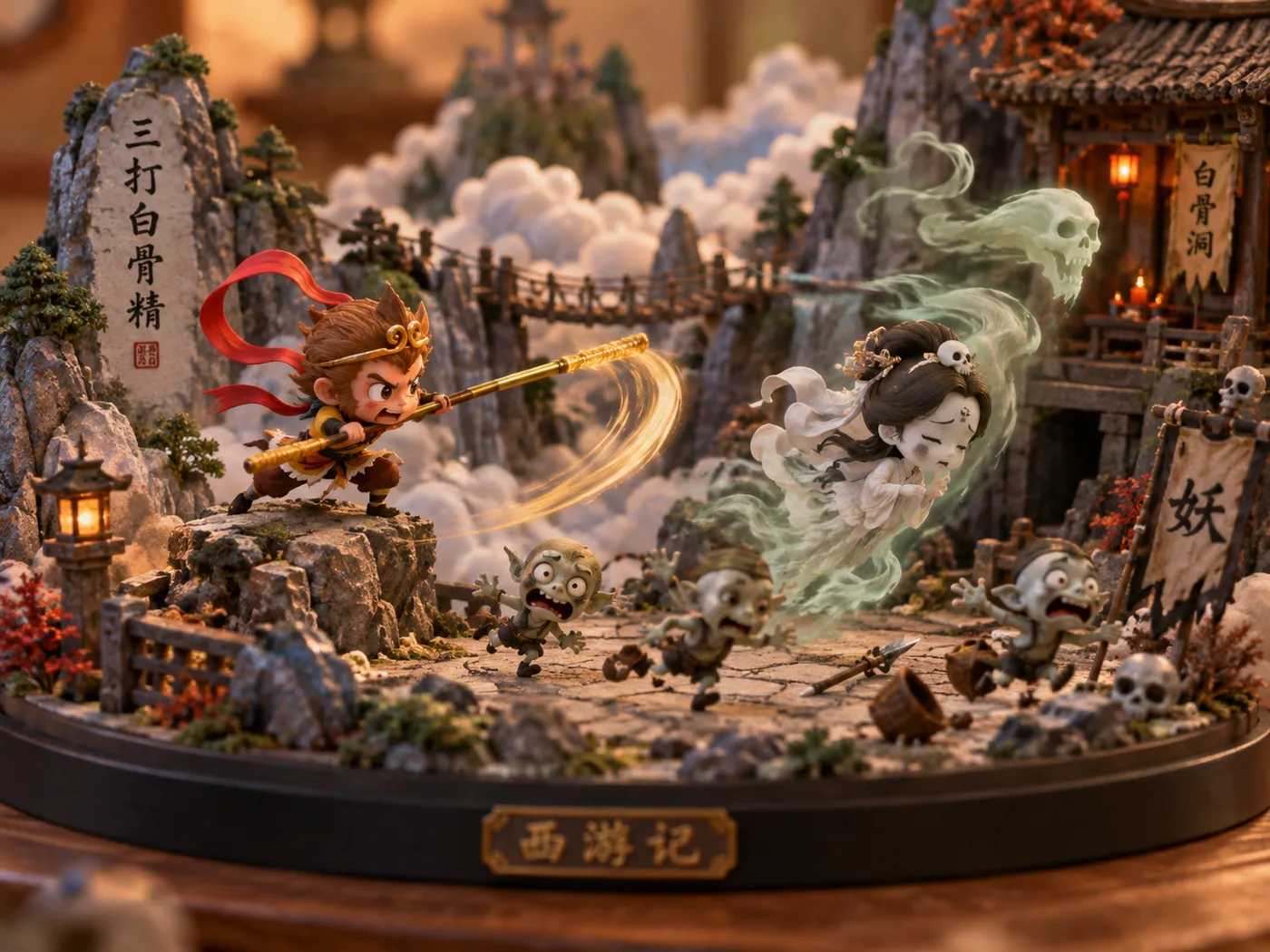
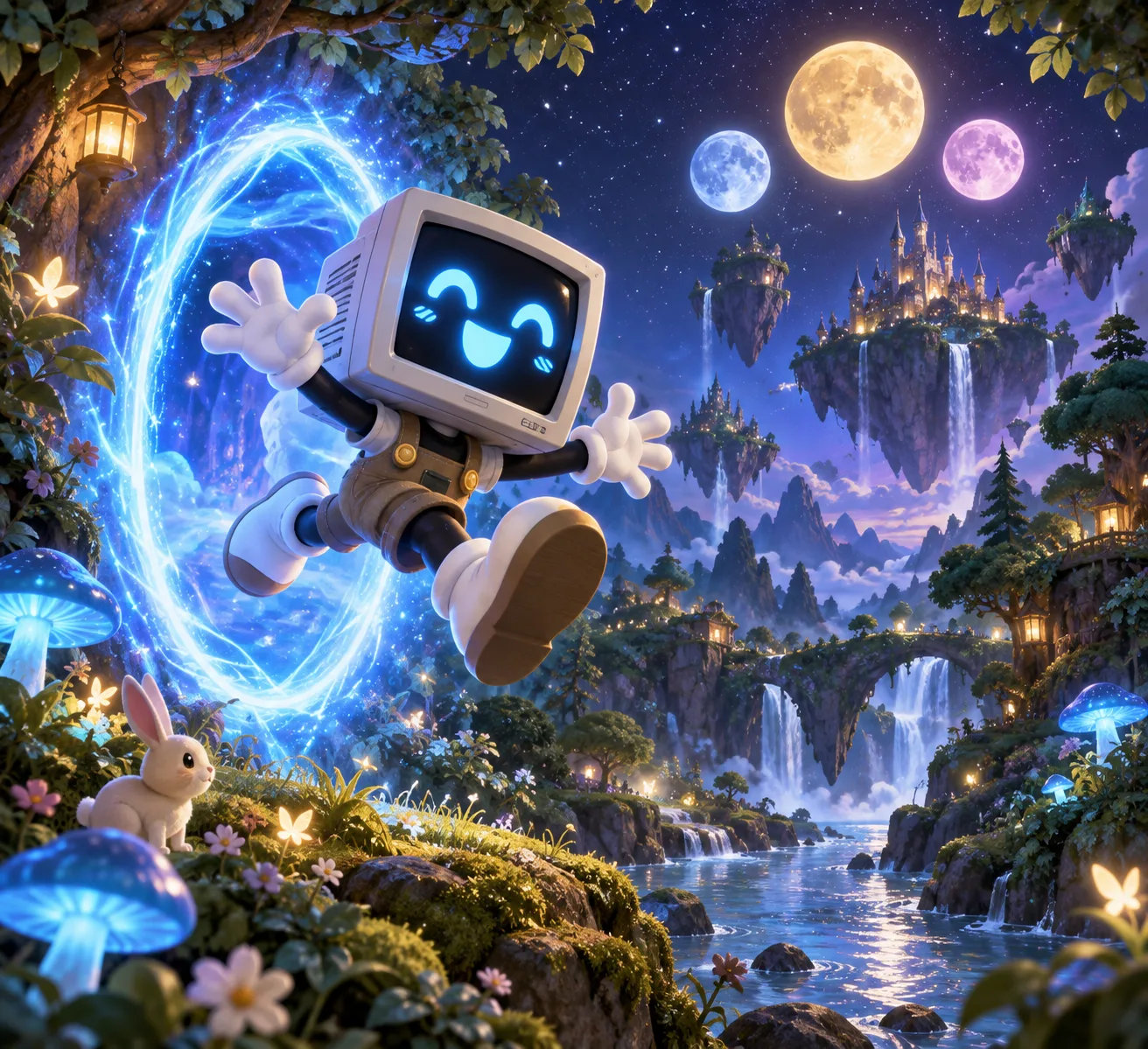
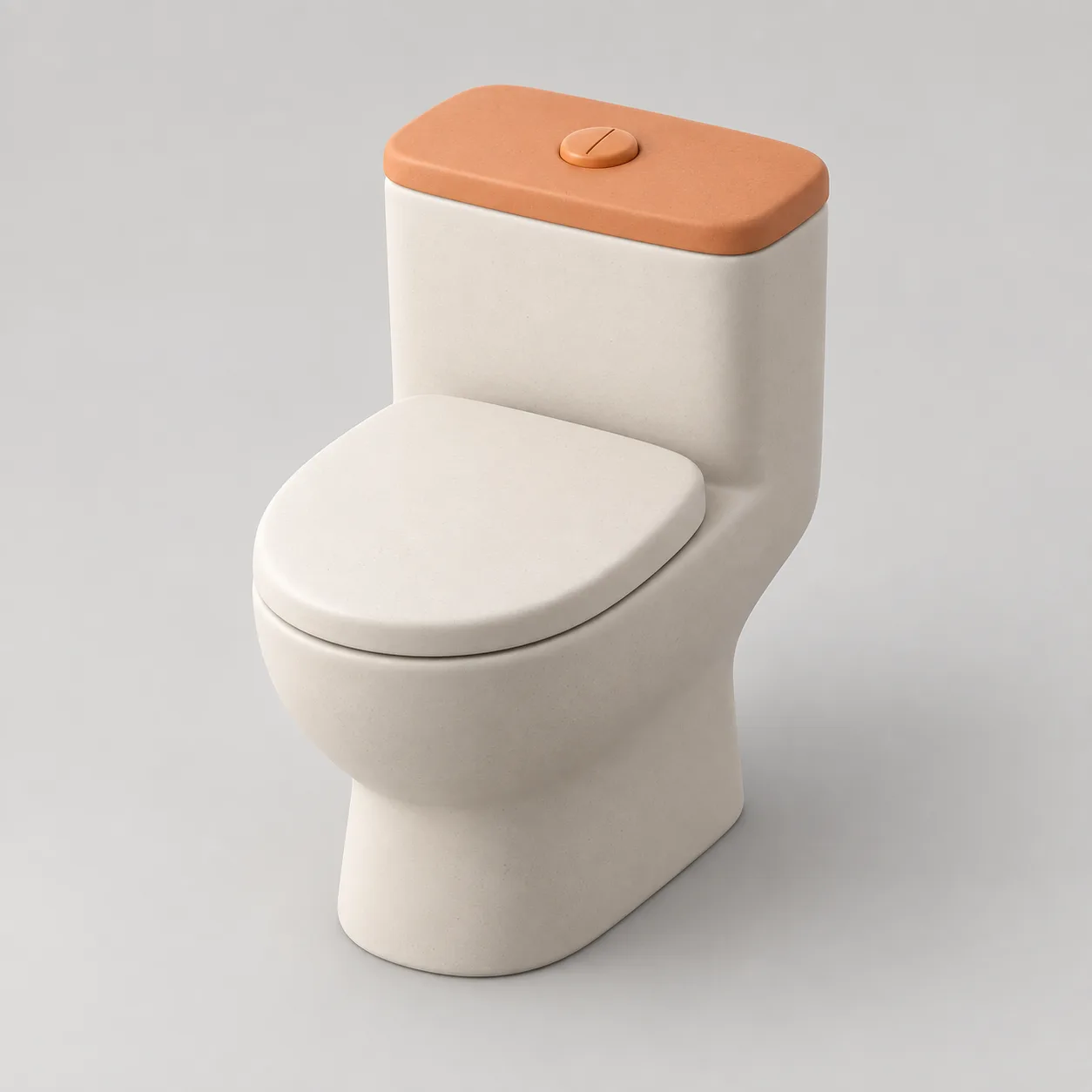
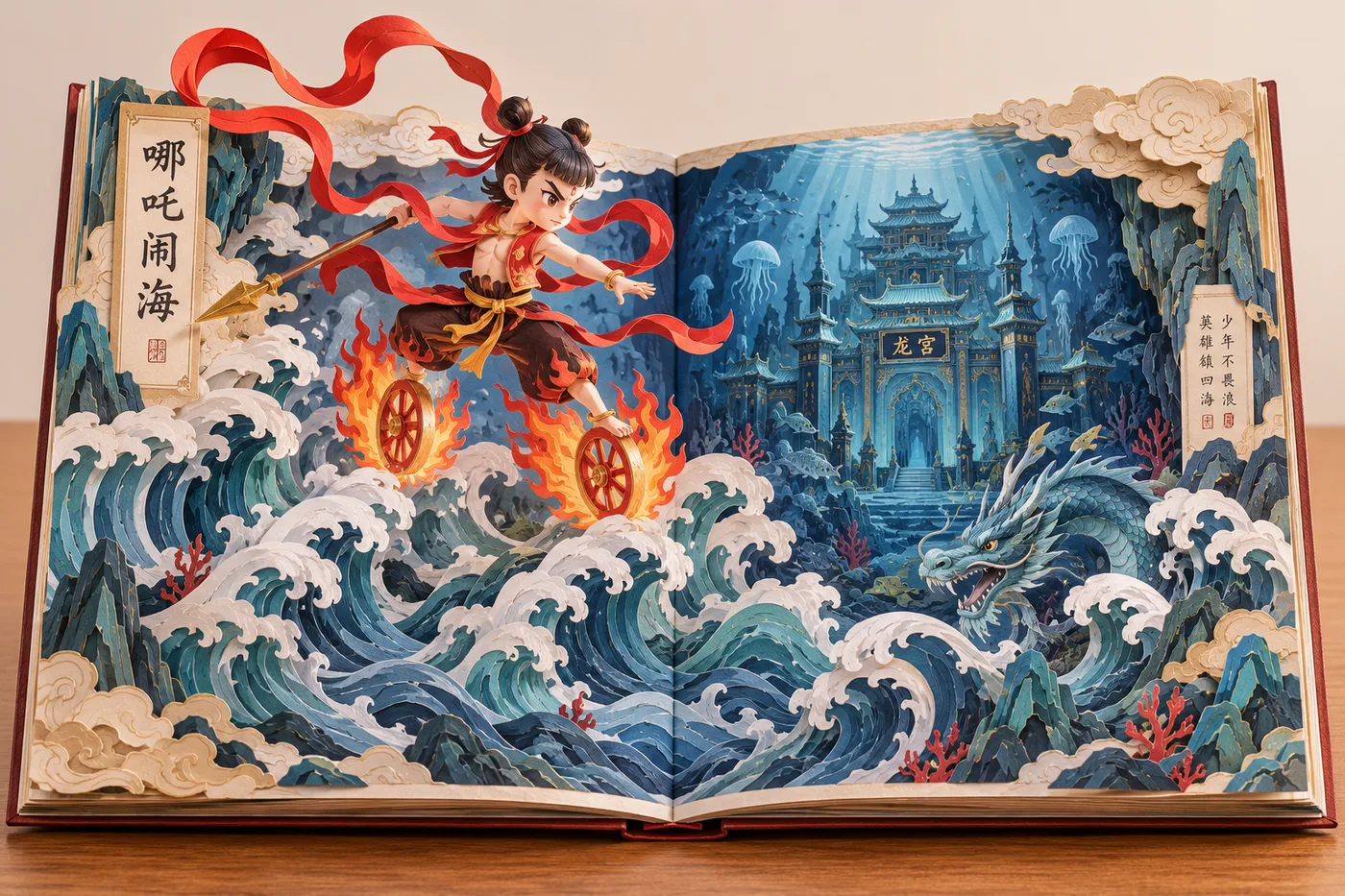
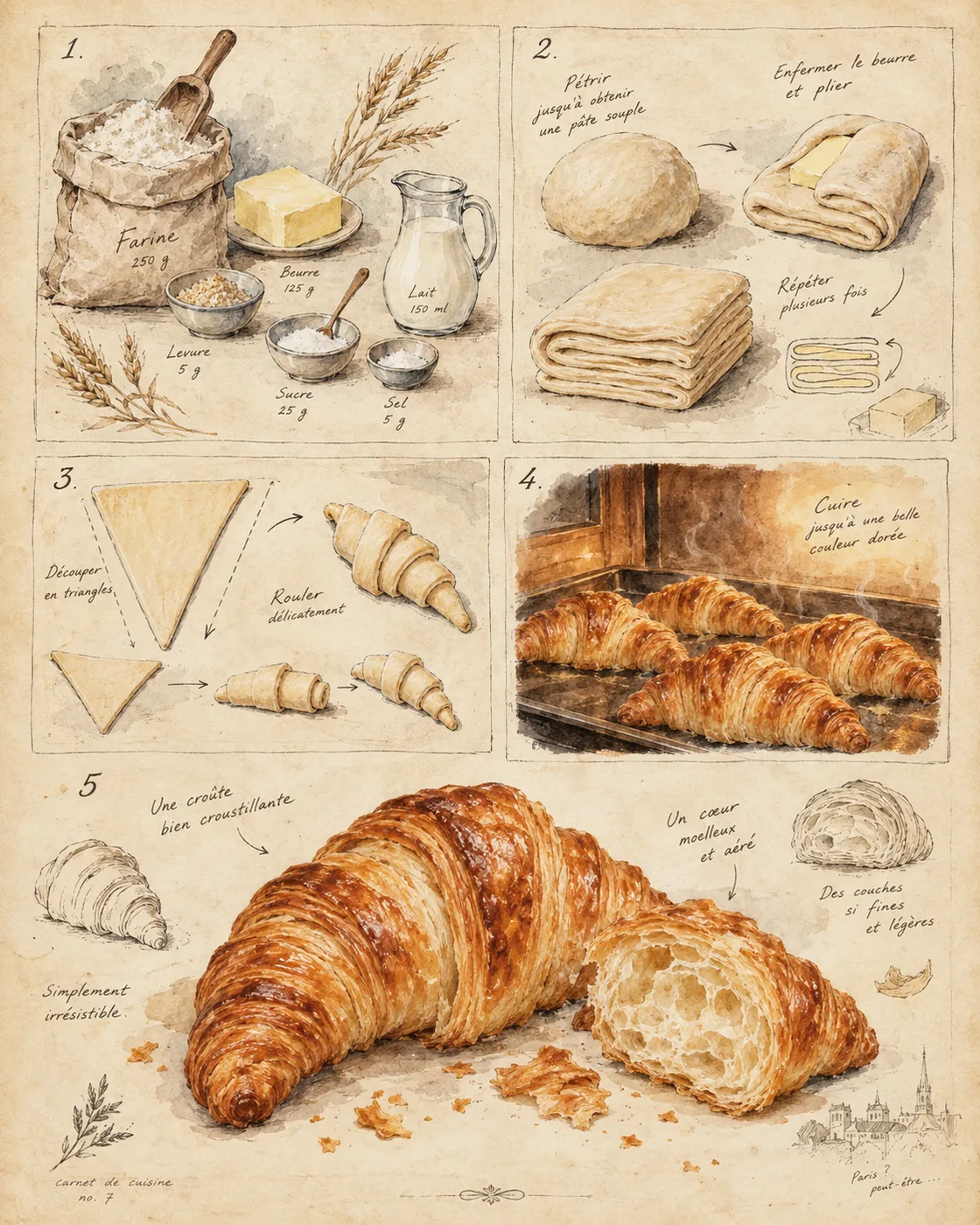
Create a short vertical comic-style reel with 4 panels.
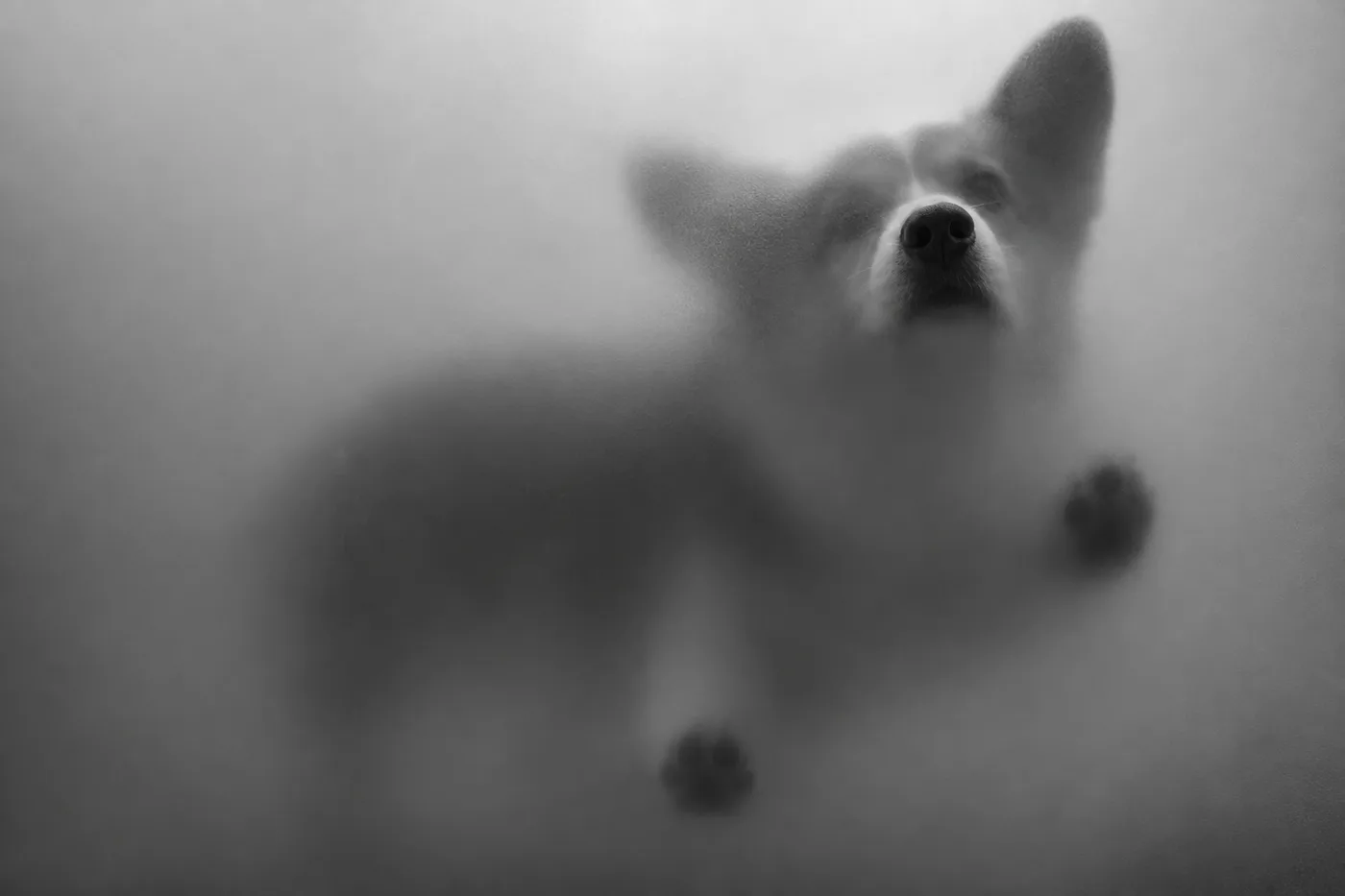
Panel 1: The owner leaves through the front door. The pet is framed in the window behind them, small against the glass, eyes wide, paws pressed high, the house suddenly quiet.
Panel 2: The door clicks shut. Silence breaks. The pet slowly turns toward the empty house, posture shifting, eyes sharp with possibility.
Panel 3: The house transformed. The pet sprawls across the couch like it owns the place, crumbs nearby, sunlight cutting across the room like a spotlight.
Panel 4: The door opens. The pet is seated perfectly by the entrance, alert and composed, as if nothing happened.
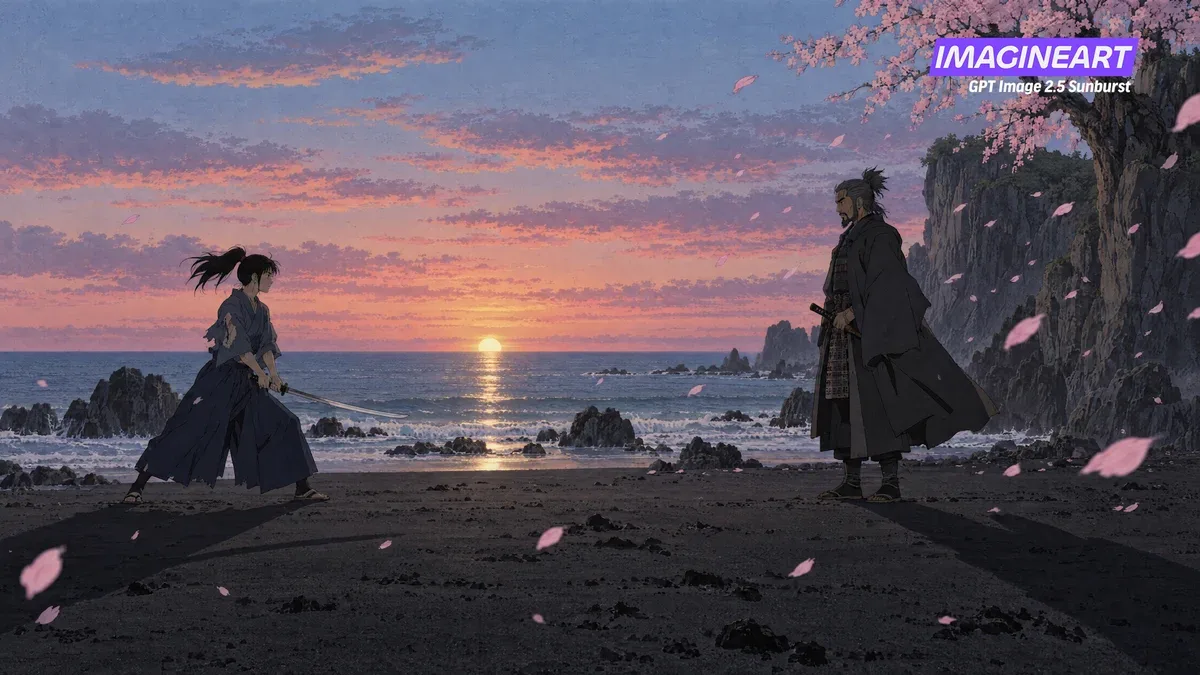
a still from a hand drawn Japanese animated film, late 1990s cel style, painted watercolour background. A dawn duel on black volcanic sand, a woman with a drawn katana facing an older man with a sheathed one, cherry blossom blowing right to left.
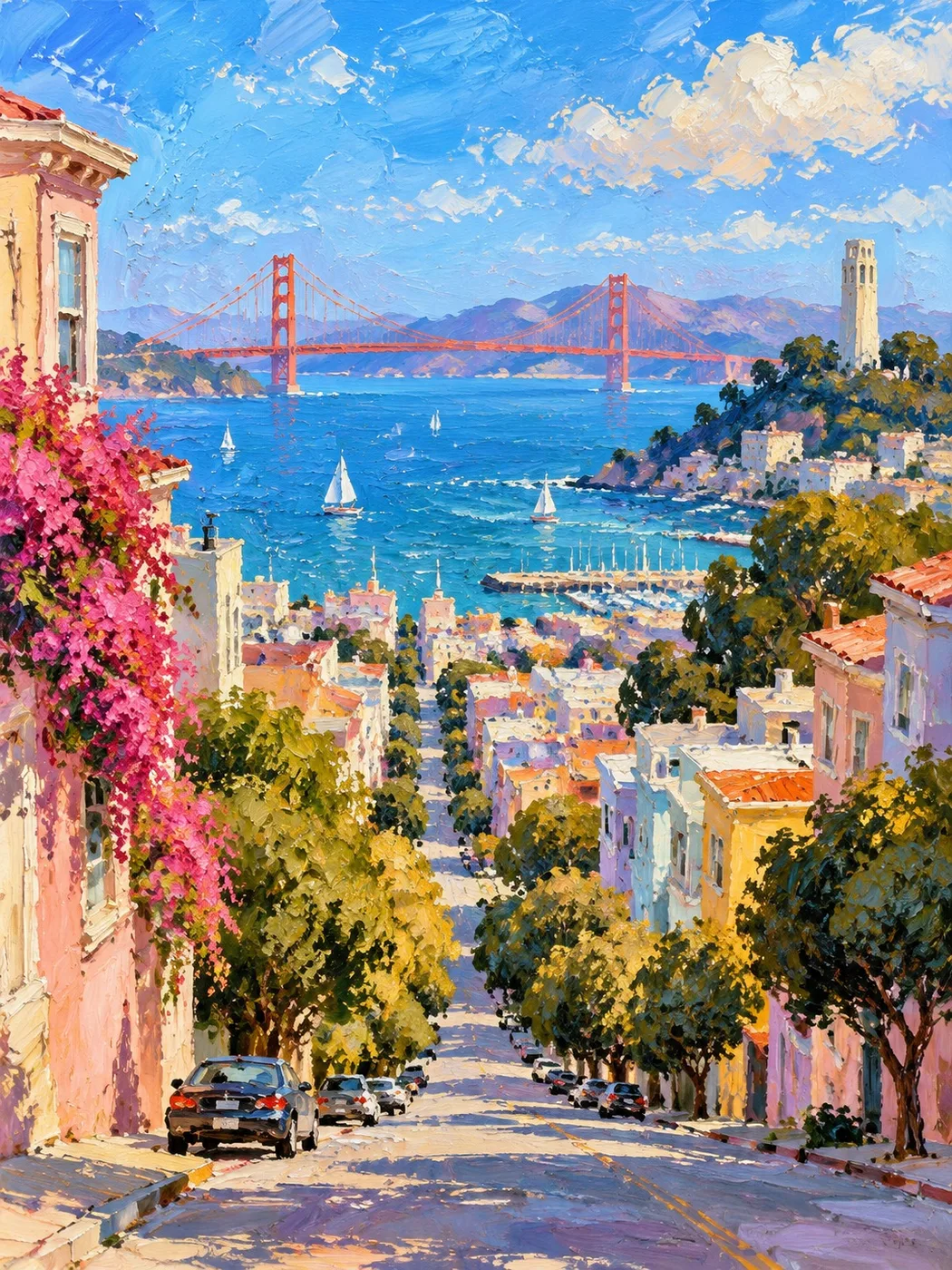
A vertical impressionist gouache and thick-oil painting of San Francisco on a bright clear day.
View downhill along a steep residential street toward San Francisco Bay. Pastel-colored houses and dense rounded trees frame both sides of the descending street.
In the distance, the Golden Gate Bridge stretches horizontally across brilliant blue water, painted in vivid vermilion red. Coit Tower appears on the right hillside.
Joyful saturated palette, loose confident brushwork, visible thick paint texture, palette-knife marks.
Mid-century California plein-air painting feeling. 3:4. No text. No photographic rendering.
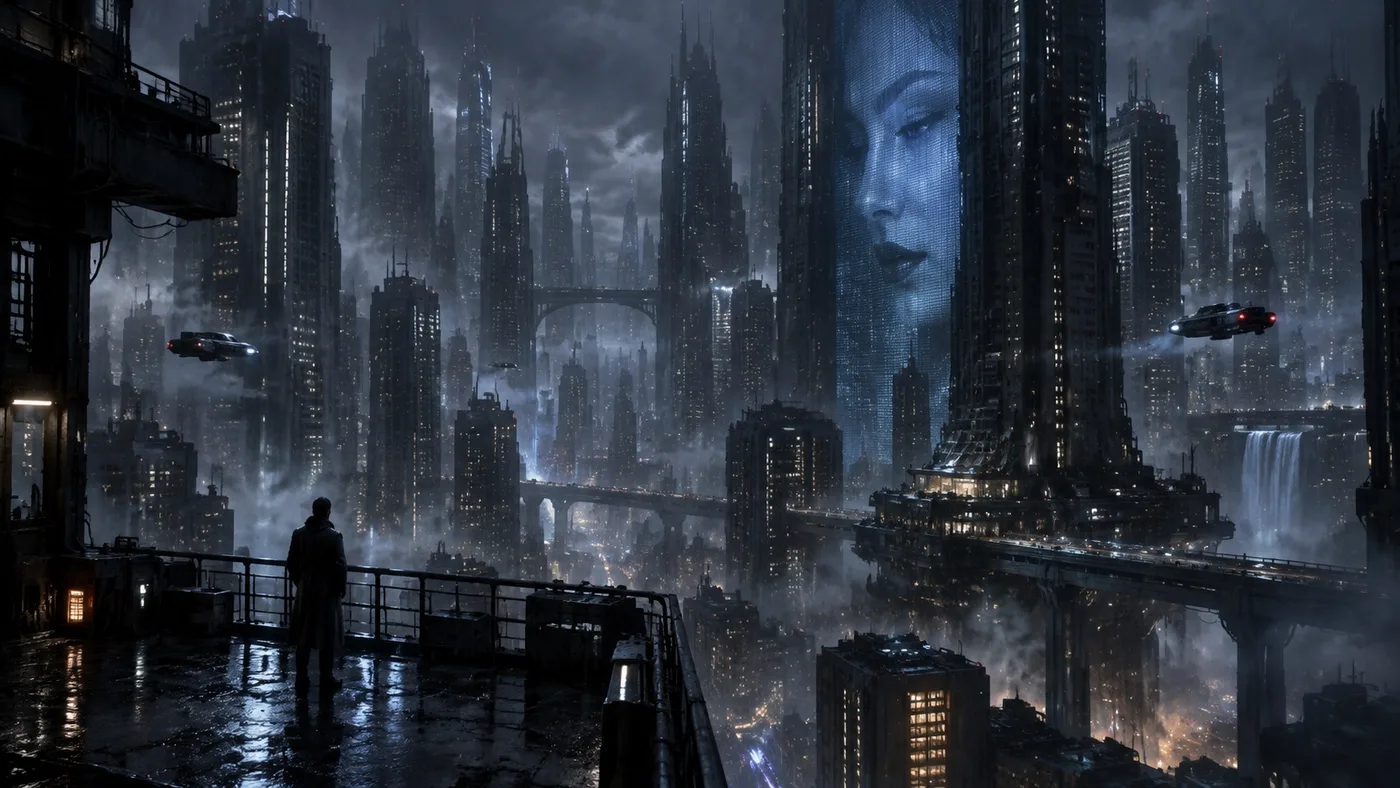
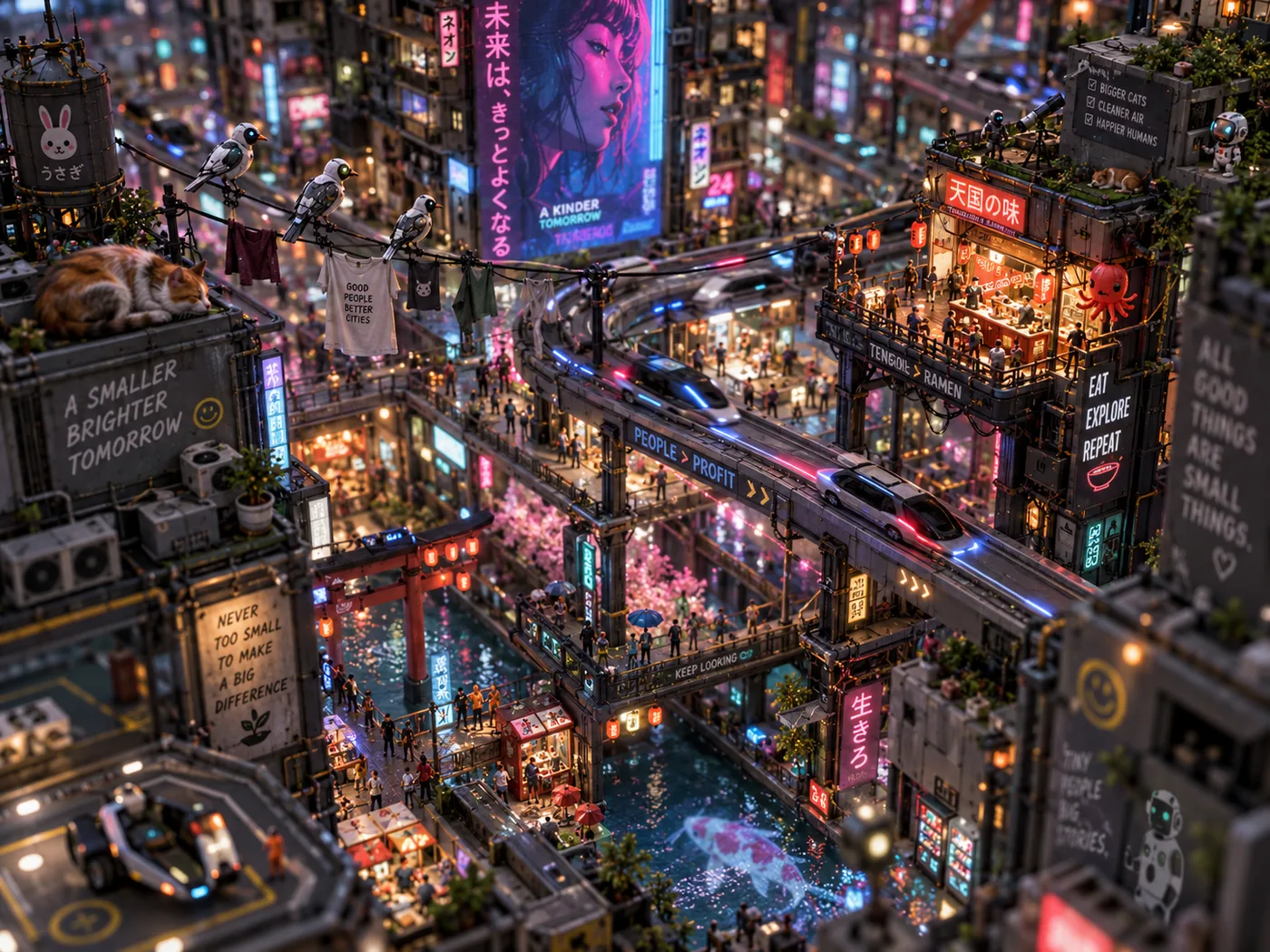
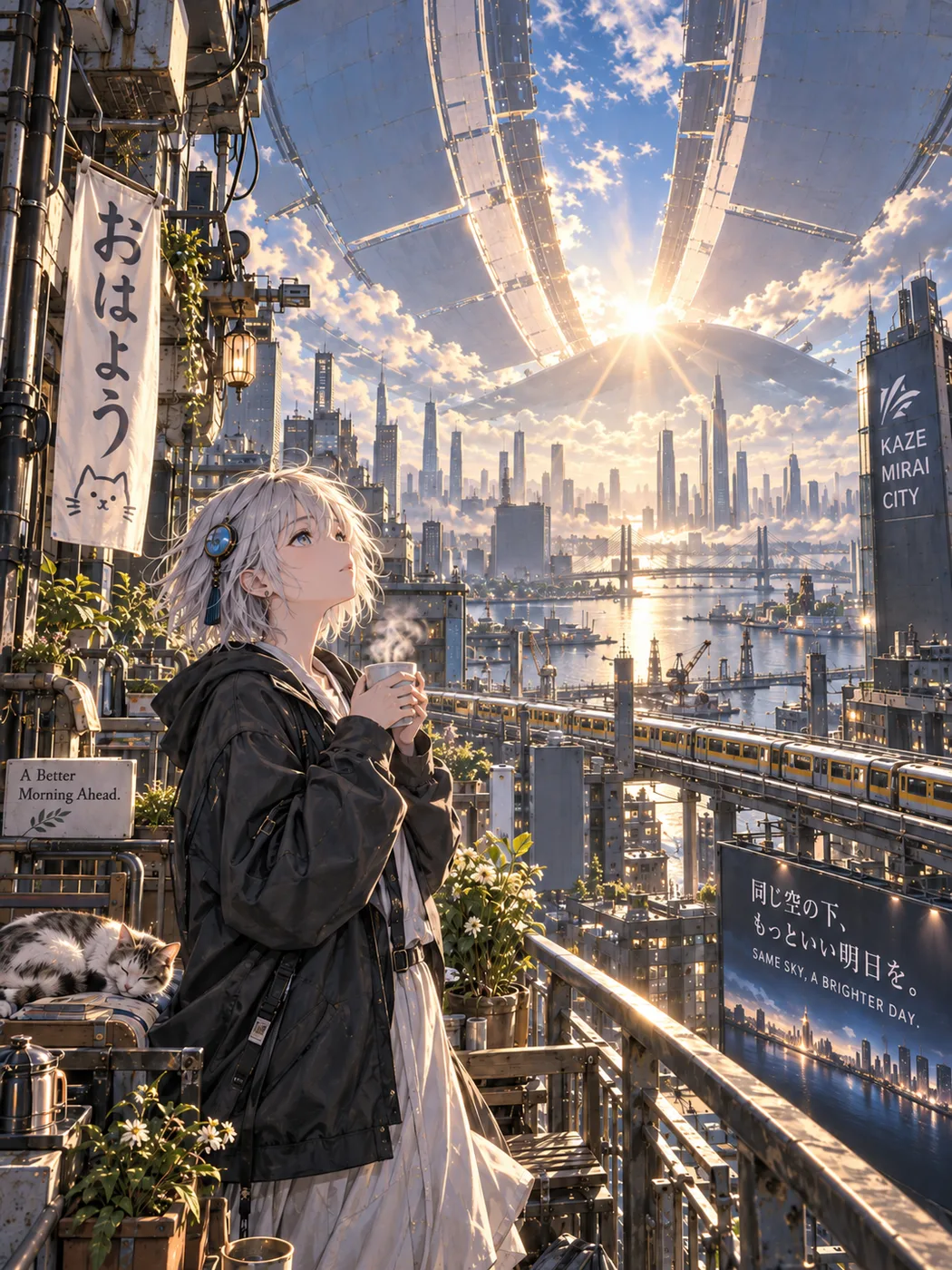
A vast dystopian cyberpunk megacity at night, viewed from a dark elevated rooftop terrace.
Extreme vertical scale, rain, fog, elevated highways, a lone silhouette at a wet railing, a monumental monochrome blue face on a skyscraper.
Restrained cyberpunk rather than colorful neon overload. 16:9. No text. No rainbow neon.
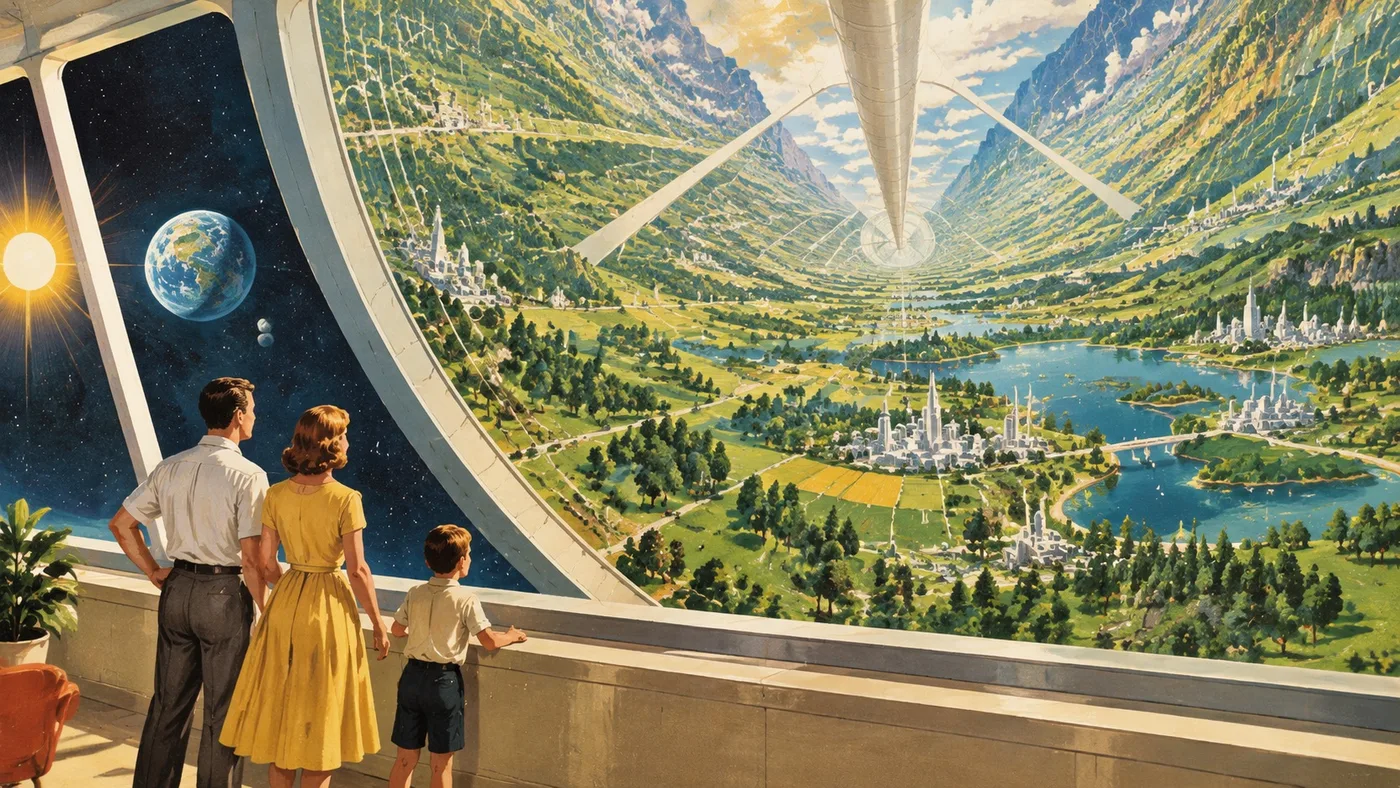
Optimistic mid-century retrofuturist illustration of a 1950s family looking into a rotating cylindrical space colony.
Landscape curves upward. Gouache and airbrush, Popular Science magazine painting. 16:9.
No modern clothing, no dystopia, no cyberpunk.
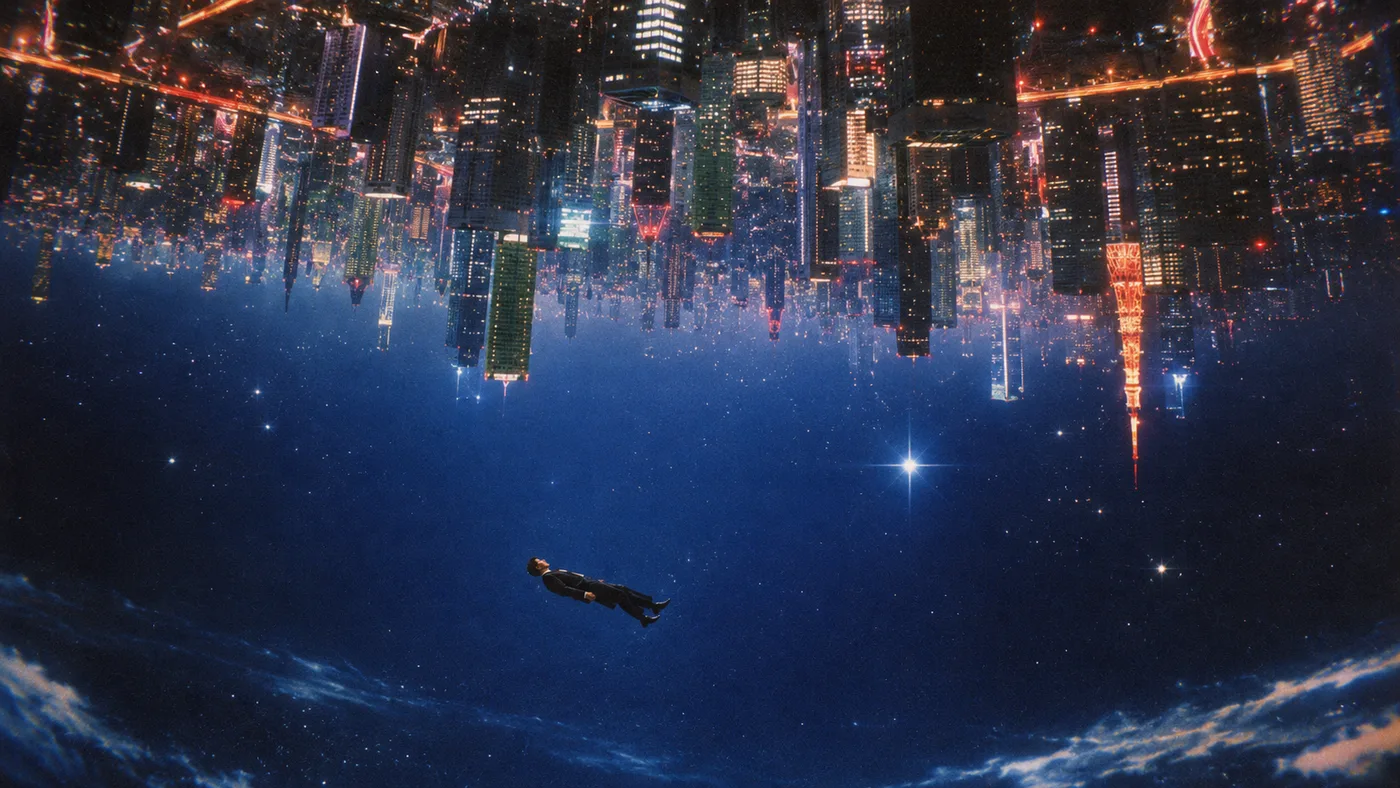
A surreal cinematic science-fiction scene in outer space.
A gigantic futuristic city hangs upside down across the entire upper half of the frame, as though gravity has been reversed. Thousands of illuminated skyscrapers descend downward from an inverted metropolis suspended in the sky.
The city is dense, dark and monumental, glowing with warm orange, red, white and occasional cyan lights.
Below the inverted city is an enormous open field of deep blue space filled with stars.
Near the lower-center-left, a single man in a dark business suit floats horizontally and weightlessly through space, tiny compared with the impossible city.
At the very bottom edge of the composition is the curved blue atmosphere of Earth, with thin white cloud formations.
Dreamlike impossible spatial logic, existential scale, quiet loneliness, retro science-fiction surrealism, analog 1980s film aesthetic, subtle VHS-era chromatic aberration, soft halation around lights, fine photographic grain.
Ultra-wide cinematic framing, 16:9, no text, no visible spacecraft, no conventional horizon.
The surreal geometry should feel physically convincing despite being impossible.
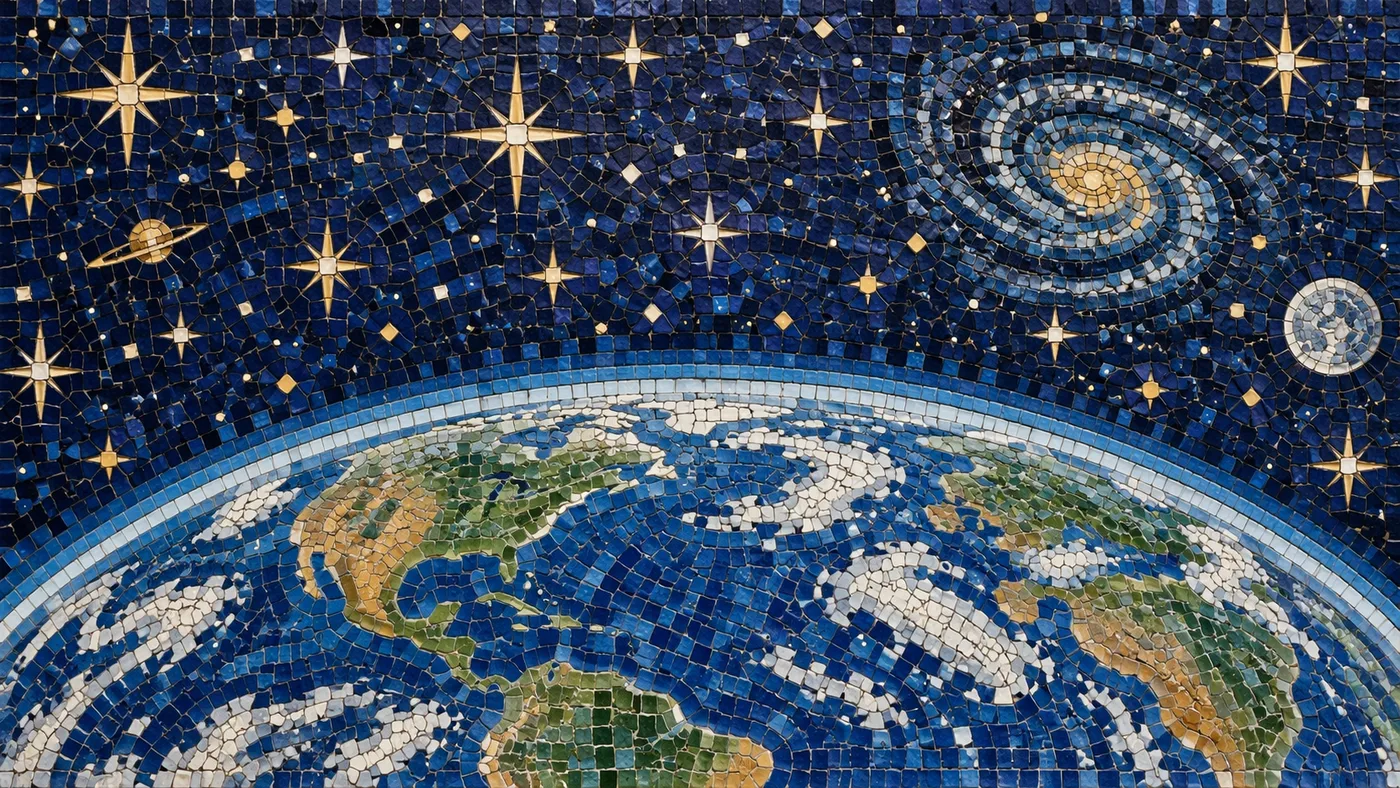
A monumental handmade ceramic mosaic depicting Earth viewed from space.
The curved horizon of Earth occupies approximately the lower 45 percent of the composition. North America, Central America, South America and parts of Europe and Africa are visible, constructed entirely from hundreds of irregular individual ceramic tesserae.
White mosaic clouds swirl over deep-blue oceans. Continents use muted green, ochre, tan and cream stone pieces.
Above Earth is an elaborate deep-cobalt celestial sky made entirely from dark blue ceramic tiles.
Fill the sky with decorative golden and ivory mosaic stars in multiple sizes, including elegant eight-pointed and four-pointed stars.
Include a small ringed Saturn on the upper left, a large spiral galaxy on the upper right constructed from concentric pale-blue, white and gold tesserae, a small moon nearby, tiny scattered stars and celestial ornaments.
Every element must physically be made from individual hand-cut mosaic tiles. Visible dark grout lines, slightly uneven tile surfaces, subtle ceramic gloss, tiny chips and handcrafted imperfections.
Straight-on photograph of the finished mosaic wall, even museum lighting, extremely tactile detail, 16:9. No painted surfaces and no digital gradients.
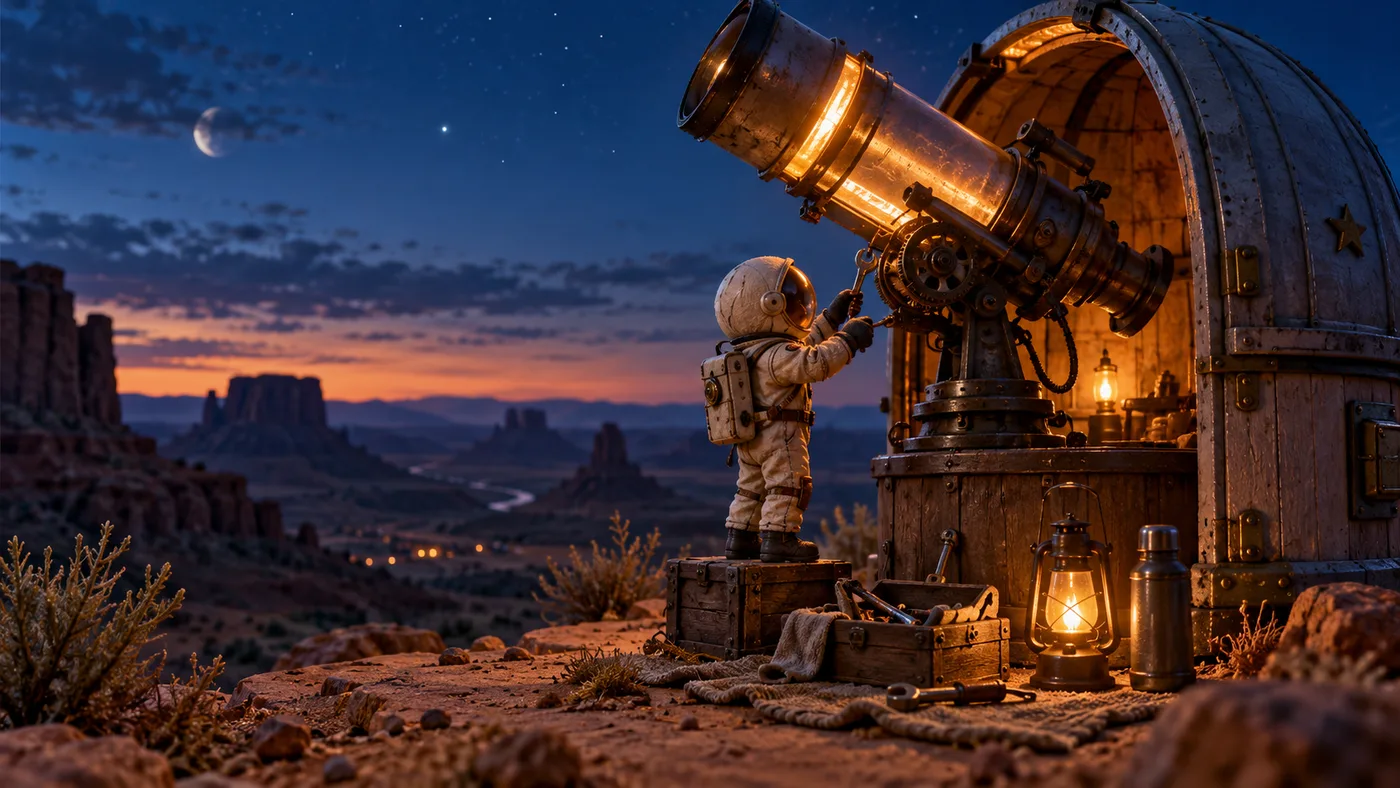
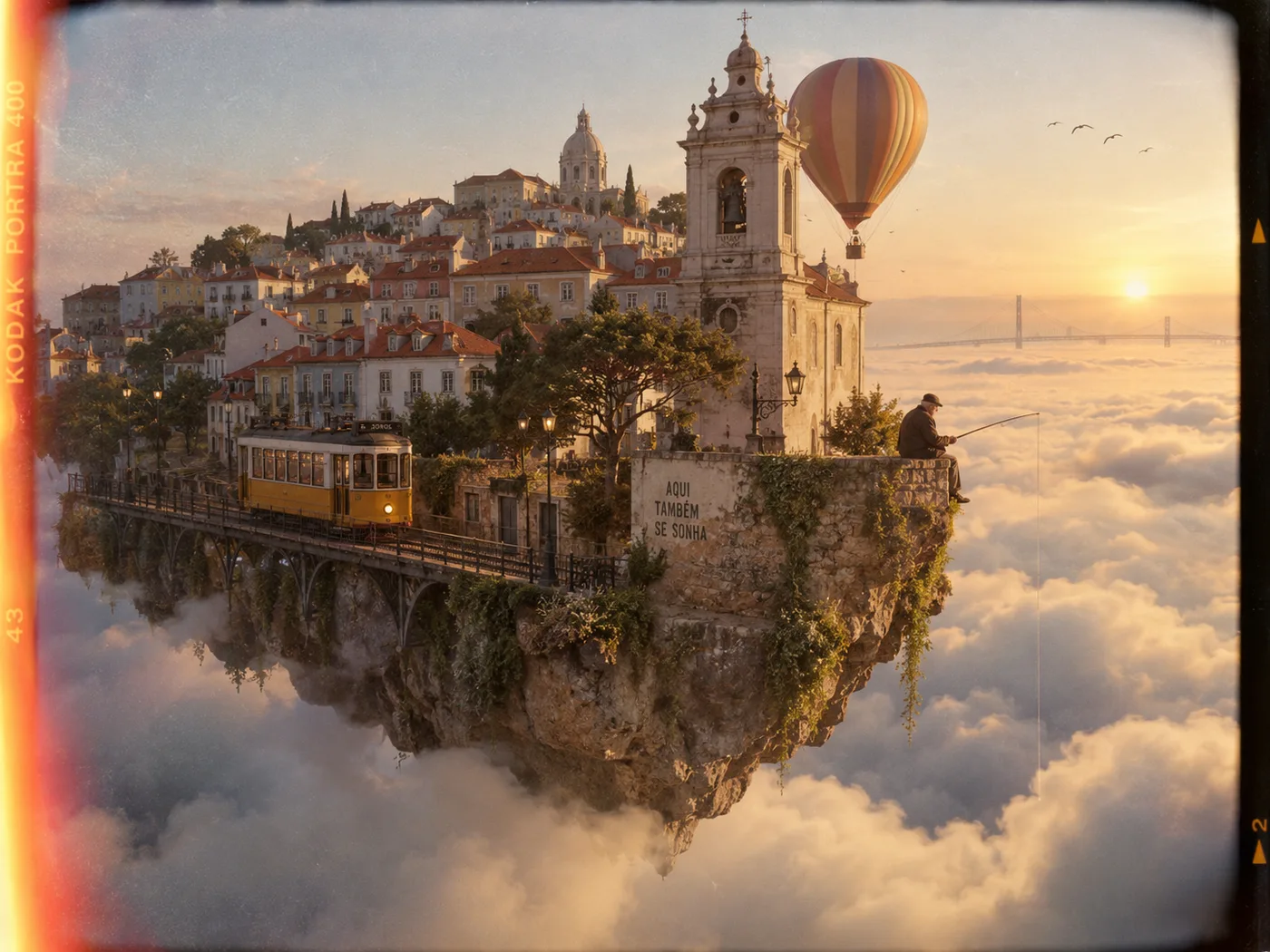
Create a polished cinematic 16:9 keyframe for an AI image showcase: a tiny handmade astronaut repairing a glowing observatory telescope on a desert mesa at blue hour, warm lantern light contrasting with a deep indigo sky, readable silhouette, stable costume details, clear foreground midground background separation, tactile miniature materials, realistic shadows, editorial color grading, no text, no watermark, no duplicate objects. This is one single finished image, not a collage.
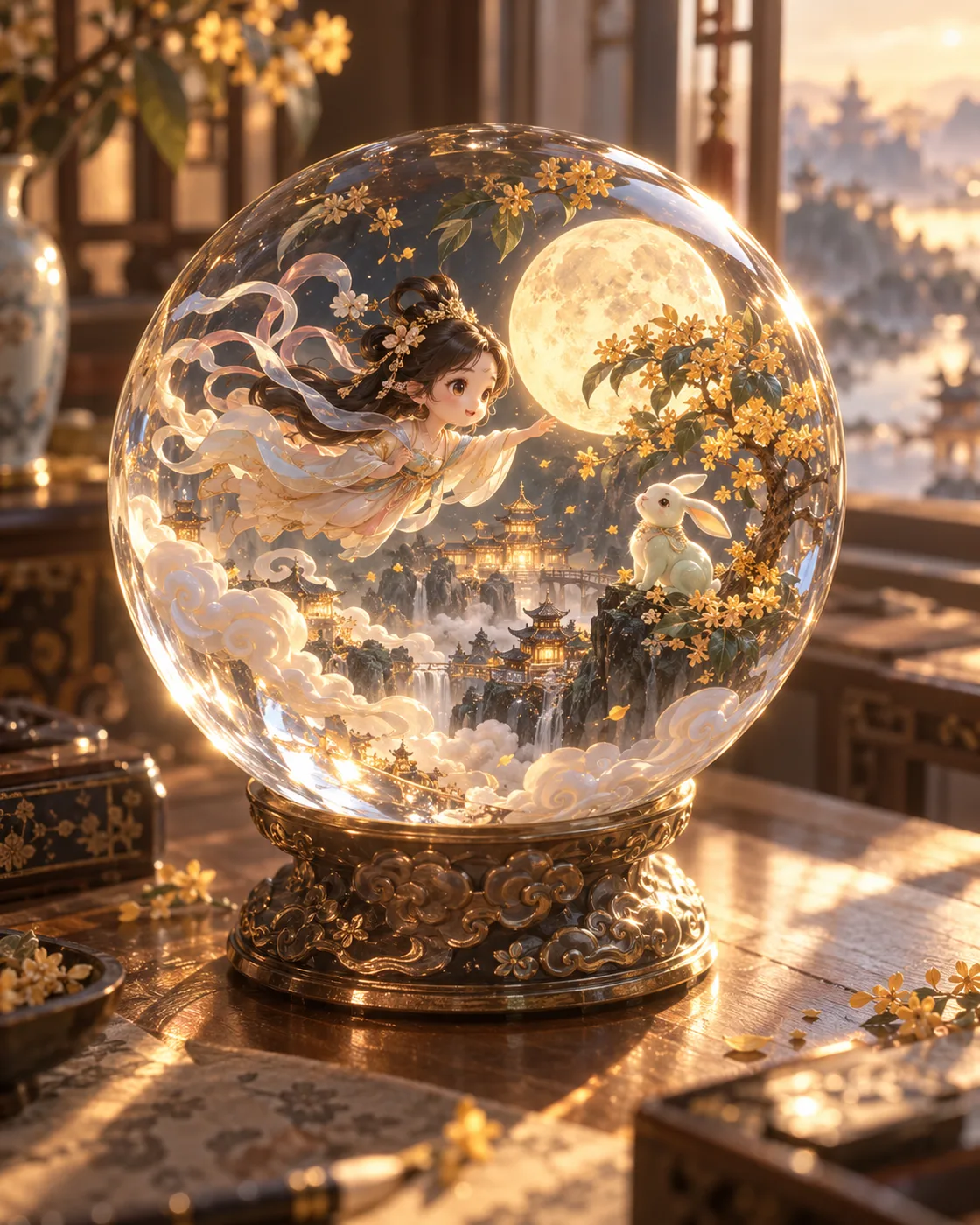
一枚精致的水晶球静静摆放在窗旁温暖的桌面上,背景虚化朦胧,暖色调阳光轻柔穿透球体,折射出点点金光,照亮微暗的空间。水晶球内部呈现一个以「嫦娥奔月」为主题的迷你立体世界:Q 版嫦娥衣袂飘飞奔向圆月,玉兔回头张望,云纹与桂花树环绕,细腻精美的 3D 景观,人物之间充满灵动的情感互动。整体氛围充满东亚奇幻色彩,魔幻现实主义质感,如诗如梦,华美典雅。
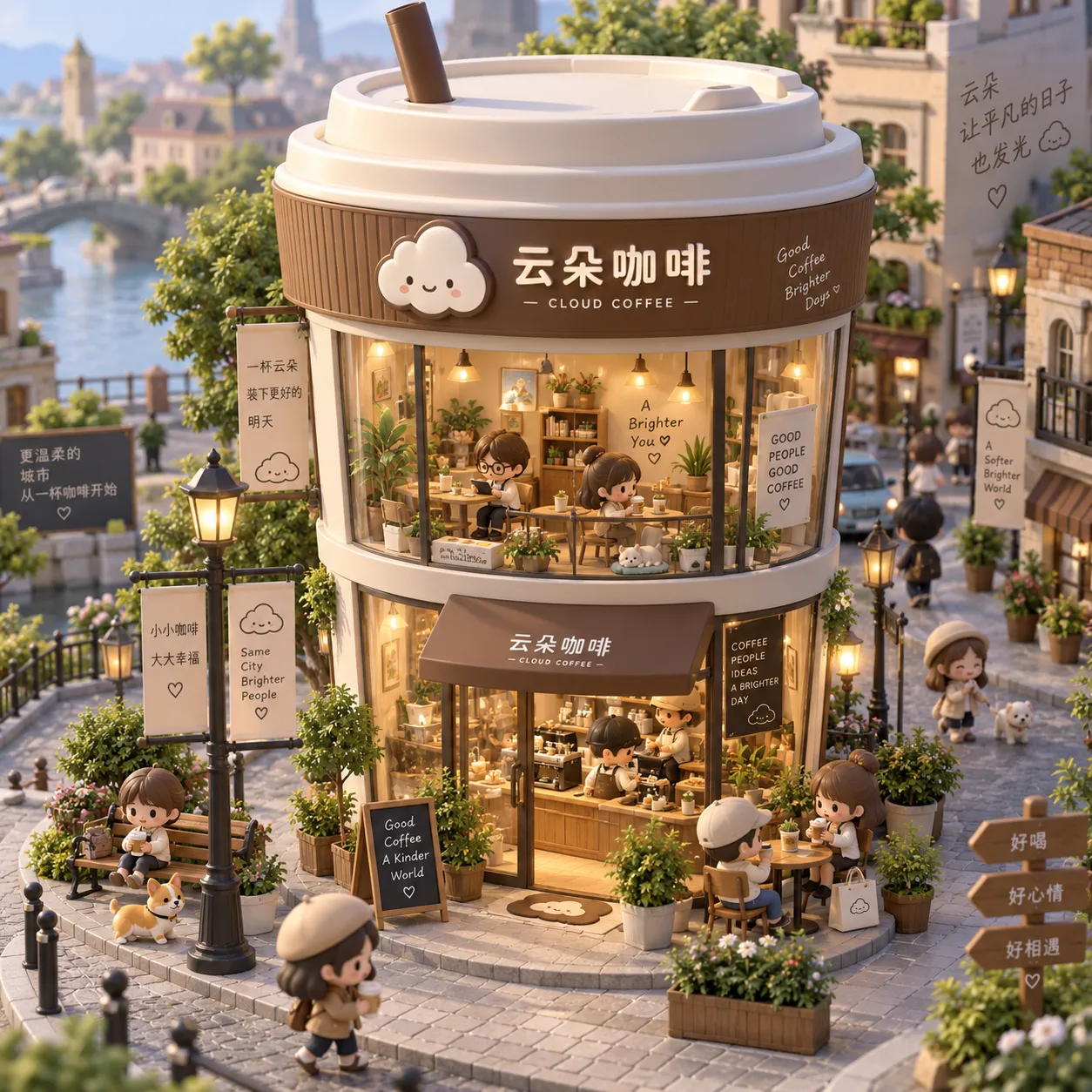
3D Q 版迷你风格:一座奇趣的迷你咖啡店「云朵咖啡」,外观是一个巨大的外带咖啡杯造型,带杯盖和吸管,杯身印着小小的云朵 logo。建筑共两层,大大的玻璃窗展示出内部温馨精致的装修:木质家具、温暖的灯光、忙碌的咖啡师。街道上有可爱的小人偶漫步或小坐,四周布置长凳、街灯和植物盆栽,营造迷人的城市一角。城市微缩景观风格,细节丰富逼真,午后柔和光线,等距视角。
一幅讽刺漫画风格的插画,采用复古美式漫画画风:背景是超市多层货架,货架上摆满一样的红色棒球帽,帽子正面印大字标语「MAKE ART GREAT AGAIN」,帽侧贴白色标签写着「MADE BY AI」。特写视角聚焦其中一顶帽子。画面下方有价格牌:原价「$50.00」被粗黑线划掉,改为「$77.00」。色调为怀旧的土黄与暗红,阴影带 90 年代复古印刷质感,构图夸张,具讽刺消费主义意味。
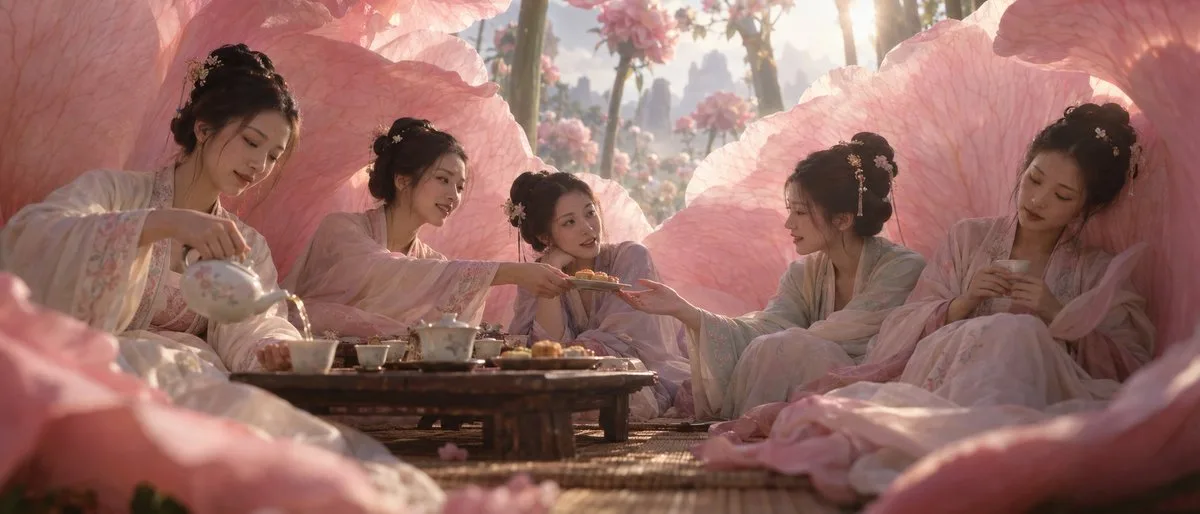
A cinematic wide anamorphic still photograph capturing an intimate floral interior — five miniature young adult Chinese women seated together inside the hollow of an enormous blooming pale-pink peony, its broad curved petals curling upward and outward to form an open floral hall that dominates the frame while all five seated figures remain clearly visible, the camera held at a low, near-eye-line position just above the tea table so the towering petal walls rise dramatically around the group, the composition intimate, unhurried, and quietly domestic.
The five women wear pale silk robes in the ancient Chinese style, soft ivory and blush tones with delicate embroidered hems, their hair swept into simple upswept styles set with delicate hairpins that catch small glints of light. They sit and lean around a low wooden tea table resting on a woven bamboo mat, white porcelain teaware and small pastries arranged between them. One woman pours tea in a steady unhurried pour, the pale liquid catching light as it falls. Beside her, a second woman offers a pastry across the table toward her neighbor, who reaches out with an open hand to accept it, her fingers just meeting the plate's edge. A fourth woman leans in slightly, lips parted mid-conversation, her gaze soft and warm toward the group. The fifth rests her shoulder against the curve of a petal wall, a teacup held loosely in both hands, her eyes lowered in quiet listening. All five wear relaxed, natural poses, their gazes drifting between each other in unforced, overlapping moments of attention.
The peony's interior surrounds them in soft translucent walls — fine branching veins visible through the petal flesh, the edges glowing faintly where afternoon light passes through, the curling petal lips forming a natural open ceiling above the group. Beyond one open gap in the petal wall, the towering stems and stalks of the wider garden rise into view, distant blossoms softening into pale mist and atmospheric haze at the edge of visibility, the miniature world reading as vast and self-contained.
A gentle breeze moves through the floral hall, lifting the edge of a silk scarf, stirring the fine hairs at a hairline, curling the thin ribbon of steam rising from the teapot's spout, and trembling faintly along the petal edges without disturbing the stillness of the seated group. Soft afternoon light filters down through the petal canopy, warm pink bounce light gathering across the near sides of the women's faces and the pale wood of the table, cool lavender shadow settling into the folds of fabric and the deeper recesses between petals where the light doesn't reach.
Captured with a wide-latitude cinema look and a vintage 2x anamorphic character at a wide aperture — gentle oval bokeh on the distant garden stems, soft frame-edge falloff, a light diffusion bloom lifting the brightest petal edges into a soft halation, color-negative daylight film rendition with fine 35mm grain, in an M1 cinematic narrative register. Real photographic frame captured on a real cinema camera, real anamorphic lens, real silk, real porcelain, real human faces and anatomy — no CGI, no rendered look, no digital cleanliness, no plastic surfaces, no AI smoothness, no skin smoothing, no doll-like faces, no waxy sheen.
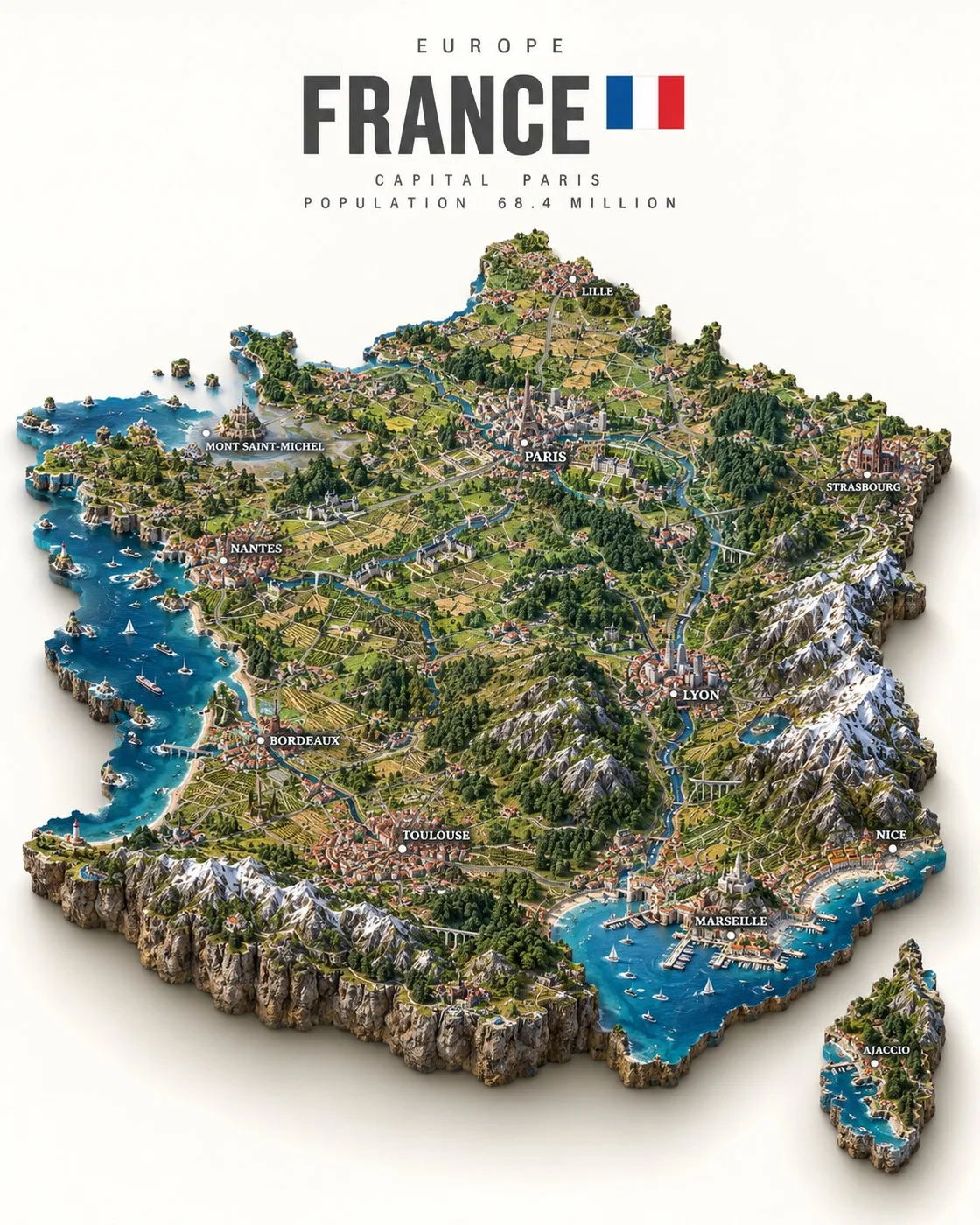
“Ultra-detailed photorealistic isometric miniature scale-model diorama of [COUNTRY], floating on a pure off-white studio background with a soft drop shadow beneath. The diorama takes the exact real-world silhouette shape of the country — not a square tile, but the true precise geographic outline of the country's borders and coastline, extruded downward into a thick slab of raw rock and earth with rough natural cliff-like edges, like a chunk of the real land physically cut out and lifted. The shape of the slab matches the country's actual geography precisely, including any islands, peninsulas or coastline indentations.
The entire top surface faithfully recreates the country's real geography and terrain: mountain ranges with correct elevation and snow coverage, rivers in their real positions, major forests and plains, deserts, coastlines with beaches and cliffs. Every major city is visible as a dense urban cluster in its correct geographic position. The country's most iconic landmarks are rendered in accurate positions and to recognizable scale. Terrain elevation is fully physically modeled — mountain ranges rise dramatically, valleys are sunken, plains are flat, creating real varied 3D topography across the entire surface.
Dense micro-detail: individual buildings in city clusters, tiny roads and highways connecting settlements, railways, bridges, harbors with boats, agricultural field patterns in rural areas, individual trees and forest coverage. Every region has its correct landscape character — the terrain of the north looks different from the south.
Style: hyper-realistic tilt-shift miniature photography — extremely sharp, everything in focus across the whole surface, no blur. Soft warm daylight from above, gentle diffuse shadows, rich natural colors. Lush greens, snow-capped peaks, golden plains, deep blue water along the coastline.
Layout: the shaped diorama floats centered in the lower two-thirds of the frame with clear margins on all sides, never touching the frame edges. Upper third is empty off-white space with minimalist editorial typography, centered: small wide-tracked caps with the continent or region name at the very top, then directly below [COUNTRY] in a bold condensed sans-serif in medium charcoal grey — large and dominant, the biggest text element — with a small flat rectangular flag of [COUNTRY] sitting immediately to the right of the country name, vertically centered with it, accurately colored and proportioned, clean flat design, sized to roughly the cap-height of the country name, floating naturally beside the name as one cohesive unit, not pushed to the far edge but sitting close and attached to the right end of the country name text. Then small wide-tracked caps below with the capital city and population.
Minimalist editorial poster aesthetic, premium print quality, 4:5 aspect ratio.”
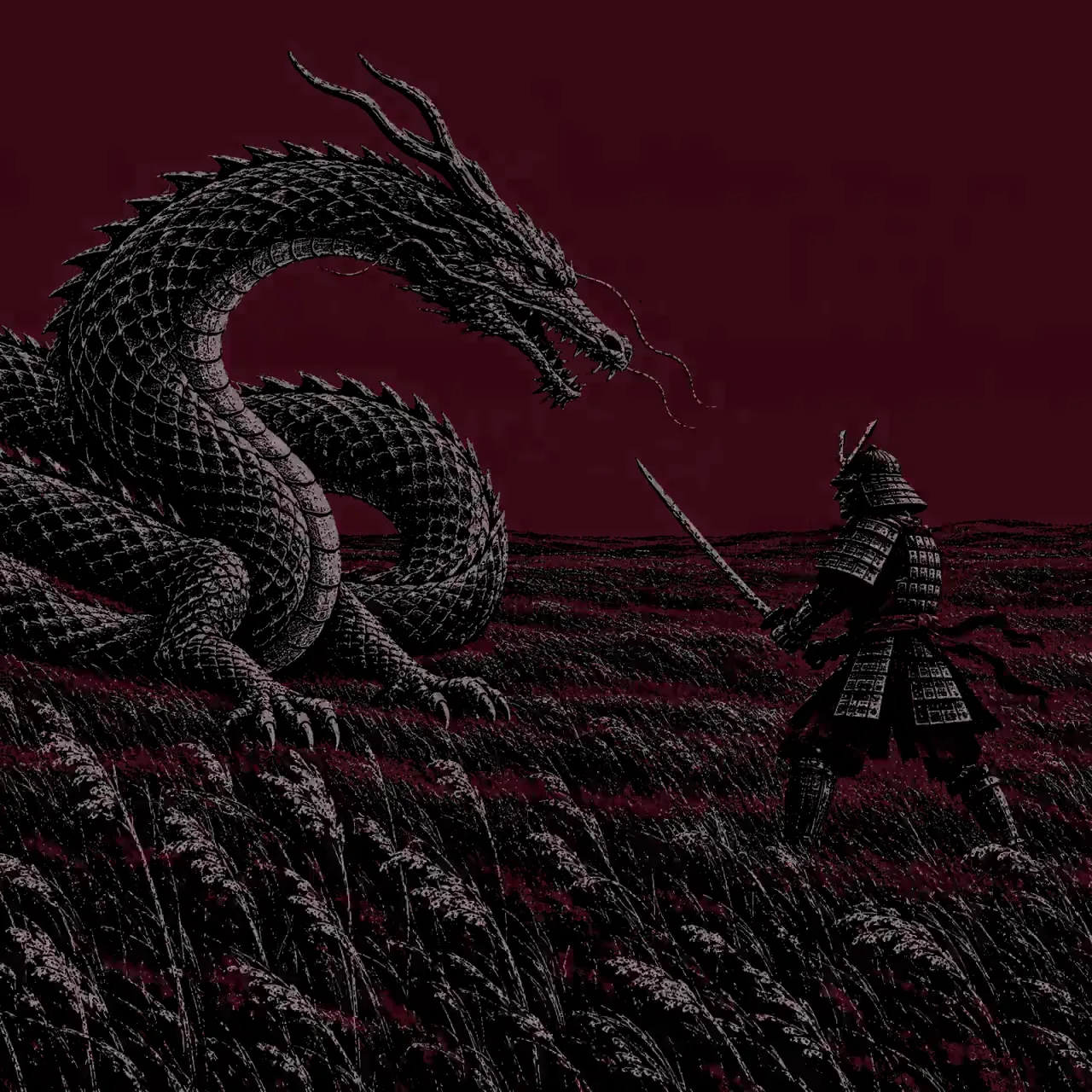
"SCENE AND COMPOSITION
A giant Japanese dragon confronting a lone samurai in a vast windswept grassland. Wide view, fixed low camera, both subjects clearly situated in the same landscape. The dragon dominates the left side; the full-body samurai stands on the right, facing left toward the dragon. Leave a clear gap between them. A low, gently rolling horizon divides the open sky from the dense grassy field.
DRAGON
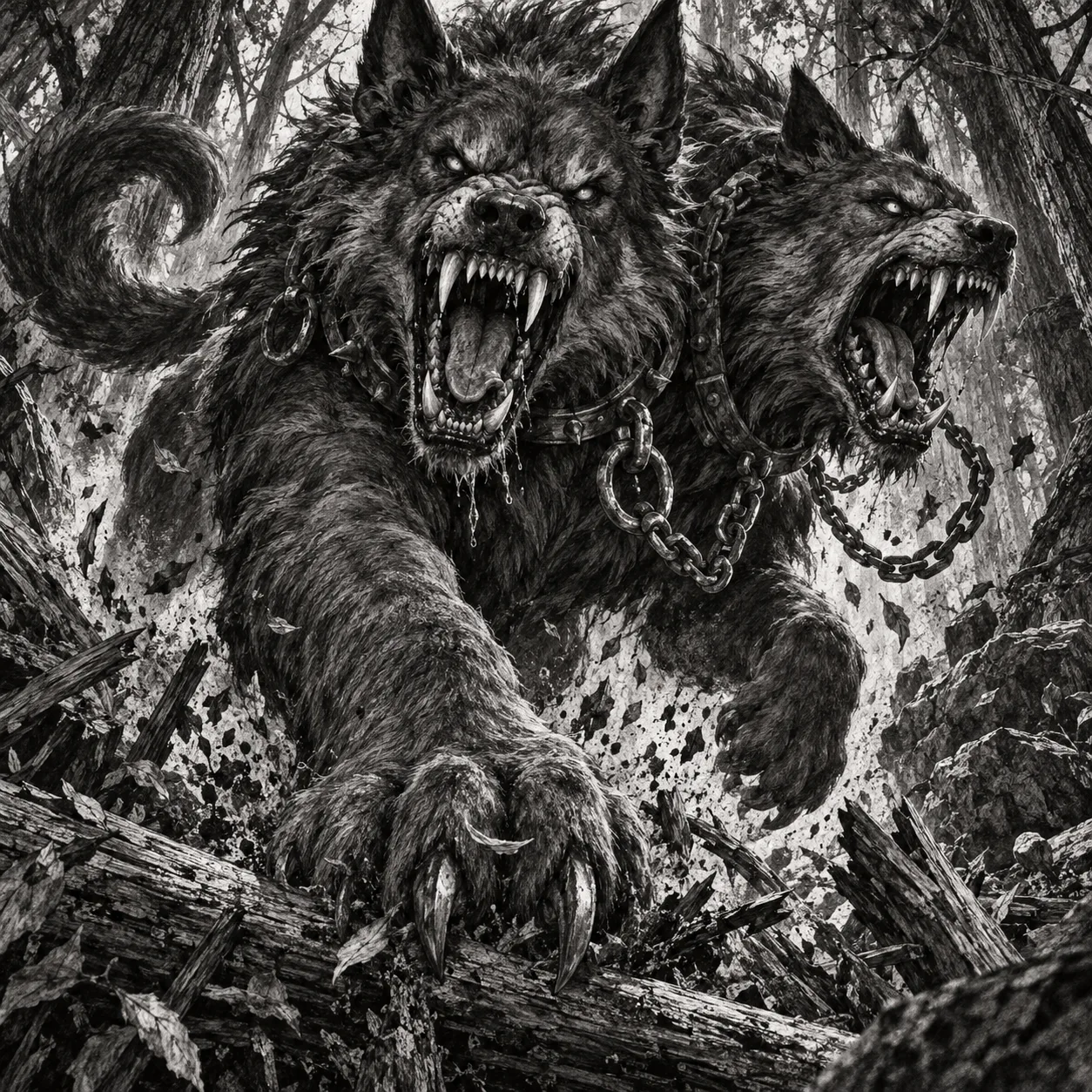
An unmistakably reptilian Japanese serpentine dragon with a long coiled body and an elegant S-curving neck. Large overlapping scale plates, broad segmented belly scutes, hard triangular dorsal spines, swept-back antler-like horns and a few long, smooth whiskers. An elongated reptilian skull with visible nostrils, an armored brow and a slightly open jaw showing sharp conical teeth. Powerful clawed forelimbs planted in the grass. Its head angles downward toward the samurai.
Completely hairless: no fur, mane, beard, feathers, wolf ears or mammalian muzzle. No wings. Define the body with individual scale plates, never hair-like strokes.
SAMURAI
A full-body warrior seen from a three-quarter back/profile angle. Traditional kabuto helmet with a crescent crest, menpo mask, layered shoulder guards, intricately laced lamellar armor, divided armored skirt and shin guards. Knees slightly bent, feet firmly planted, torso leaning into a defensive stance. Both hands hold one katana diagonally upward-left between him and the dragon. Long cloth ties stream sideways in the wind.
FIELD
Dense tall grass fills the foreground and stretches far into the distance. Large bent blades and seed heads near the camera, progressively finer grass toward the horizon. Broad curved bands of leaning grass suggest wind rippling across the entire field. Rich, irregular white scratches describe individual stems against deep black masses.
PALETTE AND RENDERING
A strictly limited palette of cool dark cherry red, approximately #901C35, absolute black and near-white. Flat cherry-red sky; the same red appears between grass blades and in the samurai’s cloth ties.
Realistic dimensional forms translated into an aggressively thresholded black-and-white xerox print. Crushed black shadows, fractured white highlights, dense stippled dithering, scratched engraving, irregular ink coverage and crunchy, slightly pixelated edges. A gritty photocopied dark-fantasy image, not polished digital painting. Preserve fine detail in scales, armor and grass.
No smooth gradients, glossy CGI, clean anime shading, soft lighting, orange-red sky, buildings, trees, mountains, sun, moon, extra characters, duplicate swords, text, logos, borders, panels or watermarks. One complete full-bleed image."